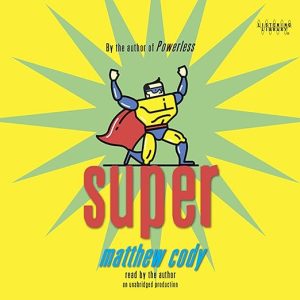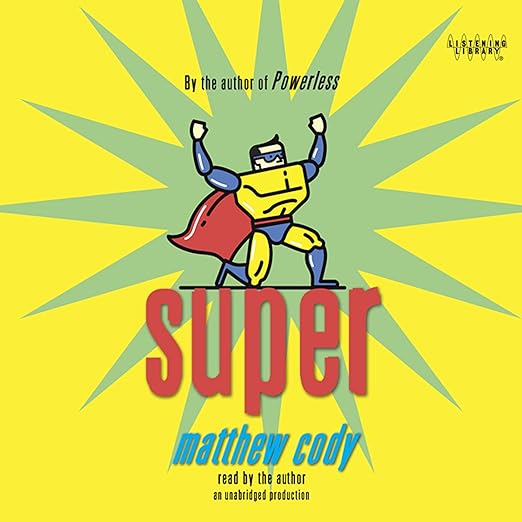
Daniel Corrigan spends the first book of this series being the only ordinary kid in a town full of superpowered friends, and this audiobook picks up exactly where that setup gets complicated: Daniel is starting to develop powers of his own, just as his friends begin losing theirs. Matthew Cody's Super, the second entry in the Supers of Noble's Green series and a direct sequel to his debut novel Powerless, spends seven hours and forty-seven minutes on Daniel's growing fear that his new power-stealing ability resembles the supervillain Shroud's a little too closely for comfort, especially since nobody is entirely sure the Shroud is really gone. Cody keeps the tone squarely middle-grade even as the stakes rise, favoring earnest emotional beats over grim violence.
Where This One Lands
Matthew Cody narrates his own middle-grade fiction, a less common choice for novelists than it is for nonfiction authors, and the choice pays off in a specific way: Cody knows exactly which lines are meant to land as a joke, a threat, or a quiet emotional beat, since he wrote all three. AVA's review captures the pacing effect directly, describing buying the book around noon and finishing it by five-thirty that same afternoon without putting it down, which is about as strong an endorsement of momentum as a middle-grade adventure can get from its actual target reader.
Dr. Patricia Eroh's review carries particular weight given her stated context: she uses the series with her middle school students and calls herself a comic book superhero lover in her own right, which makes her assessment that it is 'definitely as good as any of the classics' a genuinely informed comparison rather than casual praise. She also notes going in expecting Super to be 'more of the same' as Powerless and finding instead that it wasn't, a meaningful signal that Cody is expanding the series rather than repeating its formula at book two.
Self-narration by a middle-grade novelist is genuinely uncommon compared to nonfiction, where authors reading their own work is standard practice, which makes Cody's choice here worth noting on its own terms. A novelist reading dialogue he wrote for multiple distinct kid characters, Daniel, Eric, and the wider cast of Supers, takes on some of the same character-differentiation challenge a professional voice actor would face, without necessarily having that actor's specific vocal training.
Why Listen to Super
Bookymcbooky's review, from a young reader who read Powerless first, describes being kept 'at the edge of my seat' through this installment and moving straight on to the next book, Villainous, immediately after finishing, confirming this trilogy is built to be consumed as a complete run rather than a series a reader drifts away from between entries. That kind of momentum, one book pulling a reader directly into the next without a pause, is exactly what a middle-grade adventure series needs to hold onto its audience.
The central mystery, whether Daniel's emerging power-stealing ability connects him to the supposedly defeated Shroud, gives the book real stakes beyond typical superpowered-kids-at-school material, and it uses Daniel's friend Eric's more optimistic theory, that Daniel is simply a late-blooming Super, as a genuine point of tension rather than an obvious misdirection. That structure rewards attentive listening rather than passive background listening, which is worth knowing for a middle-grade audiobook parents might otherwise treat as pure entertainment. Cody plays it straight enough that younger listeners get a real mystery to chew on, not just a foregone conclusion.
The series' central metaphor, powers as something that can be gained, lost, or stolen depending on circumstance beyond a kid's control, gives Super real thematic depth underneath the action: it is fundamentally a story about identity shifting out from under you at exactly the age when kids are already sorting out who they are. That makes the superhero premise a vehicle for something more universal than costumes and villains alone.
AVA's same-day binge and Bookymcbooky's immediate jump to book three both point to the same practical takeaway for parents: this is a series built for a determined reader to consume back to back, so it may be worth having Villainous on hand before a child finishes Super rather than facing an impatient wait between books.
What Gives Us Pause
If Powerless is still unread, Super will spoil its central twist and reveal how that first book's Shroud conflict resolved, since this entire sequel is built around the unsettled aftermath of that ending. Newer listeners should start at book one regardless of how self-contained Super's own synopsis makes it sound, since Daniel's friendships, his town of Noble's Green, and the rules of who has powers and why are all assumed knowledge here.
This is squarely middle-grade material, built around school friendships and comic-book-style superpowers rather than darker young-adult stakes, so listeners expecting the moodier end of the superhero genre should adjust expectations toward something more in the spirit of a classic comic than a grim origin story. Seven hours and forty-seven minutes is also a real commitment for the age range this is aimed at, closer to a chapter-a-night family listen than a single-sitting binge for most of its intended audience.
Parents should also know this leans into genuine peril and moral ambiguity for its age category, Daniel's fear that he might literally be turning into the story's villain is a real, sustained plot thread rather than a passing scare, so sensitive younger listeners at the bottom of the middle-grade range may find that specific worry more unsettling than a straightforward hero-versus-villain story would be. None of the three attached reviews mention this as a concern, but the synopsis itself keeps that uncertainty about Daniel's identity open through most of the plot, worth flagging for a cautious parent previewing the book first.
Who Should Pick Up Super
Middle-grade readers already invested in Daniel's story from Powerless, and particularly comic book fans in that age range the way Dr. Patricia Eroh describes her own students, are the clearest audience for Super. Families looking for a superhero story with real emotional stakes around friendship and identity, rather than pure spectacle, will find plenty to talk about between chapters. Reluctant readers who responded to the fast pacing of Powerless are especially likely to stay hooked through this second installment.
Solo narration by the author, however well-paced, means one voice covers every character, adult and child, hero and villain alike, so listeners who prefer a full-cast production or a professional voice actor's more theatrical character work may find Cody's reading more straightforward than dramatic. That is a reasonable trade worth knowing about before committing seven hours and forty-seven minutes to a single narrator carrying the whole story.