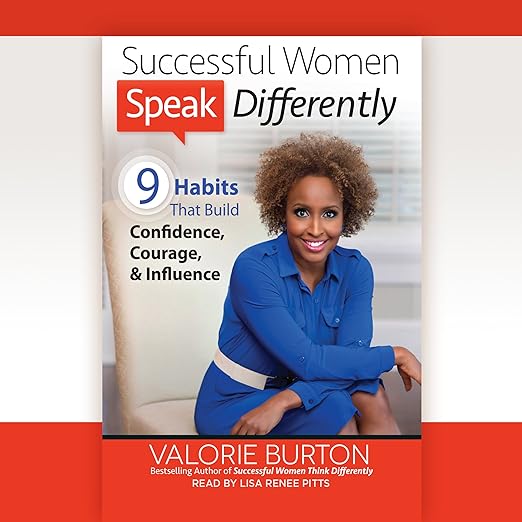
I put on Successful Women Speak Differently during a week when I was reviewing a stack of professional development titles, looking for the ones that had earned their readership rather than simply found it. Valorie Burton's book stood out from that stack, not because its premise is unprecedented but because the execution is more precise than most in the genre. By chapter three I had stopped treating it as comparative material and started actually engaging with what it was saying, which is not how that week was supposed to go.
Burton is a bestselling author and life strategist who has spent years in the specific terrain of how language shapes outcomes for women in professional and personal contexts. The book's central argument draws on behavioral science research to substantiate what its subtitle promises: that specific speech habits, in critical moments, are measurable predictors of influence, confidence, and success. Burton's distinctive contribution is connecting that scientific framework to practical application rather than simply explaining the research findings and leaving the reader to figure out the rest.
How Successful Women Speak Differently Holds Up
What separates Successful Women Speak Differently from similar titles is the rigor with which Burton grounds her practical advice. She draws on studies showing how hedging language undermines perceived competence, how self-deprecating statements compound over time into actual self-concept rather than mere social performance, and how the nuances between specific phrasings in negotiation and advocacy contexts produce measurably different outcomes. This is not vague affirmation territory where the mechanism is left to faith. The mechanisms are specific, and the practical guidance follows directly from them.
A reviewer who went through the book during a period of professional difficulty, having been laid off from a job she valued, described it helping her revamp her thoughts and approach during a transition that had moved her confidence to an all-time low. That kind of reader testimony, specific to professional circumstances and to the period of reading rather than to a general sense of being inspired, reflects the book's practical anchoring in real situations. Burton does not traffic in inspiration that evaporates when circumstances get hard. The tools are designed for exactly those circumstances.
Why Successful Women Speak Differently Works as an Audiobook
Burton integrates Christian faith as a supporting framework throughout the book, and the reader feedback on this dimension is worth examining carefully because it is more nuanced than you might expect. Multiple reviewers with and without active religious lives describe it as striking a workable balance. One reviewer specifically noted that the faith content is present but not excessive, and that someone whose life does not center religion would not find it disqualifying. Another found perfect alignment with her own perspective.
Burton frames the ancient wisdom of Scripture and scientific research as parallel evidence for the same claims rather than competing frameworks. Whether this feels elegant or awkward depends on the reader's own relationship to that kind of synthesis, but the frequency with which even secular-leaning reviewers describe the faith dimension as non-intrusive is meaningful data about how Burton has calibrated it. This is not a book that requires theological agreement to benefit from its practical content, which is a harder calibration than it sounds.
Weak Spots in Successful Women Speak Differently
Lisa Renee Pitts is a skilled audiobook narrator who has worked across a wide range of material. Here, she brings a collegial warmth to Burton's mentor-to-reader tone, as if you are being addressed by someone who has already worked through several of the challenges you are currently navigating and is not making you feel slow for the gap. The seven-hour-thirty-seven-minute runtime is comfortable rather than long, and the chapter structure makes it natural to pause and reflect between sections rather than consuming the entire book in a single listening session. This is how practical material of this kind is best absorbed.
Multiple reviewers mention returning to specific sections on relisten, which is a meaningful indicator for practical material. A book you return to for specific guidance is functioning as a reference rather than merely a listening experience, and that sustained utility beyond the initial engagement signals real value in the content rather than the satisfaction of having finished something.
A practical note for listeners deciding between the audiobook and print versions: this title rewards listening specifically because the speech habit material is absorbed differently when you hear it rather than read it. Several reviewers note that they began to catch their own hedging language and filler phrases during the days after listening, which suggests the audio format activates a kind of real-time monitoring that the print version may not. Burton is essentially teaching you to listen differently, to yourself and to others, and hearing that instruction delivered rather than reading it creates a more direct connection between the message and the perceptual skill she is trying to build. That is a rare case where the audiobook format is not merely equivalent to print but actively superior for the specific purpose the book serves.
The Right Listener for Successful Women Speak Differently
Successful Women Speak Differently is best suited to women who sense that how they speak in professional and personal contexts is costing them something, but who have not been able to diagnose exactly what or why. Burton provides that diagnosis with specificity and offers concrete adjustments to speech habits that have measurable effects on outcomes. Women in career transitions, negotiations, or any context where self-presentation matters will find the most immediate applications. Listeners who resist self-help framing or faith-adjacent content should be aware that both are present, though the faith dimension is lighter than the Christian-publishing shelf placement might suggest.
Does the Christian faith content make this book inaccessible to non-religious readers?
Multiple reviewers without strong religious affiliation describe the faith dimension as a presence but not a barrier. Burton frames Scripture and research as parallel evidence rather than requiring theological agreement to benefit from the practical content. The balance is described as workable across a wide range of the review record, including from readers who noted it explicitly as a potential concern before starting.
Lisa Renee Pitts narrates this title. Does her performance suit the mentoring tone Burton writes in?
Yes. Pitts brings a collegial warmth that matches the tone of a guide addressing you as a capable person who needs specific tools rather than someone being lectured from above. Several reviewers who relisten to specific sections describe the audio format as natural for this material and more immediate than the print version.