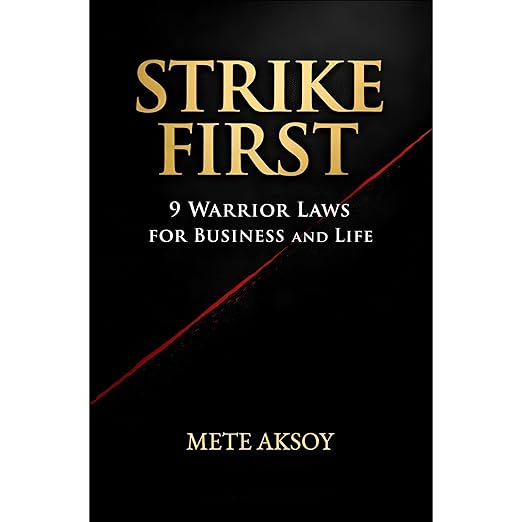
Quick Take
- Narrator: A synthetic Virtual Voice reading, which handles nine enumerated laws cleanly but strips the menace the book's whole pitch depends on.
- Subjects: Military doctrine applied to business, initiative and pre-emption, competitive strategy, leadership under pressure.
- Tone: Aggressive and declarative, sustained without let-up for sixteen hours.
- Bottom line: A genuinely structured strategy framework buried inside hard-sell packaging, best for listeners who want procedure rather than atmosphere.
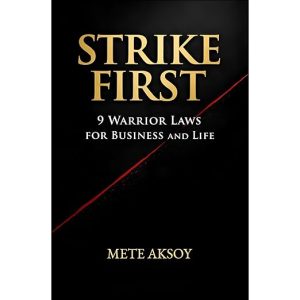
Business books that borrow military vocabulary usually borrow only the vocabulary, and the first thing worth saying about this audiobook is that it borrows the structure too. Mete Aksoy builds the whole sixteen-hour run on nine numbered laws, and the description is explicit that the laws are not the author's invention, presenting them instead as doctrine already in circulation. Two of the named ones give you the flavor immediately: the Law of the Objective, which insists you define victory clearly enough that sentimentality becomes fatal, and the Law of Surprise, which wants you doing the thing nobody prepared for, at a moment nobody chose, somewhere nobody was watching. Whether that is bracing or slightly ridiculous depends entirely on how you feel about being addressed as a strategic warrior for a full working day.
The Doctrine Survives, the Menace Doesn't
The architecture is the strongest thing here, and one reviewer confirms it precisely. Halis Elgin names all nine principles in order, then notes that Aksoy sharpens each with a maxim, quoting "Conceal Intentions" and "Deploy Strategic Coldness" among them. Those nine read like real doctrine rather than a set of invented buckets, which is consistent with the book's claim to be drawing on established military thinking. The maxims matter more than they look, because a memorable tag is what survives a sixteen-hour listen when the surrounding argument has faded. My hesitation is with the case studies. The copy reaches for Genghis Khan, Alexander the Great, Elon Musk and Jeff Bezos in a single breath, and a framework that explains all four equally well is usually explaining none of them in much detail.
The narration credit goes to Virtual Voice, a synthetic reader, and the consequences here are specific rather than general. Nine enumerated laws with named sub-maxims are close to the best case for machine reading: the structure is announced, the boundaries are clean, and a listener can track where they are without vocal signposting. The problem is that the book's actual selling proposition is register. This is copy that wants to sound dangerous, that ends sentences on words like lethal and vanish, and menace is precisely the thing a synthetic voice cannot supply. You get the doctrine intact and the theater flattened, which for a framework book may be an acceptable trade and for a motivational one is close to fatal. I would test that specifically before buying, because the difference between the two readings of this book is entirely a question of what you wanted from it in the first place.
Readers of Robert Greene Will Recognize the Mindset
The single most informative notice here is the one that positions the book against a known comparison. Huseyin Tezel expected the usual war-talk-for-hustle material and reports instead that "It feels more like a clean, organized doctrine you can actually use", adding that readers of Robert Greene will recognize the mindset but that this is "more practical and more focused on decision making". That is a genuinely informative placement. Greene supplies historical anecdote and atmosphere; the claim here is that Aksoy supplies procedure. A second reviewer, writing under Omer C., describes the core argument in far plainer language, summarizing it as success coming from "taking initiative, thinking ahead, and acting with confidence instead of just reacting to what happens".
That gap between the two summaries is itself the best guide to what you are buying. One reviewer hears rigorous doctrine with named laws and maxims; another hears a proactive-mindset book with nine lessons about preparation, focus and resilience. Each is describing the same sixteen hours. Another five-star reviewer splits the difference, calling the book "Powerful and practical" and recommending it to "anyone who wants to take action and think more strategically". The book, in other words, is firm about its skeleton and loose about its register, and which one you notice will depend on whether you are listening for a system or for encouragement.
This Copy Was Never Written for Listeners
The listing's product copy is worth flagging before you commit. It opens with promotional pricing language written for an ebook release, complete with a limited-time launch figure and a subscription-lending note, none of which has anything to do with the audio edition you would be buying. Later the same copy promises the "Source Code" of victory to whoever is holding the book, which is print framing left in place. Nothing about this makes the book worse, but it does mean the description was not written for listeners, and the practical consequence is that it tells you very little about how sixteen hours of doctrine is paced or how the historical material is distributed across it.
The feedback pool is also brand new and very small. All five written reviews arrived within a two-week window in March 2026, days after release, and they run five stars across the board against a total of fourteen ratings. That is not a scandal, but it is not a track record either, and uniform enthusiasm from a first wave tells you less than a mixed pool would. One reviewer's phrasing is a fair warning about tone: the pitch is aimed at people tired of playing it safe, which is a self-selecting audience. If you find aggression-as-philosophy tiresome, this book asks you to sit with it for a very long time.
Test the Sample Before Trusting the Star Rating
This suits managers and founders who want a framework they can actually name and apply, especially readers who finished the strategy classics for the storytelling and came away without a usable procedure. The nine-law spine gives it real navigational value in audio, since you always know which principle you are currently inside and roughly how much of the argument is left, and the maxims function as retrievable handles afterward. Listeners who enjoy the doctrinal end of business writing, where the argument is that competition has physics and the physics can be learned, will get the most from the sixteen-hour commitment.
Skip it if the underlying premise sits badly with you, because the copy is unambiguous that this is not a book for the naive or the apologetic and the tone never softens. Anyone hoping for careful history should also be cautious: the famous names are used as illustrations of the laws, not as subjects examined on their own terms. And since the reading is machine-generated and no reviewer here comments on how it lands, a listener who needs vocal conviction to stay engaged across a long runtime should treat the sample as the real test rather than the rating.
Frequently Asked Questions
Why does the description mention ebook pricing on an audiobook page?
The product copy appears to have been written for a digital text release and reused without editing. It leads with a limited-time price and a lending offer, neither of which applies to the recording. Nothing about the book changes because of it, but the description was plainly not composed with listeners in mind.
Does machine narration matter across a sixteen-hour audiobook?
It matters differently depending on why you are listening. Enumerated frameworks survive synthetic reading well, since the structure announces itself and you always know your position. Persuasive intensity does not survive, and this book sells itself on force of tone, so anyone listening for motivation rather than method should sample first.