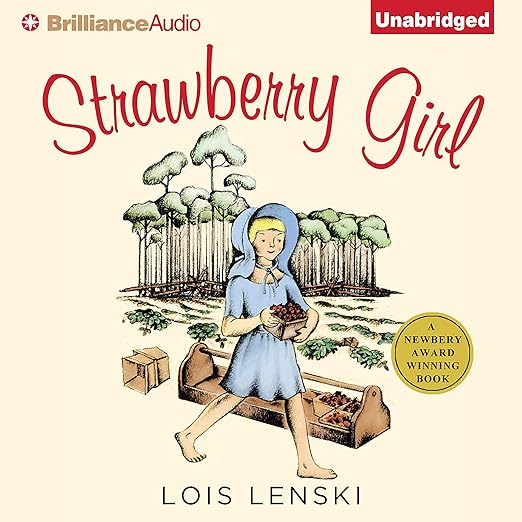
Quick Take
- Narration: Natalie Ross brings Birdie Boyer’s Florida backwoods world to life with an ear for regional dialect that honors the source material without caricature, a careful, respectful performance of a 1945 Newbery winner.
- Themes: Hardship and community in early twentieth-century rural America, neighbor relations and the slow architecture of trust, a girl’s determination in a world that expects her to wait
- Mood: Warm and unhurried, with the texture of sun-baked Florida earth in every scene
- Verdict: Lois Lenski’s Newbery Medal novel translates into audio with unexpected warmth, Ross makes the Boyer family’s struggle feel present and immediate rather than historical.
I grew up reading books like this one in the way children read books they find on a shelf without knowing why, picking them up because the title seems right, staying because the world inside is more real than expected. I had not revisited Strawberry Girl since I was about nine, and listening to Natalie Ross narrate Lois Lenski’s 1946 Newbery Medal winner as an adult was a genuinely moving experience. Not because the book is sophisticated in the way adult fiction is sophisticated, but because it is honest in the way very few books for any age manage to be.
Lenski wrote this series, Strawberry Girl is part of her American Regional books, each set in a distinct part of the United States with careful attention to the daily life and speech patterns of the people in it, with the explicit goal of capturing the lived experience of American regional communities before they changed. The Central Florida depicted here is not tourist Florida. It is the Florida of backwoods farming families in the early twentieth century, of strawberry crops and feud-prone neighbors and a heat that makes everything a little harder than it should be.
Birdie Boyer and the Work of Wanting Something
Ten-year-old Birdie wants to grow strawberries. That is the essential fact of this novel, and Lenski builds everything around it: the planting, the waiting, the weather that might ruin the crop, the neighbors who might ruin it another way. In contemporary children’s fiction, character desire is often dramatic, protagonists want to save the world, discover their powers, defeat an enemy. Birdie wants to grow strawberries and she wants her family’s new farm to prosper. The humility of this ambition is, paradoxically, what gives the book its power.
Ross’s narration understands this. She does not push Birdie’s desire into melodrama. She renders it as the straightforward, serious thing it is for the ten-year-old who holds it. When the crops struggle, Ross lets the disappointment sit rather than rushing past it. This pacing is what separates a good audiobook narration from a merely competent one.
The Slater Feud and What It Costs
The rowdy neighbors, the Slater family, are the book’s antagonist structure, and Lenski handles them with more fairness than you might expect. The Slater patriarch drinks and ranges toward trouble, but Lenski is interested in what made him that way and what it would take to change. This is not a story where good neighbors triumph over bad ones. It is a story about what community means when you cannot choose who lives beside you.
Ross handles the Slater family voices with appropriate care. She does not make them comic villains. They are difficult, specific human beings in a difficult situation, and the resolution, when it comes, is earned through patience and small acts of generosity rather than dramatic confrontation. That resolution is one of the most quietly satisfying I have encountered in Newbery fiction from this era.
One reviewer who has read this annually with schoolchildren notes that Lenski’s language is delicious, worthy of reading and rereading. That is accurate, and it is the reason the audio format works so well for this particular book. Lenski’s prose has a rhythm that benefits from being spoken. The regional dialect she renders, the Florida backwoods speech patterns of Boyer and Slater family alike, comes alive in a way that can feel distant on the page but feels immediate and warm in Ross’s delivery.
A Newbery Winner in Its Historical Context
Strawberry Girl won the Newbery Medal in 1946, which means it was written and published during World War II and reflects the values and assumptions of that era. There is no overt historical content about the war in this book, but the emphasis on community, hard work, and the meaning of making something grow from land feels of its moment. Contemporary readers may note some dated gender assumptions about Birdie’s expected future, though the book consistently honors her as a capable and determined protagonist.
For homeschool contexts, several reviewers note this book’s place in American history curricula, the combination of regional specificity, authentic period detail, and character-driven narrative makes it a strong choice for late elementary units on American regional life. Lenski’s American Regional series was explicitly educational in intent, and the educational value holds across the decades.
Who Should Listen
Children aged eight to twelve will find the most in this audiobook, particularly those who enjoy character-driven historical fiction with a strong sense of place. Families who read together will find it rewards conversation about how daily life has changed, what community responsibility means, and how patience differs from passivity. Those seeking faster plot momentum should know that Strawberry Girl is deliberate and earned rather than propulsive, its pleasures are quiet and cumulative.
Frequently Asked Questions
Is Strawberry Girl appropriate for listeners who are not familiar with Lois Lenski’s American Regional series?
Completely standalone. Strawberry Girl does not require any knowledge of Lenski’s other regional books. Each title in the series is set in a different part of the United States with entirely different characters.
How does Natalie Ross handle the Florida regional dialect in the narration?
Ross renders the speech patterns with care and respect, the dialect is present and authentic without being played for comic effect or condescension. This is exactly the right approach for Lenski’s text, which treats its characters’ regional speech as an aspect of their dignity, not their quaintness.
Is this appropriate for family listening, or is it primarily a solo children’s book?
Several families have made this an annual tradition of family reading or listening. The content is completely appropriate across ages, and the themes of community, patience, and how neighbors can change offer genuine conversation starting points for adults listening alongside children.
Is the content of a 1946 Newbery winner still relevant and engaging for contemporary children?
The core human elements, wanting something, working toward it, dealing with difficult neighbors, watching weather and circumstance threaten what you have built, are timeless. Some period assumptions about gender roles are present but do not undermine Birdie’s characterization as a capable protagonist. Contemporary children consistently engage with the book’s emotional honesty.