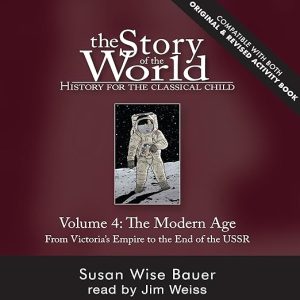
Susan Wise Bauer's Story of the World reaches its fourth and final volume here, and this audiobook moves the homeschool history curriculum's chronological sweep out of the early modern period into territory closer to living memory: the American Civil War through the twentieth century's end. This Second Edition, Revised keeps the four-volume structure intact while updating the modern-age material, and Jim Weiss returns once more as narrator, the same voice families have followed since Volume 1's ancient world.
Written by Bauer and narrated by Weiss, this twelve-hour-and-fifty-three-minute audiobook holds 4.8 out of 5 from 902 ratings on Audible, the highest rating count of any Story of the World volume. Forty-two narrative chapters carry listeners from revolt against British rule in Victorian India to the Persian Gulf War, spanning Europe, the Middle East, India, China, the Arabian Peninsula, Australia, and both American continents.
Proximity and Weiss's Familiar Cadence Anchor This Volume
What distinguishes Volume 4 from its predecessors is proximity. Ancient Egypt or medieval Europe arrive pre-filtered by centuries of retelling; the Civil War, the world wars, and the Gulf War are close enough that Bauer's chosen emphases, a story that deliberately tracks the Middle East, India, and China alongside the more commonly taught European and American threads, function as a genuine corrective to the usual Western-centric survey. Designed for grades 4 through 8, the narrative-chapter format keeps forty-two separate stories moving without collapsing into a dry chronology, which is the format's real trick: history taught as sequential story rather than a list of dates.
Weiss's approach across all four volumes has been consistent by design. He follows Bauer's prose rhythm rather than imposing extra theatricality onto material that is already dramatic enough, revolutions, wars, independence movements, which keeps the narration from ever feeling like a performance competing with the content. That consistency matters more here than reviewers might expect: a family that has been listening since Volume 1 will recognize Weiss's cadence immediately, and that familiarity is itself part of what makes a twelve-hour commitment feel manageable across a school year.
The 'Second Edition, Revised' label matters more for a volume ending in the twentieth century's final years than it would for the ancient-world opener. A modern-history text has less room to age gracefully: names, borders, and interpretations shift as events recede into history rather than current affairs, and a revision this far into a series' life signals Bauer keeping the curriculum's endpoint honest rather than letting a decades-old first edition simply calcify.
Decolonization Earns Its Own Throughline Here
Reviewer Momtographer calls the series their family's 'favorite history resources,' owning both the audiobooks and the physical books and reading them aloud to their children, a detail worth noting because it points to how this material actually gets used: not as a passive single listen but as a repeated, cross-format curriculum anchor. P.W., who has used all four volumes with kids of varying ages, describes them as 'concise, yet super-packed with information,' and specifically recommends the companion test booklet sold alongside the core audio, a detail future listeners should know about upfront rather than discovering after the fact.
KidsMom3 used the series as bedtime reading for a third-grader already getting solid social-studies instruction in an 'excellent public school program,' and still found Story of the World a valuable complement rather than a redundant one. That is a meaningful signal: this is not remedial or purely homeschool-only material, it holds up as enrichment even against a strong existing curriculum. The chronological, story-driven format also means independent listeners in the older end of the 4-8 grade range can genuinely follow along solo, not just alongside a parent.
Bauer's insistence on genuinely global coverage shows up most clearly in how she handles the mid-twentieth century: decolonization across Africa and Asia gets treated as its own throughline, not folded into a chapter about European empires winding down, which is a common shortcut in survey texts aimed at this age group. That choice alone justifies the volume's ambitious geographic range, since a chronologically organized modern-world story that skipped decolonization would badly misrepresent how much of the twentieth century actually unfolded outside Europe and North America.
The Gulf War Ends a Few Years Before Publication
The audiobook alone is not the full Story of the World curriculum, and treating it as such will shortchange the experience. Bauer built the series around a companion activity book, a separate test booklet, the one P.W. specifically recommends, and often a full textbook edition, all sold separately. The audio holds up as a genuinely good listen on its own, Weiss makes sure of that, but families wanting the complete classical-education package should plan to budget for the additional print components rather than assuming the audiobook covers everything.
At nearly thirteen hours, this is also the kind of audiobook meant to be spread across a school term rather than consumed in a few sittings, more curriculum than car-ride entertainment. Listeners expecting a single dramatic narrative arc, the way a novel builds toward a climax, should recalibrate: forty-two chapters means forty-two smaller stories, each satisfying on its own terms but not building toward one unified payoff the way a work of fiction would.
The Persian Gulf War as an endpoint is also worth flagging directly: this volume ends barely a few years before its own initial publication, meaning the modern history covered here was still living memory for many parents when they first picked this curriculum up, and only grows more distant with each new generation of listeners. That proximity is part of what makes Volume 4 feel different in tone from the more settled, textbook-distant material earlier volumes cover.
Co-op Groups and Charter Schools Continue Here
Homeschooling families already using Bauer's curriculum are the obvious core audience, but this volume specifically rewards families whose children are old enough, upper elementary through middle school, to handle twentieth-century material that includes real war and real atrocity, handled at an age-appropriate but not sanitized level. Co-op groups and charter or private schools already using the series, per multiple reviewers, will find Volume 4 a natural continuation, and independent listeners in the target age range can genuinely use this solo rather than needing a parent narrating alongside.
Start here only if your listener already has the historical grounding the first three volumes build, since the modern age assumes familiarity with earlier periods this series itself established. Families looking for a single standalone history audiobook rather than a multi-volume curriculum commitment, or those wanting exclusively American history rather than Bauer's deliberately global scope, should look elsewhere.
Do I need to listen to the first three Story of the World audiobooks before this one?
Yes, ideally. Volume 4 assumes the historical grounding the earlier volumes build, and its modern-age chapters reference context, colonialism, earlier revolutions, established in Volumes 1 through 3.
Does this audiobook cover American history or world history?
World history, deliberately. Bauer tracks events across Europe, the Middle East, India, China, the Arabian Peninsula, Australia, and the Americas rather than centering the United States, which is one of the series' consistent strengths.
Do I need the print books or activity guides to use this audiobook?
The audiobook stands on its own as a listen, but Bauer's full curriculum includes a separate activity book and test booklet that several reviewers specifically recommend pairing with the audio for complete homeschool use.