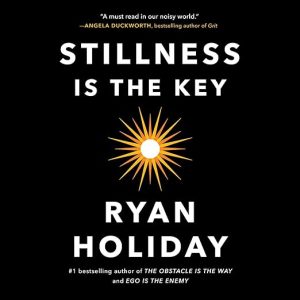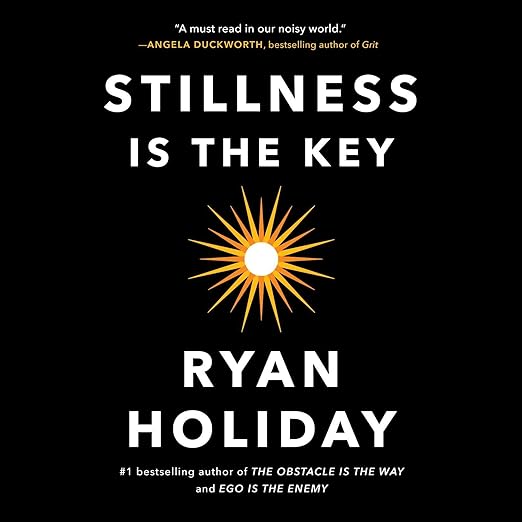
Ryan Holiday's Stillness Is the Key audiobook arrived on my radar during a stretch when I was finishing a reading project that had taken twice as long as planned because I kept pulling up my phone between chapters. Holiday's previous books, The Obstacle Is the Way and Ego Is the Enemy, had introduced a generation of business and sports professionals to Stoic philosophy through a lens of performance and achievement. Stillness Is the Key feels like the book he had been building toward: less about what to do and more about the quality of attention you bring to doing anything at all. The central argument is elegant. Holiday defines stillness not as passivity or disengagement but as a settled inner clarity that makes high performance possible.
The Review
He illustrates this across three domains, mind, body, and soul, drawing on historical figures from Confucius and Seneca to Winston Churchill and Anne Frank, and including examples from sports, art, and public life that his readers will recognize. Sadaharu Oh, the Japanese home run record holder whose Zen practice preceded his statistical dominance. Fred Rogers, whose extraordinary capacity for patient, undivided attention was itself a kind of stillness mastery. Churchill painting landscapes at Chartwell while managing a world war. The range is wide and the connections are genuine rather than forced.
The book's structure is its most debated element. Holiday organizes material thematically across three sections rather than building a single sustained argument, which means the pace and texture vary between chapters. Some readers will find this variety enriching. Others will occasionally feel something pretentious in the tone, the kind of tone that is probably unavoidable when writing about life's purpose and the examined self. Holiday himself seems to anticipate this; the best chapters carry a genuine humility about the limits of ancient wisdom in twenty-first century conditions. One reviewer who found the book "unbelievably good" and "truly life changing" also noted it covers far more territory than they expected, ranging from belief in a higher power to material possessions to the inner lives of great historical performers.
The Best Parts of Stillness Is the Key
Holiday self-narrating is a strong choice for this material. His delivery is calm and deliberate. He does not perform urgency he does not feel, and the audiobook's pacing has a contemplative quality that matches its subject throughout the nearly seven-hour runtime. At six hours and fifty-six minutes, the listening length is well-matched to the scope of the argument. One reviewer described it as "essential reading for today's times, but as timeless as ever," a response that suggests the book's reach exceeds its moment, which is the highest compliment available to philosophy-adjacent nonfiction.
The connection to Holiday's previous Stoicism work is real but not required knowledge. Stillness Is the Key stands alone as an argument, though readers who have already spent time with Marcus Aurelius through Holiday's Daily Stoic or through The Obstacle Is the Way will find certain ideas arriving with more accumulated weight. The self-narration also adds a dimension that matters here specifically: Holiday has lived with Stoic philosophy long enough that when he describes stillness, the delivery suggests someone who has worked at it rather than someone who has merely written about it.
The Caveats
The three-section structure creates some unevenness. The soul section is the most personal and occasionally the most uneven. Holiday is not writing from a settled religious tradition, and the language of soul without that anchor can feel imprecise in places. Some readers will find this section the most interesting; others will find it the most difficult to connect with on a concrete level.
Holiday's examples skew heavily toward high-achieving men in public life, which is a real limit of the framework's illustration. The book suggests that stillness is the secret weapon of the exceptional, a compelling argument, but it does not spend much time on how stillness applies to ordinary life or to people for whom achievement-oriented frameworks are not the primary lens. One reviewer flagged some anecdotes as containing inaccuracies when checked against primary sources. Holiday's method is popular history rather than academic scholarship, and he takes narrative liberties that specialists might contest. The core philosophical arguments do not depend entirely on the precision of any individual example, but it is worth approaching the historical material as illustration rather than verified fact.
The book's relationship to Holiday's broader project is worth considering. The Obstacle Is the Way addressed adversity. Ego Is the Enemy addressed ambition. Stillness Is the Key addresses the internal conditions required for both of those lessons to actually land in practice. In that sense, it is the most foundational of the three books even though it was written last. The argument is that without some degree of inner quiet, the other Stoic lessons cannot take root. You cannot use obstacles productively if your mind is too reactive to perceive them clearly. You cannot manage your ego if your inner life is constant noise. Stillness is the prerequisite, which is a framing that gives the book a structural logic that becomes clearer after you have lived with the material for some time.
Who Should Pick Up Stillness Is the Key
This audiobook belongs with readers who want the philosophical substance behind the productivity and Stoicism genre rather than just its frameworks and tactics. Fans of The Obstacle Is the Way will find it a natural and richer companion. People who have been drawn to mindfulness practice through secular routes but want the Western philosophical tradition it connects to will find Holiday's synthesis genuinely useful. Skip it if you want empirical research on attention and focus. The book is philosophical and anecdotal, not scientific. Skip it also if you are looking for a practical habit-change toolkit. Stillness is the goal Holiday is describing, not the daily planner for reaching it.
Quick Take
- Voice: Ryan Holiday self-narrates, and his measured, unhurried delivery is one of the audiobook's strengths, the pace models the book's central argument about slowing down.
- Big ideas: Stoic philosophy, inner stillness, self-mastery
- Atmosphere: Contemplative and quietly persuasive
- Worth it?: Holiday's most personal book and arguably his most mature argument, essential for readers who want the philosophical tradition behind the productivity frameworks he popularized earlier.
Does Ryan Holiday narrate the Stillness Is the Key audiobook himself?
Yes, Holiday self-narrates the full six hours and fifty-six minutes. His delivery is measured and unhurried, which reviewers consistently find appropriate for content about cultivating inner quiet. The pace of the narration models the book's central argument in a way a faster-paced production would undercut.
Do I need to have read The Obstacle Is the Way or Ego Is the Enemy before this audiobook?
No prior reading is required. Stillness Is the Key builds on the Stoic foundation of Holiday's earlier books but makes its argument independently. Readers who have spent time with his earlier work will find certain ideas resonating more deeply, but the audiobook is fully accessible without that background.
How accurate are the historical anecdotes in this audiobook?
One reviewer flagged that some anecdotes contain inaccuracies when checked against primary sources. Holiday's method is popular history rather than academic scholarship, which means he takes narrative liberties that specialists might contest. The core philosophical arguments do not depend entirely on the precision of any individual example, so the book holds up even where specific details are contested.