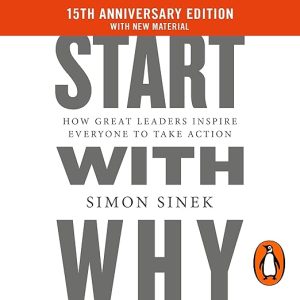
The Short Version
- Voice: Simon Sinek narrates his own work with the measured conviction of a practiced speaker, he knows exactly where to land emphasis, and the result is closer to a live keynote than a recorded book.
- Big ideas: purpose-driven leadership, organizational inspiration, the WHY framework
- Atmosphere: Energizing and methodical, with the confidence of a well-rehearsed argument
- Worth it?: The 15th anniversary edition adds a new foreword and updated examples, making this the version to choose if you are coming to Start with Why for the first time or returning to it after years away.
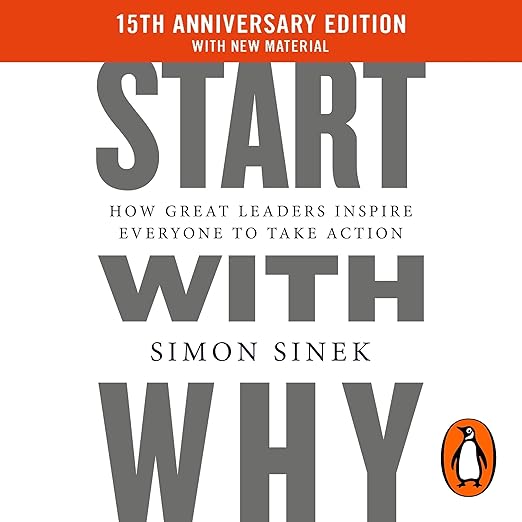
Simon Sinek's Start with Why 15th Anniversary Edition arrives as an audiobook version of a book that has, by Sinek's own accounting, sold more than three million copies since its original publication. The occasion of this anniversary edition is a good moment to consider what the book actually does well, where its limitations show most clearly, and whether the new material justifies a fresh listen if you have already spent time with the original text. The short answer: it does, particularly for the updated framing around social media and for the new foreword's honest accounting of where the WHY framework has been applied, misapplied, and tested in the fifteen years since publication.
The core argument of Start with Why remains genuinely useful fifteen years on. Organizations and leaders who communicate from purpose outward, starting with why they do what they do before explaining what they do or how, tend to generate stronger loyalty and more durable influence than those who lead with features or process. Sinek illustrates this with his Golden Circle model and a set of case studies centered on figures like Martin Luther King Jr., Steve Jobs, and the Wright Brothers. The examples work. They are well chosen and vividly rendered, and Sinek has the good sense to use them as illustrations of a principle rather than as hero worship.
The new foreword adds perspective on how the WHY concept has been received and sometimes distorted in the years since publication, and the updates throughout the text address the social media landscape with attention to how WHY functions in an environment of constant noise and short-form communication. One reviewer noted honestly that the central idea could be stated in half a page, and then praised the book for the depth it finds in expanding that idea from multiple angles across a full-length text. That tension between a simple premise and rigorous expansion is precisely where Sinek is working, and the anniversary edition acknowledges it rather than pretending the critique is unfamiliar.
Sinek Knows Which Pauses Carry Weight
Sinek narrates his own audiobook, and it matters substantially. His delivery is not the polished neutrality of a professional narrator reading someone else's prose. It carries the rhythm of someone who has delivered this material on stage hundreds of times, who knows which pauses carry weight and where to let a sentence land without ornamentation. Running at just under eight hours, this is a lean recording for a business title, and the pacing benefits from Sinek's own sense of where the argument needs room to breathe versus where it can move forward without pause.
One reviewer praised the book's ability to make readers think deeper about purpose, motivation, and intention. Those qualities emerge more vividly in audio than in print because Sinek's voice conveys conviction rather than merely stating it. The 15th anniversary edition is also the version that includes updated examples and the new foreword, which means it is now the authoritative audio version of the text rather than simply the most recent recording. If you own an older audio edition, this one has material the earlier version does not.
A Wish for More Diversity in the Stories
The book's most cited limitation is the relative homogeneity of its case studies. The WHY framework is illustrated almost entirely through Western, predominantly male examples of leadership, and one reviewer gave four stars while noting a wish for more diversity in the stories shared. That observation remains valid in this edition. The framework itself is portable and applicable across much wider contexts than the examples suggest, but listeners who want to see it modeled in organizations led by women, by non-Western leaders, or in community and social sectors will need to do that connective work themselves.
The other thing to calibrate expectations around is the book's scope: Start with Why is an argument for a principle, not a step-by-step implementation guide. It will show you what WHY-driven leadership looks like and why it matters. For the operational mechanics of finding and articulating your own WHY, Sinek's later works in the series pick up where this one leaves off. This audiobook is the foundation, and it is designed to be experienced as such rather than as a practical playbook.
The Same Narrowness, Only Somewhat Softened
This audiobook is for leaders, managers, and founders who are grappling with questions about organizational purpose and internal alignment, and who want a framework that goes beyond mission statement language. It is also well suited to anyone entering a career in communications, marketing, or public leadership who wants a conceptual grounding in why some movements and brands generate genuine loyalty while others generate only transactions.
Those who already listened to the original and found it transformative will want this edition for the updated foreword and the social media additions. Those who bounced off the original's narrowness in its case studies will find the same limitation present here, though somewhat softened by Sinek's own acknowledgment of the critique in his new framing. This is not a book for those who want tactical daily management tools. It is a book for those willing to examine the foundational question behind their work and to sit with it long enough that the answer becomes genuinely useful. For most listeners in that category, this anniversary edition is the authoritative version to choose.
Does Simon Sinek narrating his own audiobook add value over a professional narrator?
Meaningfully yes. Sinek's delivery carries the cadence of a seasoned speaker. He knows where the argument needs emphasis, and the result sounds less like a book being read and more like a keynote being delivered, which suits the material strongly.
Is Start with Why 15th Anniversary Edition a standalone audiobook or part of a series?
It stands alone as the foundational argument. Sinek has written subsequent books in what is sometimes called the Start with Why series, but this audiobook is complete and self-contained. The others extend rather than resolve it.