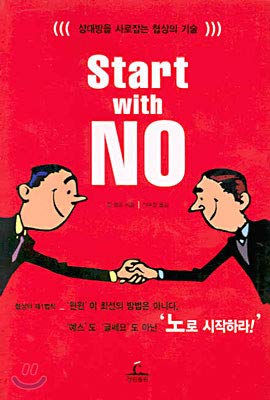
I read Getting to Yes in graduate school, the way most people who end up in media or publishing do, and I spent years treating its principles as established fact rather than a particular school of thought with identifiable limitations. Jim Camp's Start with No is the book that retroactively explained several negotiations I watched go wrong in the years since. I came to the audiobook on a long train ride and arrived at my destination wanting to call back at least two people from my career to apologize for what I now understood I'd been doing.
Camp spent twenty years coaching negotiators at companies including Motorola, IBM, and Merrill Lynch, and the argument he makes is not simply that win-win is wrong but that win-win, as conventionally understood, creates a particular kind of vulnerability for the party who internalizes it. If your negotiation framework starts from the premise that you need to find an agreement both sides can feel good about, you have already conceded something essential about your relationship to the outcome. You have made it your problem to make the other side comfortable, and that is a gift that sophisticated negotiators will take from you every time.
Where This One Lands
The title is provocative but the argument is more precise than the provocation suggests. Camp is not arguing that you should open every negotiation by refusing whatever is on the table. He's arguing that your relationship to the other side's discomfort or disappointment needs to be fundamentally revised. When you are willing to walk away, when you have genuinely internalized that a no is not a failure but a data point, you make entirely different decisions throughout a negotiation than when you are committed to finding an agreement at almost any cost.
The word that matters in Camp's framework is need. The negotiator who needs a deal is already losing. The negotiator who wants a deal but doesn't need one has an entirely different leverage position, and that leverage doesn't require any kind of theatrical toughness or explicit threat. It's structural. It lives in how you've prepared and what you've allowed yourself to care about. Robert Jordan's narration delivers this distinction with the kind of authority it deserves. This is not a book about being aggressive. It's a book about being clear.
Why Listen to Start with No
Fisher and Ury's Getting to Yes, the canonical text Camp is arguing against, is built around the idea that principled negotiation, focused on interests rather than positions, produces better outcomes for all parties than positional bargaining. Camp's critique is not that interests are unimportant but that the framework creates a mental model where the negotiator is optimizing for the other side's satisfaction alongside their own, which is a fundamentally different problem than optimizing for their own interests while respecting the other side's autonomy to make their own decisions.
This distinction matters practically rather than just philosophically. Camp's clients were negotiating with sophisticated counterparties for major commercial outcomes, situations where a negotiation culture that primes you to find the comfortable middle can cost real money and real opportunity. The case studies woven throughout the text, drawn from his actual coaching work with Fortune 500 companies, are more useful than abstract principle precisely because they show the mistake at the moment it happens rather than after the fact.
What Gives Us Pause
At just under eight hours, Start with No has room to do something that shorter negotiation primers can't, which is to build out the methodology systematically rather than just stating its principles. Camp walks through the preparation framework, the mission and purpose formulation, the specific techniques for staying out of what he calls the needing zone during actual negotiation, and the ways that even experienced negotiators reliably undermine themselves through habits that feel like professionalism but function as concession.
The chapter on vision, specifically the idea that your counterpart needs to be helped to paint a picture of their own problem rather than being presented with your solution, is the section most worth revisiting after a first listen. It reframes the negotiator's role from persuader to facilitator in a way that initially sounds counterintuitive but becomes harder to argue with the more specific examples Camp provides. Jordan paces this section well, giving the more counterintuitive claims room to land before moving forward.
Should You Listen to Start with No?
Anyone who regularly negotiates professionally, whether in sales, business development, legal practice, or any other field where agreement-making is central to the work, will find Camp's framework worth serious engagement. The material is particularly valuable if you've read and applied Getting to Yes and found that it worked less cleanly in practice than the theory suggested.
If you're looking for a quick tactics guide, this isn't it. Camp is building a philosophy rather than a playbook, and the runtime reflects that ambition. The methodology requires practice and internalization rather than just application. But for listeners willing to engage with the full argument rather than extract usable tips, Start with No offers a perspective that holds up to the kind of pressure real negotiation involves.
The most lasting thing Camp gives you is a diagnostic lens for your own behavior in negotiation contexts. Once you understand what the needing zone looks like from the inside, you start recognizing it in yourself with an accuracy that no amount of tactical coaching produces. That shift in self-awareness is worth the eight hours it takes to build it.
Good to Know
Is Start with No a direct rebuttal to Getting to Yes by Fisher and Ury?
Yes, Camp explicitly frames his work as a challenge to the win-win paradigm that Getting to Yes represents, which he describes as a spell that sophisticated negotiators use against less prepared counterparts. He argues that starting from a commitment to mutual agreement puts you at a structural disadvantage before the negotiation begins.
Does the 'no' in Start with No mean opening every negotiation by refusing the other side's position?
No. Camp's argument is about your internal relationship to outcomes rather than a tactical opening move. The key principle is that a negotiator who doesn't need a deal, who has genuinely internalized that a no is acceptable, makes entirely different decisions throughout the process than one who is committed to finding agreement. The behavioral expression of this varies by situation.
How does Robert Jordan's narration handle the more counterintuitive claims in the book?
Jordan delivers the material with measured authority rather than evangelism, which serves the content well. When Camp makes claims that push against conventional negotiation wisdom, Jordan's pace gives the argument room to establish itself before the listener's skepticism closes in. The narration never oversells, which is appropriate for an author who is explicitly arguing against oversell as a negotiation strategy.