Quick Take
- Narration: Austin R. Stoler delivers a clear, accessible read that suits the non-intimidating positioning of the material, workmanlike without distracting from the content.
- Themes: SQL fundamentals, database concepts, practical data querying skills
- Mood: Encouraging and pragmatic, the feel of a crash course designed to get you job-ready fast
- Verdict: A compact introductory SQL overview that works for complete beginners wanting orientation to the skill, but the 3.5-hour runtime limits how much actual SQL you’ll leave knowing how to write.
I ran into SQL for the first time during an internship in editorial data management, tasked with pulling query results I didn’t fully understand from a database I definitely didn’t understand. A coworker pointed me at a thin print guide and said “just learn the SELECT statement and you’ll be fine for now.” That advice turned out to be accurate, and it’s essentially the philosophy behind this audiobook: start at the beginning, build confidence, work up to intermediate concepts, and don’t let the technical frame scare you off before you’ve had a chance to try it.
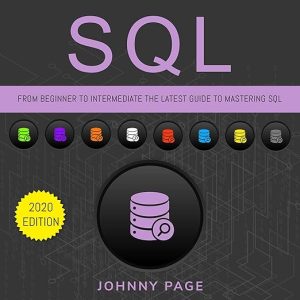
SQL: From Beginner to Intermediate is a short book with an enthusiastic pitch, the “hidden talent that big companies are looking for” framing that opens the synopsis positions SQL as something close to a secret skill, which slightly overstates the case, but the core claim underneath is legitimate: SQL is widely useful, often undertaught in bootcamps relative to web development, and learnable in weeks rather than months. The audiobook is trying to be the gateway to that learning.
What Three Hours and Fifty Minutes Can Actually Teach
The runtime is the first thing to reckon with. Four hours of SQL instruction is enough to cover SELECT statements, WHERE filtering, DISTINCT, table creation and modification, data types, and the conceptual structure of relational databases. It is not enough to get comfortable with JOINs, subqueries, window functions, stored procedures, or the performance considerations that distinguish intermediate from advanced SQL practice. The title’s “Beginner to Intermediate” promise needs calibration against that constraint, this is an introduction that gets you to a functional beginner level and gestures toward intermediate concepts rather than delivering true intermediate proficiency.
That’s not a failure of the book; it’s the nature of the format. Audio SQL instruction has an inherent ceiling because SQL is a hands-on skill. You learn it by writing queries, seeing errors, adjusting syntax, and developing intuition for what the query engine is doing. Stoler reads the content cleanly, and the coverage of SQL SELECT, SQL Distinct, SQL Where, and the basic database architecture concepts translates reasonably well to audio, these are conceptual rather than procedural in the way that, say, debugging workflow guidance is. The syntax descriptions are harder to retain without being able to type them.
The Database Architecture Foundation
The sections on what a database is and how information is compiled to be easily found in a query, and what tables are and how to create and modify them, are where the audio format actually serves the material well. These are conceptual explanations that don’t require you to be at a keyboard to absorb. Understanding why relational structure exists, why you’d normalize data across multiple tables rather than putting everything in one spreadsheet, is the kind of intuition that listening builds differently than reading. Page author Johnny Page’s treatment of data types and their appropriate use is similarly well-suited to audio framing.
The job-market framing throughout the synopsis is enthusiastic to a degree that sophisticated readers will want to discount slightly. SQL is a valuable and marketable skill; it is not a hidden secret that guarantees job placement. The listener who approaches this as a confidence-builder and conceptual orientation to the skill will be better served than the listener who expects specific employment outcomes from a 3.5-hour audiobook.
Stoler’s Narration and the Accessible Entry Point
Austin R. Stoler’s narration is competent and consistent, he reads technical terminology with the clarity the material requires without the flat affect that sometimes accompanies narrators not fully comfortable with tech content. The rating of 4.4 across three reviews is a data set too small to be statistically meaningful, but the absence of negative feedback suggests the audio quality and delivery haven’t been obstacles for the listeners who’ve finished it.
The approach of multiple statement types covered explicitly, SELECT, DISTINCT, WHERE, and variations, gives the audio a structural predictability that aids retention. You know roughly what’s coming, which means you can organize your mental notes around the sequence rather than trying to hold an undefined amount of information simultaneously. For someone who has never seen a SQL query and wants to understand what the skill is before committing to a longer course, this audiobook serves that orientation function well.
Who Starts Here and Who Goes Elsewhere
Complete beginners to SQL who want a confident, non-intimidating orientation to the skill before investing in a hands-on course will find this valuable as a primer. People switching from web development who want to understand what database administrators and data analysts are actually doing will get enough conceptual grounding to have informed conversations. Anyone who plans to do anything substantial with SQL, analysis, development, data engineering, should treat this as the first hour of a much longer learning journey and pair it with a hands-on platform like SQLZoo, Mode, or a database course where you actually run queries.
If you’re already comfortable writing SELECT statements and want to get to JOINs, aggregations, or window functions, this title’s intermediate claim will leave you disappointed. The right audience is genuinely the person who’s never opened a database GUI and wants to understand what the skill involves before committing to a full curriculum.
Frequently Asked Questions
Does this audiobook actually teach you to write SQL, or is it more conceptual overview?
It’s closer to a conceptual overview that introduces syntax rather than a hands-on SQL course. The audio format limits how much query practice you can do while listening. You’ll understand what SQL does and how basic statements are structured, but you’ll need to practice in a live environment to develop actual query-writing skill.
Which SQL dialect does the book cover, MySQL, PostgreSQL, SQL Server?
The synopsis doesn’t specify a particular database platform. Basic SQL syntax, SELECT, WHERE, DISTINCT, table creation, is largely consistent across major platforms. Platform-specific syntax differences matter more at intermediate and advanced levels, so the omission is less significant for a beginner orientation.
Is the ‘beginner to intermediate’ range accurately described?
In 3 hours and 50 minutes, the book covers beginner fundamentals well. The ‘intermediate’ label is aspirational given the runtime, true intermediate SQL involves JOINs, subqueries, aggregation functions, and performance considerations that require more instructional time and hands-on practice than audio can efficiently provide.
What should I do after finishing this audiobook to actually become proficient at SQL?
Practice in a live environment. Free platforms like SQLZoo, Mode’s SQL Tutorial, or Khan Academy’s SQL course give you actual queries to write and databases to query against. This audiobook is the orientation; the hands-on practice is where the skill develops. Consider pairing with a project that uses real data you’re actually interested in.