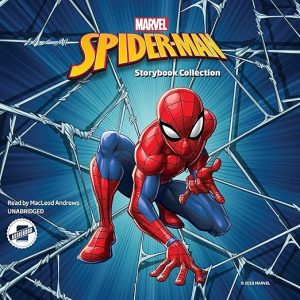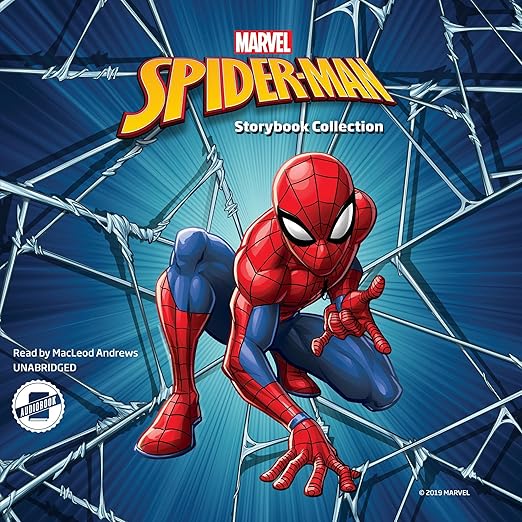
Two books share one cover on this listing, and the audiobook does not hide it. The description opens by announcing "Two collections in a single volume", then names them separately: Spider-Man Storybook Collection first, 5-Minute Spider-Man Stories second. What arrives is an omnibus of three hours and eleven minutes, credited to MacLeod Andrews, issued by Listening Library and dated October 2025. The set pieces come straight out of the copy: the shape-shifting Lizard threatening Peter's school, the incredible Hulk helping to clear out some bad guys, the Sinister Six, Electro, a Wild West Spidey rodeo, and Rocket and Groot on Broadway.
Five written notices sit on this page, and all five were filed between August 2017 and June 2019, six to eight years before this recording was released. Two of them describe the physical object closely. One reports that "The outer edges of the pages are silver", and that "each page has full color illustrations on it". Another praises how "the pictures are so vibrant". Not one of these responses can be about a reading, because at the time none existed to respond to.
The Review
Judged as an omnibus, this is generous. One half of it is titled by its own unit of measure, 5-Minute Spider-Man Stories, so the length of the listening experience is written into the product name. The other half carries no such label, and the copy for it runs through a longer list of scenarios. Marvel Press holds the author credit, which tells you what kind of book this is. No single writer's sensibility runs through it. These are house-built stories assembled around characters a child already recognizes, and the pleasure on offer is recognition rather than surprise. It sits under a series called Storybook Collection with no number attached, which is accurate in spirit: this is a shelf format rather than a continuing story, and nothing inside it depends on anything else you might own.
That structure sets the real production question, and it is worth understanding before you buy. The description names Iron Man, Black Panther, Ant-Man, Doctor Strange and Black Widow as guests, plus the Lizard, Electro, the Sinister Six, Rocket and Groot, along with Peter himself. One credited reader covers all of them, in an omnibus where two separately conceived collections sit end to end. Nothing on the page says whether the two halves were recorded to match each other or deliberately kept distinct. Sample the opening of each half rather than only the first, because the start of the file tells you about one book, not two.
Why Listen to Spider-Man Storybook Collection
Short units are the argument. A collection whose second half is defined by a five-minute story length gives an adult something a novel cannot: a natural stopping place every few minutes, with no plot debt carried into the next night. The publisher makes the same claim in its own words, calling these stories "perfect before bedtime, on the go, or any time of day". Kimi's four-star notice describes buying the book "for story time", which is exactly the slot this format is cut for.
Then consider what a recording replaces. Matt describes reading the book to a three-year-old "every night" and credits it with introducing characters that had not come up at home yet. T. Scott, whose son was four, writes that some of the concepts and vocabulary were challenging, "but that is the joy of reading aloud to children". A recording does that job when the adult is driving, cooking or simply out of voice, and it does it without the quietly skipped pages that a tired grown-up performs at the end of a long day.
Roster breadth matters for a specific kind of household. A child who knows Spider-Man from a screen or a lunchbox meets Black Panther, Doctor Strange, Ant-Man and Black Widow inside stories built at a small child's comprehension level, which is a far gentler introduction than any of those characters get in their own feature-length material. The Wild West rodeo and the Broadway sequence with Rocket and Groot suggest writers who were told to vary the settings hard, and that variety is what keeps a long sitting from flattening into one note.
The Caveats
Pictures do not come with you. Neither the title nor the description mentions illustration anywhere; the only evidence that this material was designed around images comes from the reviews, and it is emphatic. Silver page edges, full color on every page, pictures one reviewer calls vibrant. I would rather a listing said so plainly than left a parent to discover it. A storybook collection for young children is a co-designed object, words and images working in the same beat, and a recording keeps one half of that. This is not a defect in the production. It is a fact about what you are buying, and it weighs heaviest on the youngest listeners, for whom the picture usually does half the work of holding attention.
Age is the second thing to weigh, and the pool's only four-star notice is the honest one about it. Kimi bought the book for a three-year-old and reports "He may be a little too young to enjoy this book", finding the story lines less interesting to him than a simpler collection he already owned. Meanwhile Matt's three-year-old loved it. Treat three as the boundary rather than the floor. A 4.6 average built on 276 ratings deserves the same asterisk as the written notices, since nothing on the page connects that figure to this recording rather than to the book families have been reading aloud since 2017.
Who Should Listen to Spider-Man Storybook Collection
Households with children of about four and up, already fluent in Marvel, are the center of this. It suits the car, the kitchen and the half hour before sleep equally well, because the story is the unit and nothing breaks when you stop. Adults who read aloud every night and have run out of voice get the most concrete benefit of all. A child who has met Spider-Man only in moving pictures gets him here in prose, which is a slower and more verbal pleasure than the films offer.
Buyers after the object should look elsewhere. The silver edges and the full-color pages are exactly what the two reviewers who described the physical book loved about it, and none of that transfers. Parents of children under three will want to wait, and anyone hoping for a single sustained story rather than a stack of short ones is in the wrong aisle entirely. As a gift for a Spider-Man household that already owns the hardcover, though, an audio omnibus is the one version nobody in that house has yet.
Good to Know
Does this audiobook contain both story collections named in the description?
Yes. The copy announces a pair of collections in one volume and then lists them by name, Spider-Man Storybook Collection and 5-Minute Spider-Man Stories. You are buying an omnibus rather than one of the two, which is worth knowing if your household already owns either title in print.
How long is the Spider-Man Storybook Collection audiobook and how is it broken up?
Three hours and eleven minutes in total. Half of that is a collection whose own title advertises a five-minute story length, so the natural stopping points arrive constantly. That structure makes it unusually easy to use in short doses rather than in long sittings.
Do the written reviews on this page describe the audiobook?
No. Every one of them dates from 2017, 2018 or 2019, long predating this recording, and they discuss a printed book: silver page edges, full color illustrations, reading aloud at bedtime. Treat them as evidence about the stories, not about the reading.
What age does this suit?
The pool splits at three. One reviewer's three-year-old found the story lines less interesting than a simpler collection, while another's three-year-old asked for it every night. The older children in these notices, aged four and six, did well, so four and up is the safer assumption.