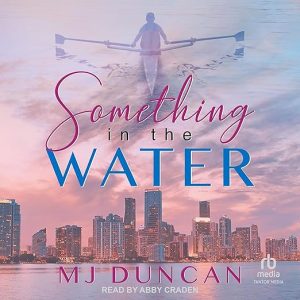
Does a twenty-year age gap between an engineering professor and an Olympic rowing coach actually complicate Something in the Water's romance, or just season it? The audiobook spends its opening chapters letting Carter Burke get hooked on Kate Walker well before either woman, or the story itself, treats the age difference as a real obstacle to push against.
Two Already-Fulfilled Women Meet at a Rowing Camp
The synopsis is careful to establish both women as whole on their own terms before the romance complicates anything: Kate has a job, a daughter, and friends who've stayed close through difficult stretches, while Carter is happily married to her sport in every sense that matters to her, dedicated to the rowing team she coaches rather than actively looking for a relationship. That grounding matters for an age-gap romance specifically, since it removes the reading that either woman needs rescuing from an empty life.
Kate Walker is introduced as a tenured, world-renowned engineer with a job she loves, a daughter she adores, and a life the synopsis frames as already fulfilling, not a woman waiting to be completed by romance. Carter Burke, an Olympic medalist turned collegiate rowing coach, is drawn just as deliberately as content with her own life before Kate walks into her boathouse.
Reviewers Kathy and Tammy both fill in the connective detail the synopsis leaves implicit: Kate's daughter Maddie attends a summer rowing camp that Carter coaches, which is how the two women's paths actually cross. That grounding detail matters, since it roots the central relationship in an ordinary, plausible overlap of daily life rather than a contrived meet-cute.
The Charles River itself gets treated almost as a character in the synopsis, host to years of both joy and heartbreak before Kate and Carter's story adds to that history. Boston's rowing culture supplies the backdrop throughout, and Tammy's review confirms Carter's coaching job sits at a university in the city, keeping the setting consistent across both the official synopsis and reader accounts. Reviewer Kathy adds that the secondary characters bring real levity to the book, enough to say the laughs came often, which suggests the tone stays lighter around the edges even while the central romance carries real emotional weight.
Craden Alone Voices Both Alternating Rowers
Rowing is a genuinely underused sport in romance, and reviewer Tammy's account specifically credits the book with making the sport's terminology accessible to newcomers, aided by a glossary of rowing terms placed at the front of the book. Reviewer Michelle independently flags the same glossary as helpful, a rare case of two reviewers converging on the exact same craft detail without prompting.
Michelle's review also supplies useful context about where this sits in MJ Duncan's catalog, noting the book is spicier than previous releases, which confirms an established author with a prior readership rather than a debut arriving with no track record. That existing body of work is worth knowing about for readers deciding how much to trust the uniformly strong ratings here. Reviewer Lexi goes further, placing the book among the top three favorites of all time across any genre, a specifically high bar that stands out among the batch of otherwise strong but more measured praise.
The narrator credit here lists Abby Craden alone, so Kate's and Carter's alternating chapters both run through one performer's range instead of two dedicated readers trading off by character, a real technical demand given how evenly the book weights both women's perspectives.
Rating Badge Math That Doesn't Add Up
This listing's rating math does not add up, and it is worth naming plainly rather than passing over: the badge shows 4.6 stars, but the counter attached to it reads exactly one rating, and a single whole-star vote can only ever average to a whole number, never to 4.6 under any rounding convention. Five full written reviews sit on the page regardless, so the actual reader response is genuinely positive, the displayed count next to it simply cannot be reconciled with the math.
The rowing glossary that reviewers praise as a print convenience raises its own audio-specific question: a glossary works as a flip-back reference on the page, something a reader can return to mid-chapter, while an audiobook delivers it once, linearly, near the start. Listeners unfamiliar with rowing terminology may want to listen to that section twice, or find a written glossary alongside the audio, since audio offers no equivalent way to flip back mid-scene once the story moves on.
Dykiesmurf's review offers the one clearly critical note among otherwise uniform praise, wishing the happily-ever-after got more than a single epilogue's worth of space. That is a useful counterweight for anyone assuming five reviews this positive means zero reservations exist about the book's pacing choices in its final stretch. Dykiesmurf's review also notes this was a first exposure to this author, and that the reservation about the epilogue was not enough to stop that reviewer from downloading more of Duncan's catalog immediately afterward.
At twelve hours and thirty-three minutes, the runtime gives both the coaching-world detail and the growing relationship room to develop without feeling rushed toward a resolution. That length also tracks with Michelle's observation that the book carries more sustained tenderness than a shorter, plot-compressed romance usually has space for.
F/F Romance for Readers Who Trust Five Reviews
F/F age-gap romance grounded in a specific, well-researched sport, rather than a vague athletic backdrop, is the core appeal here, best suited to listeners who want a central couple already secure in their own lives before the relationship complicates things. Fans of MJ Duncan's earlier books have a specific reason to pay attention too, given Michelle's account that this entry runs spicier than what came before it.
Listeners who prefer their happily-ever-afters fully dramatized across multiple chapters rather than compressed into an epilogue should go in aware of Dykiesmurf's specific reservation on that point. The five written reviews, not the single-vote counter sitting beside the badge, are the more reliable signal here for anyone put off by the inconsistent rating display.