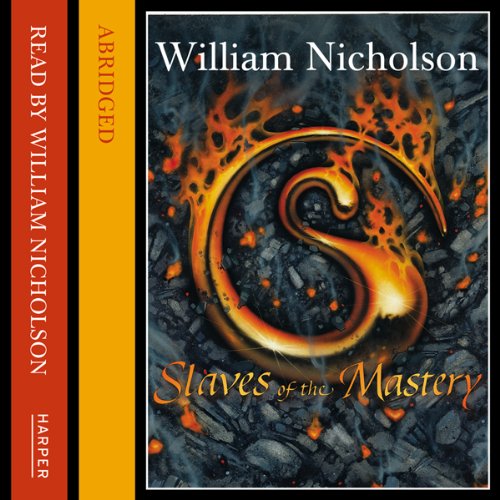
Quick Take
- Narration: William Nicholson reads his own work with quiet authority, bringing an intimacy to Kestrel and Bowman that a hired narrator could not easily replicate.
- Themes: Separation and reunion, the cost of power, the search for freedom
- Mood: Mythic and urgent, with an undercurrent of genuine tenderness
- Verdict: A second installment that honors the emotional groundwork laid in The Wind Singer and earns every moment of its larger scope.
I came to Slaves of the Mastery having loved The Wind Singer more than I expected to. That first book in William Nicholson’s Wind on Fire trilogy surprised me with its genuine strangeness, its refusal to soften the brutal logic of Aramanth’s merit-obsessed society. When I finally queued up the sequel on a quiet Saturday afternoon, I was not entirely sure the momentum could hold. Sequels in fantasy for young readers often lose the compressed intensity that made the opening book work. Nicholson does not let that happen here.
The five years that have passed since the events of The Wind Singer are felt rather than explained. Aramanth has grown kinder, yes, but also softer, and the novel makes clear early on that kindness without backbone is its own kind of vulnerability. Then the soldiers of the Mastery arrive, the city burns, and Kestrel Hath is left standing alone while everyone she loves is taken. The separation of Kestrel and her twin brother Bowman is the engine of everything that follows, and it hurts in exactly the way a good adventure story should.
Our Take on Slaves of the Mastery
What strikes me most about this audiobook is how well the author-as-narrator serves the material. Nicholson reads with a measured pace that resists melodrama even in the most violent passages. His voice carries the weight of someone who knows exactly what these characters mean, who built them over years before committing them to the page. There is a phrase that surfaces early in the narrative, spoken by the Singer people’s prophet figure: every time I touch the future I grow weaker, my gift is my disease, I shall die of prophecy. Nicholson delivers it without flourish, and that restraint makes it land harder than any emphasis could. You feel the tragedy in it before you fully understand its implications for the plot.
Why Listen to Slaves of the Mastery
The novel works as a genuine sequel, not just a continuation. Nicholson has constructed a separate threat in the Mastery itself, with enough internal logic and menace to function as a standalone antagonist, while also deepening the mythology of the Singer people that was only sketched in the first book. Bowman’s arc here, learning the secrets of those who carry music as a form of power, is genuinely new territory. Kestrel’s fury and her vow of revenge give her a harder edge than she had before, and it suits her. One reviewer described this as the best children’s book he had ever read and invoked The Lord of the Rings in the comparison. That is the kind of claim that usually makes me skeptical. In this case, I understand what he was reaching for, even if I would frame it differently. The philosophical undercurrents, particularly the questions around power, sacrifice, and what we owe each other, are not simplified for a young audience. They are just stated with clarity, which is its own form of respect.
What to Watch For in Slaves of the Mastery
The pacing in the second half tightens considerably compared to the first, which some listeners may notice as a structural unevenness. The world of the Mastery itself is sketched rather than fully drawn, and certain secondary characters in the enslaved Manth community remain underdeveloped. These are not fatal problems, but they are places where the book’s ambitions slightly outrun its execution. Listeners who came to the first book for its school-exam dystopia satire will find that element largely absent here, replaced by something more conventionally epic in scope. Whether that feels like growth or drift depends on what you loved about The Wind Singer. The 3-hour and 16-minute runtime means the story moves briskly, which works in its favor even where the world-building is sparse.
Who Should Listen to Slaves of the Mastery
This is the right listen for anyone who finished The Wind Singer and felt the world deserved more space. It rewards patience and works best when taken in longer sessions rather than short commute fragments. Adults who typically avoid the children’s fantasy label will find the thematic density more than sufficient. Skip it if you have not listened to the first book; the emotional stakes depend entirely on already caring about Kestrel and Bowman.
Frequently Asked Questions
Do I need to listen to The Wind Singer before this one?
Yes, and there is no shortcut around it. The emotional weight of Kestrel and Bowman’s separation only registers if you have already spent time with them in Aramanth. Starting here would mean missing the context that makes every reunion in this book matter.
Is William Nicholson a strong narrator of his own work?
He is restrained rather than theatrical, which suits the material well. If you are expecting a high-performance audiobook with distinct character voices, this is not that. If you want the feeling of a writer who knows exactly what he intended, the self-narration delivers something harder to manufacture.
How does this compare to the first book in tone?
Slaves of the Mastery is more epic in scope and less satirical than The Wind Singer. The confined world of Aramanth gives way to a broader journey across geography and culture. Some readers find this a natural expansion; others miss the focused claustrophobia of the original setting.
Is this appropriate for the same age range as The Wind Singer?
Generally yes, though the enslavement themes and the violence of conquest are handled more directly here than in the first book. It is still firmly middle-grade in its emotional register, but parents reading alongside younger children may want to use it as a prompt for conversation.