- Performance: Steffen Groth delivers Taleb's combative, aphoristic prose with dry authority that suits the material, though the audiobook's non-linear structure is harder to track than on the page.
- What it covers: Accountability and risk-sharing, institutional failure, symmetry in ethics and commerce
- Feel: Provocative and intellectually aggressive, with flashes of genuine dark humor
- Our call: Skin in the Game rewards listeners who can hold Taleb's contrarian energy at arm's length and extract the genuinely useful framework from the surrounding polemic.
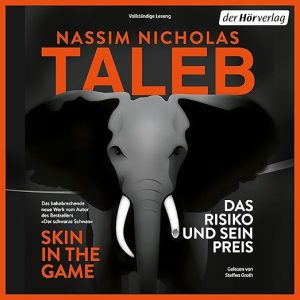
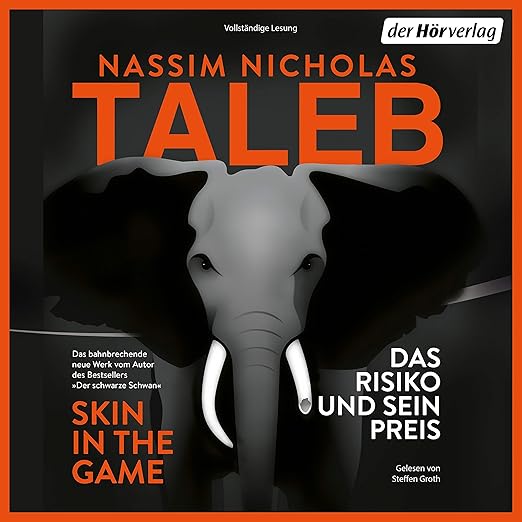
Nassim Nicholas Taleb has a gift for articulating something you half-knew and making you wonder why it took this long to hear it stated plainly. Skin in the Game, the audiobook for which runs just over ten and a half hours with Steffen Groth narrating, is built around one of those articulations: the idea that people who make decisions but do not bear the consequences of those decisions are structurally dangerous, not just to others but to any system that depends on accurate feedback. This is not a novel insight. Taleb knows that, and the book's project is less discovery than systematization, an attempt to show how this single principle, when applied consistently, explains a remarkable range of political, economic, and ethical failures across history and in the present.
The examples he deploys are characteristic: bureaucrats who recommend wars they will not fight, consultants who collect fees regardless of whether their advice works, politicians who impose policies on populations they do not live among. The reviews around this production include listeners who describe Taleb's writing as having changed how they approach fundamental questions of how to live, and that response makes sense as an account of what the best Taleb passages accomplish. When he is operating at full force, the connections between ancient ethical principles, modern financial engineering, and Lindy-resistant businesses feel illuminating rather than merely clever.
Where This One Lands
Steffen Groth's narration is steady and authoritative, which serves the didactic sections well. Taleb's prose has a particular rhythm: short declarative statements, an aphorism, an extended example, another declarative statement. That rhythm can feel relentless on the page, and in audio it occasionally risks monotony. Groth varies his pacing well enough to prevent the flattest sections from losing the listener entirely, but the book's non-linear structure, where Taleb loops back to earlier arguments from new angles without traditional chapter signposting, can be harder to follow in audio than in print where you can flip back to locate your position within the argument.
What the audiobook format does well is deliver Taleb's wit. The book is funnier than readers who encountered his earlier work primarily through hostile summaries might expect, and Groth's dry delivery suits the occasional sharp aside. The section where Taleb dismantles the logic of academic economists who have never run a lemonade stand is both the most polemical and the most entertaining portion of the production, and Groth handles it with the appropriate controlled contempt that the material invites.
Why Skin in the Game Works as an Audiobook
The central framework is genuinely useful as a decision-making lens. The concept of skin in the game, requiring that the people advocating for a decision also bear meaningful personal cost if that decision fails, applies across contexts Taleb explores throughout the ten-plus hours: medicine, politics, finance, religious practice, warfare, and everyday ethics. Listeners who work in any field where advisory roles are separated from operational ones will find the argument repeatedly landing in their own professional experience.
The Lindy effect, Taleb's concept that the expected remaining lifespan of non-perishable things is proportional to their current age, gets substantial treatment here and connects usefully to his broader argument about what kinds of institutional knowledge survive because they work versus what survives because it is protected from the feedback that would expose its failure. These are productive ideas, and the audiobook format makes them available during routine tasks that give complex arguments room to settle and develop in the listener's mind.
What Gives Us Pause
Taleb's polemical mode can exhaust listeners who want argumentation without the performance of intellectual dominance. The book is as much about positioning Taleb's perspective against the people he considers foolish as it is about building a positive framework, and that orientation is a feature for some listeners and a bug for others. The target is consistently the professional class who give advice they do not live by, and by the third extended version of that critique, listeners either find the repetition reinforcing or find it grating. Knowing which camp you occupy before starting will save you time.
The structure is also non-linear in ways that are deliberate but can confuse audio listeners who cannot track their position within the argument as easily as print readers can. Taleb circles back frequently, and the circling is productive in print but occasionally makes the audio version feel like it has lost the thread when it has actually picked up a new strand of the same argument. Listeners who find themselves confused are usually not missing the logic; they are simply encountering the spiral structure from the inside.
The book's treatment of barbell strategies and asymmetric risk, built on earlier Taleb work but distilled here into its most practical applications, is where the audiobook format proves most useful. Hearing these arguments during the kind of routine attention that lets the mind work on concepts in parallel is one of the genuine advantages of audio over print for dense nonfiction. Groth's steady delivery keeps the arguments audible without flattening them, and the production's consistent pacing means listeners who zone out briefly can reenter the argument without losing the thread entirely.
Should You Listen to Skin in the Game?
Listeners already familiar with The Black Swan or Antifragile will find Skin in the Game the most directly applicable of Taleb's works: it makes fewer formal demands and offers a framework that translates immediately to daily professional and personal decisions. New listeners to Taleb can start here without prior context; the central argument is stated early and clearly. Listeners who prefer argument without polemic, or who want their business and philosophy audiobooks to build systematically rather than spiraling outward and back, may find the format and tone challenging. Those willing to work with Taleb's style will find ideas that remain in circulation long after the listening session ends and continue reshaping how ordinary decisions look.