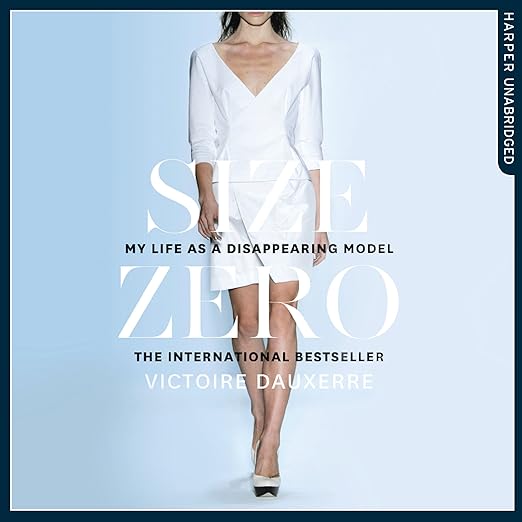
Seventeen years old and scouted off a street corner, Victoire Dauxerre was walking New York runways within months: how many fashion-world memoirs actually name names the way hers does? This audiobook is Dauxerre's account of watching that dream curdle fast, as modeling executives and photographers pushed her toward a thinness her body couldn't sustain, and of the real battle with anorexia and bulimia that followed. Two major UK papers backed the print edition on release, one calling it 'unique and persuasive' and praising how 'bravely, Dauxerre names names - even the big ones,' the other calling it rare 'for someone to blow the whistle so spectacularly.' Narrator Emily Lucienne reads it all with a measured, unsentimental restraint that mirrors Dauxerre's own unflinching tone rather than adding performative grief to material that doesn't need it.
Dauxerre Names Names Instead of Composite Executives
What separates this from a generic behind-the-fashion-industry exposé is specificity: Dauxerre names names, as the Sunday Times blurb puts it, rather than describing composite executives and unnamed photographers the way memoirs worried about legal exposure often do. Reviewer Yol calls it 'a shocking tale of the fashion world's obsession with unnaturally thin, unhealthy women who are held up to the rest of the world as the ideal' and describes finding the author 'endearing in her honesty,' gesturing toward a deeper sadness before the review itself cuts off mid-thought.
Samantha C is more mixed, praising Dauxerre's 'candor when telling the story' in 'a very matter-of-fact way,' while flagging that the book isn't a full five stars 'only due to the translation which I feel should have been better.' That's a meaningful caveat: Dauxerre wrote this in French with co-writer Valerie Peronnet, and Samantha C's critique suggests something got lost in the English adaptation, even if the core material still lands.
The specificity extends beyond just naming names, too. Dauxerre doesn't generalize her experience into a vague statement about the fashion industry as an abstraction; she describes particular shows, particular pressures, particular moments of being weighed and measured, which is part of why Yol calls the account 'a brutally honest story' rather than something filed down into a more palatable general statement. That specificity also explains why this generated pull-quotes from two major UK papers rather than fading into the crowded field of fashion-industry exposes; naming names carries legal and reputational risk that vaguer accounts avoid, and readers tend to notice the difference.
Lucienne's Steady Register Avoids Melodrama Entirely
The unflinching quality reviewers keep circling back to is exactly where Emily Lucienne's narration earns its keep. This is physically specific material, the mechanics of restriction and bingeing described without euphemism, and a narrator who leaned into melodrama or excessive emotion here would risk turning genuine testimony into something closer to spectacle. Lucienne instead keeps a steady, controlled register throughout, letting Dauxerre's own honesty do the work rather than adding interpretive weight on top of it.
That restraint matters for a memoir the Evening Standard praised specifically for blowing the whistle rather than softening the industry's role in what happened to her; a gentler narration style would undercut exactly what makes the book distinct from more diplomatic insider accounts. At six hours and thirty-three minutes, the pacing also stays tight, moving from the initial scouting and excitement of early catwalk success into the specific pressure tactics that pushed Dauxerre toward disordered eating without wasting time on excessive scene-setting.
Co-writer Valerie Peronnet's involvement is also worth noting as a structural choice: memoirs about trauma written with a collaborator often benefit from an outside eye helping shape raw experience into a readable narrative arc, and the tight, focused pacing multiple reviewers note suggests that collaboration worked in the book's favor, even if Samantha C's translation concern suggests the English-language adaptation specifically lost something the original French didn't. The relatively short runtime, six and a half hours against memoirs that often run twice as long, also keeps the intensity from becoming numbing; Dauxerre and Lucienne get in, tell the specific story, and get out before the material's weight becomes exhausting rather than affecting.
Nellie Bleu Calls It More of a Novelette
Samantha C's translation concern is worth taking seriously, and it's not the only caution among the reviews. Nellie Bleu, giving three stars in a review titled 'good but not a full length book,' calls the content 'nothing special or shocking' on its own terms and describes real frustration at what she experienced as thin runtime relative to the price of a full listening credit, writing that it felt 'more like a novelette.' That's worth weighing against Yol's very different reaction calling the same material shocking; expectations going in clearly shape how substantial the book feels coming out.
Nellie Bleu also specifically mentions being legally blind and relying on audiobooks for entertainment, which makes her disappointment about perceived value carry extra weight; for listeners in a similar position depending on audio as a primary format, the six-and-a-half-hour runtime is worth confirming matches your expectations beforehand. Given the subject matter, physically detailed descriptions of anorexia and bulimia throughout, this also isn't casual listening, and anyone currently navigating similar struggles should approach with real awareness of what's coming. The catwalk-industry specifics also root this firmly in a particular moment, Dauxerre's own run through the New York shows of her era, so listeners expecting an up-to-the-minute account of current modeling practices should know this reflects her specific experience rather than a comprehensive present-day survey.
Parents Weighing Modeling for Their Teens Should Listen
Readers interested in the fashion industry's actual mechanics, not the glamorous version but the specific pressure executives and photographers apply to teenage bodies, will find Dauxerre's firsthand account more credible than secondhand journalism on the same subject, precisely because she names names rather than staying diplomatically vague. Those drawn to memoirs about eating disorders that prioritize testimony over clinical framing will also find Lucienne's restrained narration exactly suited to material that needs to be heard plainly rather than performed. Parents of teenagers considering modeling or entertainment work may also find this a sobering, worthwhile listen before letting a child pursue that path.
Anyone currently in recovery from disordered eating should approach the more physically specific passages with real caution, since Dauxerre and Lucienne together don't soften the details for a general audience. Anyone expecting a long, immersive fashion-industry saga should also recalibrate around Nellie Bleu's novelette comment; at six and a half hours, this reads fast and stays focused, which is a feature for some and a disappointment for anyone hoping for a fuller, more sprawling account.
Before You Press Play
- Read by: Emily Lucienne's measured, unsentimental delivery mirrors Dauxerre's own unflinching honesty without adding performative grief.
- At its heart: Fashion industry pressure, anorexia and bulimia, naming names instead of staying diplomatically vague.
- Vibe: Unflinching and testimonial, difficult by design.
- Short version: A genuinely brave, specific memoir best approached with real caution around its physically detailed content.