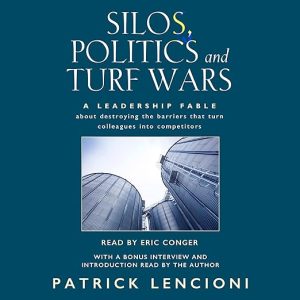
Patrick Lencioni's business fable format has a specific contract with its audience: a realistic but fictional organizational scenario, a consultant or leader character who diagnoses a structural problem, and a named framework the reader can carry back to their own workplace. That format has made Lencioni the most widely read organizational theorist in American management culture, not through academic rigor but through immediate recognizability. Every manager who opens this audiobook has worked inside the problem it describes. Silos, Politics, and Turf Wars follows that contract with more focus than many of his other books, and this audiobook, narrated by Eric Conger across three hours and thirty-four minutes, delivers it in a form that rewards professional listeners in transit or between meetings. The central problem, organizational silos creating interdepartmental dysfunction that kills productivity and drives away good people, is one that any mid-size or large organization will recognize immediately, regardless of industry.
Is Silos, Politics, and Turf Wars Worth Your Time?
Lencioni's insight in this book is narrower and sharper than in The Five Dysfunctions of a Team. He is not diagnosing team failure in general; he is diagnosing one specific organizational disease: the tendency of departments to optimize for their own metrics and interests at the expense of the organization's shared goals. His protagonist, Jude Cousins, is a consultant navigating not one but three different organizations wrestling with this dynamic, and that parallel structure gives the audiobook a range that a single case study would lack. Each organization demonstrates a different manifestation of silo behavior, which makes the diagnostic framework more robust than any single example could establish on its own.
The key tool Lencioni introduces, a thematic goal or rallying cry that gives everyone in an organization a shared qualitative objective beyond departmental metrics, is simple enough to be dismissed and practical enough to actually work when applied correctly. Reviewers consistently note that the book is easy to use, which is the appropriate standard for business fables. The goal is not literary depth but transferable clarity. One reviewer was preparing to facilitate an important stakeholder conversation using the book's framework, which is exactly the use case the format is designed for, and that real-world applicability is what separates Lencioni's best work from organizational theory that stays on the shelf.
The Best Parts of Silos, Politics, and Turf Wars
Eric Conger's narration fits the corporate fiction register Lencioni writes in. The prose is functional and clean, and Conger reads it with a clarity that serves the instructional purpose without adding performative warmth the material does not need. The business fable genre demands a narrator who can make realistic organizational dialogue sound like actual conversation without pushing into melodrama. Conger manages that balance throughout. The three-and-a-half-hour audiobook runtime is the appropriate length for the book's scope. Lencioni does not pad the fable beyond what the framework requires, and the listening experience benefits from that discipline.
For listeners who already know Lencioni's Five Dysfunctions work, this audiobook will feel like a complement rather than a repetition. The silo problem is distinct from the team dysfunction problem, and while the fable format is identical, the framework and its application are different enough to justify a separate treatment. One reviewer who has read several Lencioni books finds his ideas genuinely compelling and notes that this format, while simpler than traditional management literature, carries the ideas effectively. The compactness is a feature for busy professional listeners who cannot invest three hours in a longer business text but can justify three and a half hours in a readable fable with a single actionable takeaway.
Before You Commit to Silos, Politics, and Turf Wars
The three-organization structure is effective for demonstrating the breadth of the silo problem, but it creates a constraint: no single organization gets enough time in the audiobook for its characters to develop beyond functional archetypes. Jude Cousins is more rounded than most of the client characters he interacts with, and some of the organizational leaders function primarily as resistance mechanisms for the consulting intervention rather than as fully realized people. This is a structural choice rather than a failure of craft. Lencioni is writing for managers who will identify with the situation, and the thin characterization of secondary figures is the price of covering three cases rather than one.
The framework is most powerful for organizations that have a clear external goal or customer. The rallying-cry concept works most intuitively when the organization's shared purpose can be stated in terms of what it delivers to someone outside itself. Organizations without a clear external mission, internal service departments or research bodies with diffuse outputs, will need to do more adaptation work to apply the framework than the fable's examples suggest. That limitation is worth knowing before you take the tool back to your own context. The audiobook does not address it directly.
Should You Listen to Silos, Politics, and Turf Wars?
This audiobook is built for managers, team leaders, and organizational consultants who recognize the silo problem in their own context and want a clear diagnostic framework with an implementation path attached. The short runtime makes it appropriate for professional listeners who cannot invest in longer management texts but want actionable frameworks rather than motivational content. Those who have not yet read The Five Dysfunctions of a Team might consider starting there, since that book establishes more of Lencioni's foundational thinking. Readers looking for research-based organizational behavior literature rather than illustrative fiction will find the format unsatisfying regardless of the quality of the underlying idea, and should look elsewhere.
Good to Know
Do I need to read The Five Dysfunctions of a Team before this audiobook?
Not strictly required, but The Five Dysfunctions is the better starting point for Lencioni's thinking. The silo framework in this audiobook is distinct and self-contained, but readers who come to it with the organizational health vocabulary from his earlier work will apply the framework more quickly to their own situations.
Is the audiobook format effective for a business fable with practical frameworks?
Yes. The business fable format is among the most audio-friendly in management literature because the fictional narrative carries the concept without requiring the reference-checking that traditional case studies demand. Conger's narration makes the three-and-a-half hours feel productive without effort.
How does this audiobook compare to Lencioni's other books in terms of practicality?
This is arguably the most focused of his business fables. The single-framework structure means there is less to remember and more to apply directly. Readers who found The Five Dysfunctions actionable will find this equally so, and the shorter runtime makes the core idea even more extractable.
Does the audiobook work well for team listening or is it best consumed individually?
The book was designed with organizational implementation in mind, and the three-organization structure makes it particularly effective for group discussion. Teams or leadership cohorts listening together can map their own situation onto the three cases Lencioni presents, which the compact audiobook format supports in car or meeting contexts.