Quick Take
- Narration: Tara Sands brings warmth and restraint to Julia’s interior voice, she never oversells the emotion, which makes the quieter moments hit harder.
- Themes: Self-image and physical difference, unexpected mentorship, finding identity through performance
- Mood: Tender and funny, with a current of genuine emotional depth underneath
- Verdict: A well-crafted middle-grade listen that treats its protagonist’s insecurities with the honesty they deserve.
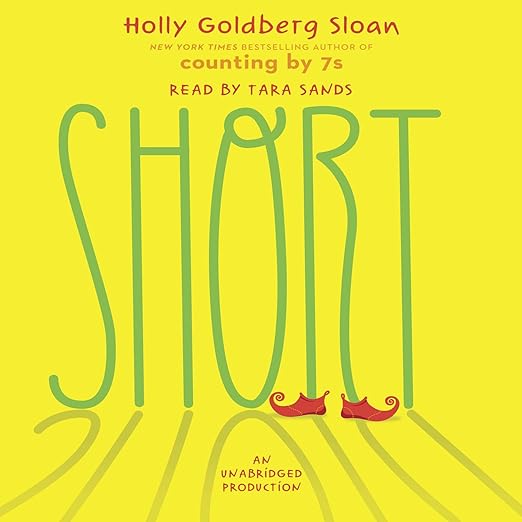
I first picked up Short on a Sunday afternoon when I was looking for something to accompany a long, aimless walk, the kind where you don’t have a destination and just want something to fill the quiet without demanding too much. By the time I got home I’d abandoned the walk entirely and was sitting on my front steps in the cold, not willing to go inside and interrupt it. Holly Goldberg Sloan has this quality across her books, Counting by 7s has it too, of making you feel like you’re overhearing something rather than being told a story.
Julia is small for her age, self-conscious about it in the particular way that children are self-conscious about things they can’t change, and the summer her mother signs her up for a university production of The Wizard of Oz turns out to be the one where she starts to understand herself differently. The setup is simple enough that it risks feeling predictable. It doesn’t, and the reason is that Sloan is less interested in Julia’s journey than in the people Julia encounters along it.
Olive and the Art of Taking Up Space
The character who gives this book its real gravity is Olive, one of the adult performers with dwarfism who joins the Munchkin cast. The relationship between Julia and Olive is the emotional engine of the whole thing, and Sloan is careful never to make Olive a device. She has opinions, habits, a specific way of speaking that Tara Sands renders with quiet authority. What Olive gives Julia isn’t advice exactly, it’s the example of someone who has already worked through the questions Julia is just starting to ask. That kind of intergenerational mentorship in children’s fiction often tips into sentimentality, but Sloan keeps it specific and a little rough around the edges in a way that makes it feel real.
The Wizard of Oz as a Structural Mirror
The choice of production matters. The Wizard of Oz is a story about wanting to be somewhere else, about feeling inadequate in the place you actually are, and about discovering that what you thought you lacked you were already carrying. Sloan doesn’t belabor this, she doesn’t need to. The parallels surface naturally through Julia’s growing engagement with the rehearsal process, her conversations with the director, her neighbor Mrs. Chang’s parallel story about art and perception. By the time the production opens, you’ve been watching Julia practice the play’s central lesson without realizing that’s what was happening.
How the Audiobook Earns Its Length
At just over six hours, Short sits comfortably in the range where it can be a full co-listening experience for a parent and child or a satisfying solo listen for a ten-to-twelve-year-old. Tara Sands, who also narrates the Allie Finkle series, does something different here. Julia is quieter, more internal, less prone to the comedic self-dramatization of Allie Finkle, and Sands adjusts accordingly. Her read has a contemplative quality that suits the material. The pacing is deliberate without feeling slow. Sloan writes some of her best sentences when describing the experience of watching live performance, and those passages gain something from being heard aloud, the rhythm of the prose is doing work that requires sound to fully deliver.
Who This Book Is For
Short speaks most directly to kids who have ever felt defined by something physical they didn’t choose, height, weight, a visible difference, anything that makes them feel conspicuous in a room full of people who don’t share it. It’s also for kids who are starting to figure out what it means to make art, and for the adults who read alongside them and want something that won’t condescend to either party. Readers who loved Counting by 7s will find the same authorial instinct at work here: Sloan writes about children who are more observant than the adults around them realize, and the books have the texture of being seen.
Frequently Asked Questions
Is Short connected to Counting by 7s, or is it a completely separate story?
Completely separate, different characters, different setting, different plot. They share Holly Goldberg Sloan’s voice and her interest in kids navigating difference, but no plot or character overlap.
How does Tara Sands handle the adult characters, particularly Olive?
Sands distinguishes Olive from the younger characters with a more measured, grounded vocal quality, she doesn’t do a character voice in the theatrical sense, but the differentiation is clear enough that you always know whose perspective you’re in.
Is this a good family listening choice, or is it better suited to solo listeners?
Both work well. Several reviewers mention reading or listening alongside children and finding it emotionally resonant for adults too. The themes of self-image and mentorship have cross-generational pull.
Does the book deal with the Munchkin cast’s dwarfism in a way that’s handled sensitively?
Yes, Sloan treats the adult Munchkin performers as full characters with agency and perspective, not as props for Julia’s growth. The portrayal avoids both sentimentality and othering, which is one of the book’s real strengths.