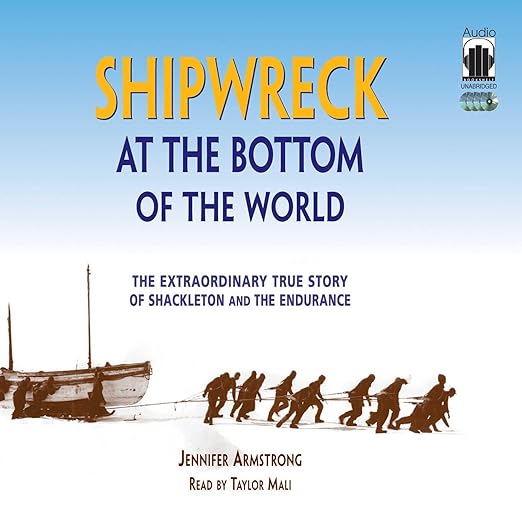
Quick Take
- Narration: Taylor Mali delivers the Shackleton story with the controlled urgency it demands, never overstating the heroics while making the physical danger viscerally present
- Themes: Survival against impossibility, leadership under pressure, the psychology of endurance
- Mood: Harrowing and propulsive, with the clean urgency of a survival documentary
- Verdict: One of the strongest pairings of narrator and material in children’s nonfiction audio, and a near-essential listen for anyone who hasn’t encountered the Endurance story before.
I first heard about Shackleton’s Endurance expedition in a college lecture on Antarctic exploration, delivered by a professor who kept saying the story was almost too extraordinary to be useful as history because it made everything else look timid by comparison. Jennifer Armstrong’s Shipwreck at the Bottom of the World was my reintroduction to that story, and I finished it on a treadmill, which is an absurdly comfortable context for a book about men surviving for a year and a half in one of the harshest environments on earth. The contrast was not lost on me.
The story Armstrong tells is documented history: Shackleton and 27 men set out from England in 1914 intending to make the first land crossing of Antarctica. The ship becomes icebound and eventually sinks 100 miles from land. What follows is one of the most sustained episodes of survival and leadership in the historical record. Shackleton’s famous declaration that if you’re a leader, other fellows look to you to keep going, quoted in the synopsis and given full weight in Mali’s delivery, functions as the book’s organizing principle rather than merely a quotable line.
Armstrong’s Storytelling and the Problem of Too Much Heroism
One of the challenges in writing about Shackleton is that the story is so relentlessly extreme that it risks becoming unbelievable, or worse, becoming a mere catalog of hardships that lose meaning through accumulation. Armstrong handles this by staying close to specific individuals and their specific experiences. The crew is not a monolithic group of heroes; there are men who struggle, men who give in to despair, men whose particular skills become crucial at unexpected moments. This granularity is what distinguishes the book from a summary account and gives the audiobook its emotional traction.
Armstrong’s Newbery Honor recognition reflects a prose style that takes young readers seriously. The sentences are constructed with care, and Mali’s reading makes that care audible. The book never condescends, which is why adult listeners, several reviewers noted the husband-and-wife-reading-along dynamic, find it fully satisfying rather than simplified.
Mali’s Narration and the Architecture of Tension
Taylor Mali brings something specific to this material: a quality of focused attention that suggests he is genuinely inside the story rather than executing a performance. The moments of high physical danger, the ice crushing the hull, the open-boat crossing to South Georgia, the final mountain traverse, are read with measured urgency. He doesn’t ramp up his delivery to signal that something important is happening. The writing does that work, and Mali trusts it. That restraint is exactly right for survival nonfiction, where melodrama would feel like a betrayal of the actual stakes.
At three hours and forty-six minutes, this is a more substantial listen than many children’s nonfiction audiobooks, but the pacing earns the runtime. Armstrong structures the book in chapters that correspond to phases of the expedition, and Mali keeps the listener oriented in time and geography without resorting to the kinds of editorial signposting that weaker audiobooks rely on. You always know roughly where you are in the story and why it matters.
The Shackleton Literature and Where This Sits
The Endurance story has been told many times for adult audiences, most comprehensively in Alfred Lansing’s Endurance, and more recently with additional photographic and filmic documentation. Armstrong’s version is not competing with those accounts on depth or scholarly detail. What it does instead is make the essential human drama fully accessible to a listener who might be nine or ten years old without stripping away the moral and physical complexity of what happened. That’s a harder balance to strike than it looks, and Armstrong strikes it.
The 1999 Orbis Pictus Award citation holds up. This is rigorous, humane nonfiction with a clear argument about leadership and endurance that doesn’t require any softening of the historical facts to make it appropriate for young listeners.
Who Should Listen, Who Should Skip
Shipwreck at the Bottom of the World is a near-universal recommendation for listeners aged nine and up, families seeking a shared car-ride listen with genuine dramatic stakes, and adults who have somehow missed the Shackleton story. It works as an introduction to Antarctic exploration, as a study of leadership under extreme conditions, and as a straightforwardly excellent audio experience. The absence of the book’s photographs is a limitation, but Mali’s narration compensates substantially. Skip only if you require adult-level scholarly analysis of the expedition; for everything else, this is the version to start with.
Frequently Asked Questions
Does this audiobook work for a child who has already read the adult version of the Endurance story, or will it feel simplified?
Armstrong’s writing is careful and substantive enough that most readers who know Lansing’s adult Endurance will find this a respectful retelling rather than a simplified one. It prioritizes specific crew experiences over comprehensive expedition documentation, which gives it a different emphasis rather than an inferior one.
Is the survival content too intense for younger listeners, given the deaths, extreme cold, and starvation involved?
Armstrong presents the hardship honestly, including the deaths, without graphic detail. The book is calibrated for ages 9 and up, and multiple reviewers noted sharing it with 8 and 9-year-olds. The tone is adventurous rather than harrowing for its own sake.
Does Taylor Mali’s narration include any audio production beyond his voice, such as sound effects or music?
The recording is voice-only, with no additional production elements. Mali’s performance carries the material without assistance.
How does this compare to other Shackleton-themed children’s audiobooks?
Armstrong’s is consistently cited as one of the most complete and well-written treatments for young audiences. The combination of Orbis Pictus Award recognition, strong critical standing, and Mali’s narration makes it a reliable benchmark against which other versions are measured.