At a Glance
- Read by: Sean Pratt delivers steady, professional pacing well suited to framework-dense business content, though his even-keeled read stays functional rather than emotionally immersive.
- At its heart: Burnout prevention, boundary-setting for driven professionals, sustainable ambition
- Vibe: Grounded and practical
- Short version: A genuinely useful reflection-based framework for entrepreneurs and high achievers ready to slow down enough to use it.
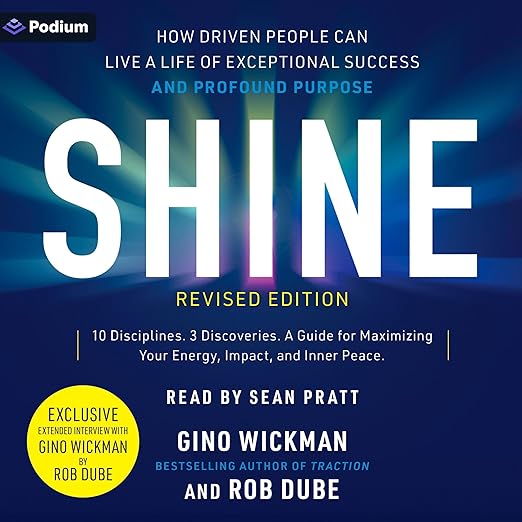
Burnout rarely announces itself to the person heading toward it, which is the real subject of Shine long before Gino Wickman gets to his ten disciplines. Wickman, whose earlier book Traction built a following among small-business founders, teams up here with mindfulness teacher Rob Dube, and the pairing does real work. Wickman supplies the operator's instinct for systems and measurable habits; Dube supplies the patience to notice when those systems start quietly damaging the person running them. Neither author treats ambition itself as the enemy. Instead, the audiobook zeroes in on the specific, relentless drive that keeps a founder productive while eroding their team, their relationships, and their health, and it argues, discipline by discipline, that the erosion is not inevitable.
A Tenth Discipline Built Around Flow
The ten disciplines themselves avoid the vague, aspirational language so much of this genre defaults to. Wickman and Dube get specific: set boundaries at work without quietly sabotaging your own output, learn to reset your energy before burnout forces the reset for you, and recognize the early warning signs of stress rather than discovering them the hard way. A self-assessment survey up front lets a listener locate exactly which discipline needs the most attention, and a resource guide plus reflection prompts at the end of every chapter turn the book into something closer to an ongoing practice than a single read-through. Reviewer Lauraforero singles out the boundary-setting material specifically, describing it as practical relief for anyone stuck in constant hustle mode rather than another round of vague encouragement.
Pilar's review calls the book a set of 'glimmers of hope' for anyone trying to hold high achievement and inner peace at the same time, and that phrase captures the book's real balancing act better than a straightforward summary would. Ivana S. makes a related point, noting how the authors blend business advice with mindful self-awareness rather than treating the two as separate tracks a listener has to reconcile alone. Most productivity guides treat rest as a tactic for better output; Shine treats output as one legitimate goal among several, alongside creativity, relationships, and physical health, and refuses to rank them in a strict hierarchy.
The tenth discipline circles back to something most productivity books skip entirely: tapping into a flow state to harness creativity rather than just manage time. Wickman and Dube frame flow not as a nice bonus but as the actual payoff for doing the other nine disciplines correctly; the reward for boundary-setting and energy management is supposed to be more creative clarity, not just fewer hours worked. That framing gives the book's back half a different, more inspiring register than its more procedural opening chapters.
Pratt Reads the Prompts, You Pause to Think
Sean Pratt narrates with the kind of steady professional reliability that framework-dense business content needs and rarely gets. He does not dramatize the material or editorialize on Wickman and Dube's advice, which keeps the listener in an analytical, note-taking frame of mind rather than a passively entertained one. That restraint suits a book built around ten distinct disciplines meant to be absorbed individually rather than as one continuous argument. Pratt's pacing gives each discipline room to land before moving to the next, which matters more here than it would in a book meant for one uninterrupted sitting.
The audiobook format works particularly well for the book's chapter-by-chapter reflection prompts, since hearing a prompt read aloud during a commute or a walk creates a natural pause for actually thinking about the answer, rather than skimming past a text box on a page. At eight hours and twenty-seven minutes, Shine is compact enough to revisit specific chapters rather than committing to a full relisten, which matters for a book explicitly designed as an ongoing resource. The revised edition framing signals updated content, though the recording itself does not spell out exactly what changed from the original.
A 4.8 rating across 119 ratings is a strong, consistent signal for a business title in a genre where reviews often skew polarized between true believers and skeptics of the founder-guru format. All three visible reviews land at five stars, and each highlights a different discipline, boundaries, energy, creativity, suggesting the book's ten-part structure genuinely gives different listeners different entry points rather than repeating the same idea nine times in new packaging.
Pratt's Steadiness Doubles as a Mild Limitation
The self-assessment survey and the resource guide mentioned in the description are the kind of material that loses something in audio-only form. A survey works best with a pen in hand, checking boxes and returning to compare results over time, and reflection prompts benefit from being written down rather than only considered in passing during a drive. Listeners who want the book's full practical value should plan to pair the audiobook with the print or digital edition for those specific sections, even if the core instructional content translates cleanly on its own.
Sean Pratt's steadiness is also, honestly, a mild limitation. His delivery is functional rather than memorable, which is the right choice for retention but means Shine will not be anyone's pick for an immersive, entertaining listen. Anyone expecting the theatrical energy of a motivational speaker rather than the measured tone of a workplace training session should recalibrate before starting. The tradeoff favors substance over performance, and for a book meant to be studied rather than merely enjoyed, that is arguably the correct one.
Pilar's review, titled 'Learning the Trade of Mindful Entrepreneurship,' is worth noting for how it reframes expectations: this is being read as a craft to practice, not a single insight to absorb once. Listeners expecting a quick, one-sitting motivational boost should recalibrate; Shine rewards the same slow, repeated engagement its own reflection prompts are built around.
Sustaining Ambition Instead of Lowering It
Founders, executives, and anyone whose job rewards constant availability will recognize themselves quickly in Shine's description of relentless drive curdling into exhaustion. Ivana S.'s review speaks directly to entrepreneurs tired of the grind but wary of self-help that asks them to simply work less, and that is exactly the audience Wickman and Dube are writing for: people with no intention of lowering their ambitions who want a framework for sustaining them instead.
The book also works well for listeners newly transitioning into leadership roles, where the temptation to prove worth through sheer hours worked is often strongest and least examined. Wickman and Dube write for people already succeeding by conventional measures, not those just starting out, which sharpens the book's usefulness for exactly that specific, often under-served audience.
Anyone hoping for a stripped-down list of quick productivity hacks rather than genuine reflection work should reconsider, since Wickman and Dube build the book explicitly around chapter-end prompts meant to be sat with rather than raced through. Listeners already deep into mindfulness practice may find some of the underlying ideas familiar, though the business-specific framing and the self-assessment structure still give the material a distinct, practical shape.
Before You Listen
Do I need to have read the original Shine before this revised edition audiobook?
No. The revised edition stands on its own with updated content, and Wickman and Dube do not assume familiarity with the earlier version.
Does the Shine audiobook work if I skip the self-assessment survey and reflection prompts?
You can listen straight through, but you lose real value. The survey and prompts are built for pen-and-paper use, so pairing the audiobook with the print or digital edition gets you more from the ten disciplines.