
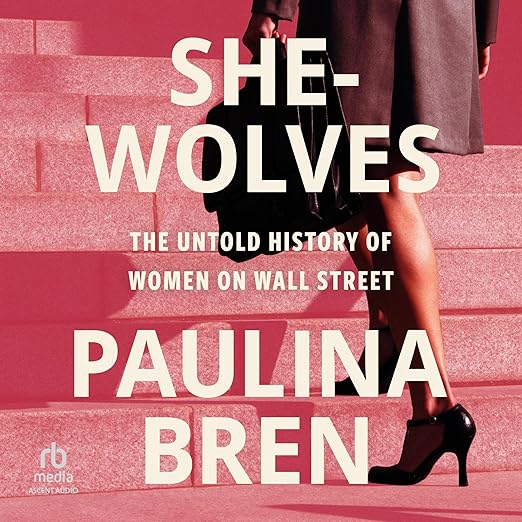
Wall Street's private clubs once hung signs barring women from the premises entirely, and Paulina Bren opens her history of the industry's first women right there, at the threshold those signs were built to protect. This audiobook traces three overlapping generations: the secretaries from Brooklyn and Queens who learned finance on the job despite having no formal path in, the first wave of Harvard Business School graduates who still routinely settled for less than they had earned, and the power-suited yuppies of the 1980s who finally forced open doors the earlier generations had only managed to crack. It is currently in development with Mark Gordon Pictures, a strong signal of how cinematic this material is, and listening to this audiobook, that is easy to believe.
An Interview Subject Reviews Her Own Portrayal
Rebecca Lam brings a cool, journalistic authority to the narration that suits archival nonfiction like this well, treating decades of interviews and historical research with the steady, unsentimental clarity the material deserves without ever draining it of emotional weight. Bren's book is built on real testimony from women who lived through the eras she is chronicling, and Lam handles the shifts between straight historical narration and quoted first-person accounts smoothly for most of the book, though the busiest multi-source passages, where several distinct voices from different decades appear close together, occasionally ask more of a listener's attention than a simpler single-thread narrative would. It is a strong, sustained performance overall, well matched to a book built from many overlapping voices rather than one continuous story.
What gives the book its credibility is that Bren did not just research this history from a distance; she interviewed the women who actually lived it. One of those interview subjects, reviewing the finished book herself, wrote that Bren captured the reality of the times as if she had truly been there, calling out the fun, the disappointments, and the injustices these women fought against in equal measure. A former Wall Street veteran offered similar praise, calling it an accurate description of the industry from the 1960s through the 1990s and the trials and tribulations of the women who worked there. That kind of firsthand endorsement is rare for a work of history and worth taking seriously.
The Smart Cookies Label, Complimentary and Diminishing
The three-generation structure is what makes this more than a single success story. Bren starts with the secretarial pool, women who absorbed enough of the trading floor's actual mechanics to eventually deserve real titles they were denied for years, moves through the first Harvard Business School graduates who discovered a diploma did not erase the industry's sexism, and ends with the visible power-suit generation of the 1980s who get remembered as the breakthrough despite standing on the earlier two generations' unpaid labor. That layered structure means the book functions as a genuine institutional history, not just a highlight reel of a few famous firsts, and it is the specific detail Bren builds each chapter around, real names, real firms, real dollar figures, that keeps it feeling concrete rather than abstract.
Bren does not soften the hostility these women faced either. Unapologetic sexism and racism were simply standard practice at the top firms during the period this book covers, and the result reads as an engaging and, at points, genuinely enraging listen, which matches how the attached reviews describe it. The specific texture of that hostility, from being barred at the door to being systematically underpaid once inside, gives the book real stakes beyond a general sense that things used to be harder for women in finance. It is institutional history with names attached, not a vague gesture at historical unfairness.
Even the book's own terminology carries real historical weight. The secretaries who first broke into finance work were nicknamed 'smart cookies' by the men around them, a label that manages to be complimentary and diminishing in the same breath, acknowledging real intelligence while still filing it under something closer to a party trick than a professional qualification. Bren returns to that kind of double-edged, era-specific language throughout the book, and Lam's narration handles the tonal shift between quoting it neutrally, as the historical record, and letting its condescension register for a modern listener, without needing to editorialize on top of it.
Lam's Multi-Voice Passages Reward a Rewind
At just over ten hours, the book covers a lot of ground, and at least one reader with three decades of finance experience found it a great history that runs a little long in the story, suggesting the middle stretch could have moved faster without losing anything essential. That is a fair caveat for a book spanning multiple generations and interview subjects; readers wanting a tighter, more streamlined narrative may notice some sections pulling in more supporting detail than the central argument strictly requires. It did not stop that same reviewer from finding real value in the coverage overall, but it is worth going in expecting a fuller, more discursive history rather than a tightly plotted single narrative.
The narration's one real limitation shows up in the same busy, multi-voice passages that make the book so rich in the first place. When Lam moves quickly between several different interview subjects' testimony within a single chapter, distinguishing whose specific experience is being described in the moment takes a bit more concentration than the book's clearer, single-narrative stretches. This is a minor friction rather than a real flaw, and it never derails the listening experience, but anyone listening during a distracted commute rather than dedicated focus time may want to occasionally rewind through the densest interview-heavy sections to keep the various women's individual stories straight.
What a Screen Adaptation Won't Preserve Intact
Anyone interested in business history, women's history, or finance specifically will find a genuinely rich account here, and the appeal extends well past readers who already follow Wall Street closely. Listeners who enjoyed other deeply reported institutional histories built from firsthand interviews, the kind that combine real archival rigor with a strong narrative throughline, are exactly the audience Bren is writing for. Given the book is already in development as a screen adaptation, listeners who like getting to a true story before it becomes a film or series have good reason to start here first, while the full texture of Bren's original reporting is still the primary version available.
The middle stretch, according to more than one reader, runs longer than the story strictly needs, so anyone wanting a tight, fast-moving narrative rather than a fuller institutional history should go in with that expectation set correctly. Readers looking for a book focused on current finance-industry gender dynamics rather than this specific multi-decade origin story, from the 1960s secretarial pool through the 1980s power generation, will want a more contemporary title instead. And readers who would rather wait for the in-development screen adaptation than engage with the full written history now should know that the book's real texture, specific names, firms, and dollar figures drawn from firsthand interviews, is exactly the kind of detail a dramatized version is least likely to preserve intact.
Before You Press Play
- Performance: Rebecca Lam brings cool journalistic authority to archival nonfiction, occasionally tested by the busiest multi-source passages.
- What it covers: Women in finance, institutional sexism, three generations of Wall Street history
- Feel: Engaging and, at points, genuinely enraging
- Our call: A richly reported institutional history that runs a bit long but earns its scope.
Frequently Asked Questions
Does this audiobook cover current gender dynamics on Wall Street, or mainly history?
Mainly history. It traces three generations of women in finance from the 1960s secretarial pool through the 1980s power-suit era, rather than focusing on the industry today.
Is Rebecca Lam's narration well suited to a book built from real interviews?
Largely yes. She handles the shift between historical narration and quoted testimony smoothly, though the busiest multi-source passages ask a bit more concentration than the book's clearer stretches.
Was this audiobook's author actually connected to the women she is writing about?
Yes. Paulina Bren interviewed women who lived through this history directly, and at least one of them has confirmed in a review that the account matches her own experience.
Is the She-Wolves audiobook considered too long by listeners?
At least one experienced finance-industry reviewer felt the middle stretch ran a little long, though the same reviewer still rated the overall history highly.







