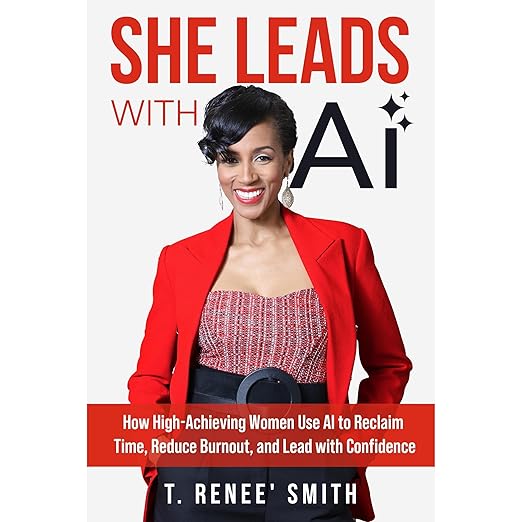
Can a book about handing work to machines be delivered by one? The narrator credit on this audiobook reads Virtual Voice, which means the eight hours and seven minutes on offer were generated rather than performed in a booth. T. Renee' Smith has written a leadership guide arguing that artificial intelligence should give women their time back instead of taking their work away, and the production decision behind this edition puts that argument in an unusually literal position before a single chapter starts.
Calling It Divine Delegation Instead of Disruption
Smith's pitch is narrower and more useful than the title suggests. This is not a coding manual and it makes no attempt to explain how the underlying models work. It is a book about delegation, aimed at women who are already running a team or a department or a household and who keep being told to figure the new tools out somewhere between strategy calls, carpool lines and text messages. The framing is spiritual as often as it is operational, and Smith calls the shift divine delegation rather than disruption.
What that looks like in practice is a set of promises the description lays out plainly: use the tools to amplify a leadership voice rather than replace it, build systems that free up a schedule, release what Smith names as Superwoman syndrome, and train a model to think and sound like you. That last item struck me as the most interesting of them, partly because it is the only one that asks for real technical patience, and partly because it is the piece most likely to age badly as the tools change underneath it.
Smith is described on the listing as a leadership strategist and the chief executive of iSuccess Consulting, and the copy says the method came out of rebuilding a life and a business after a crisis. Whether that biography earns the book its authority depends on how much lived experience you want inside a technology guide. The most substantial of the three written notices, filed by Integrated Resolutions, LLLC, calls it an "excellent read for those that are novices" in artificial intelligence, which is a fair reading of the altitude Smith works at.
Read by a Machine, About Training One
Format is the first thing to settle here, and it settles in an odd and interesting way. A book instructing you to train a machine to sound like you arrives read by a machine, and rather than undercutting the thesis I think the choice demonstrates it. Synthesized narration is precisely the kind of delegation Smith is selling, applied to her own manuscript, which lets a buyer judge the trade directly instead of accepting it as an abstraction.
Eight hours is generous for a book with no software instruction in it, and the length goes into breadth rather than repetition. The description promises coverage of leadership, career, family, spiritual life and schedule, which is a wider brief than most business titles attempt, and it accounts for a running time closer to a full work of nonfiction than to the productivity pamphlet the subject usually produces.
For a listener who wants permission as much as instruction, the tone does genuine work. Smith writes to someone already competent and already depleted, and the recurring move is to reframe a fresh demand as an offloading opportunity rather than one more thing to learn. That reframing is the actual product being sold. Anyone hoping for prompt libraries or a comparison of platforms will find the book operating a level above the software, on purpose.
Nine Anonymous Clicks Aren't Really a Verdict
Evidence is thin on this page, and the thinness has a particular shape worth understanding before you decide. Nine ratings sit behind the 4.6 average, but only three people left anything written at all, and those three are not describing the same object. Two of them run to a single line. Treating that average as a consensus would mean treating nine anonymous clicks as a verdict.
One of the three, posted by Sylvia, awards four stars under a heading about on-time delivery, then reports that "the book itself is good, but it was delivered with a torn cover." That is a note about a printed shipment rather than a recording, and it carries a date roughly six weeks before the listing's own release. A second, from Rita, runs to two words. What remains as usable commentary on this edition is very close to nothing.
Promotional debris fills out the rest of the page. The copy closes with two website addresses and a social handle, which is marketing material carried straight onto a product listing, and it refers more than once to what waits inside these pages, a phrase belonging to a printed edition rather than to a recording. None of that touches the quality of Smith's argument, and none of it is unusual for an independently published title. It does mean the sales copy in front of you was written for a different format and never adapted for this one, so read it as an advertisement for the idea rather than a description of the product.
A Synthesized Read Is a Different Proposition
Women running a team, a client list or a household who feel behind on artificial intelligence and want an entry point that does not open with jargon will get the most out of this. The book assumes competence in every area except the technology, which is a rarer and more respectful assumption than the genre usually makes, and it never pauses to flatter the listener for showing up.
Equally well served is the buyer who wants the values conversation attached to the tools rather than bolted on at the end. Smith spends real time on boundaries, on what should stay human, and on the cost of treating speed as a virtue in itself, and none of that reads as decoration around a productivity system. If that is the argument you have been having with yourself since the tools arrived, the book will feel like company rather than coursework, which is a different and probably more durable kind of usefulness.
For anyone who wants benchmarks, model comparisons or a technical grounding, this is the wrong purchase and no amount of encouragement will substitute. The generated narration is the second thing to weigh, and weighing it means sampling it, because a synthesized read is a different proposition from a performed one and the description makes no claim about how this one turned out. Buy it for the framing and the permission, not for the delivery.
In Brief
- What it covers: AI as delegation rather than threat, leadership without self-erasure, systems for women carrying several roles at once
- Feel: Encouraging and pragmatic, pitched squarely at the already-overloaded
- Our call: A values-first entry point for women leaders wary of AI, sold on a page with almost no listener evidence behind its score.
Common Questions
Who narrates the She Leads With AI audiobook?
Virtual Voice sits in the narrator slot, meaning a synthesized reading rather than a person in a studio. No director, engineer or human reader is credited anywhere on the page, so treat the delivery as a format decision to sample before buying rather than a performance you can judge from the description.
What fills the running time in an audiobook with no technical instruction?
Range rather than depth on any one tool. The same delegation argument gets applied in turn to work, home, faith and the calendar, so eight hours and seven minutes buys breadth of application rather than technical detail, and the length reflects how many arenas Smith walks through.