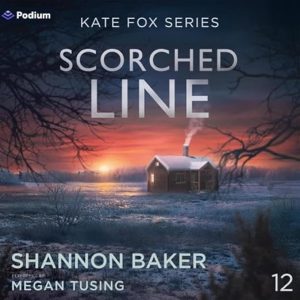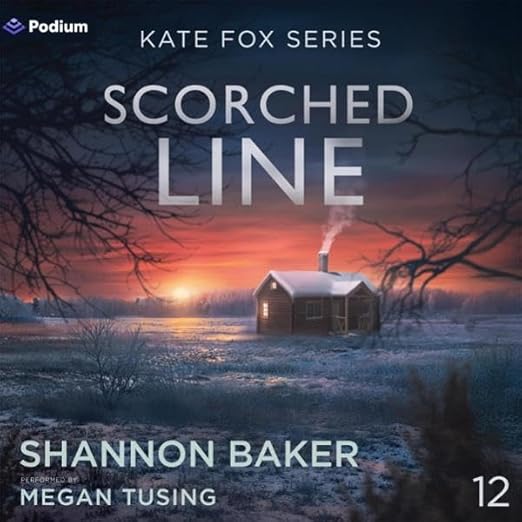
Does a twelfth book still owe anything to a first-time listener? Scorched Line sits deep enough into the Kate Fox series that the question is worth settling before you spend eight hours on this audiobook, and the answer here is a qualified no. Everything that matters is family history: the mother who walked out and broke the family is back after three years gone, somebody is trying to kill her, and Kate has to work out whether protecting her people means protecting the one person she has never forgiven.
Marguerite Fox is the whole engine of this one. She vanished without a word three years ago, she has returned to the Sandhills, a shot is fired, and a chase runs out across open country. Kate's siblings are on edge. Threats tighten. Trust inside the family thins to almost nothing, which is the real subject, because the danger to Marguerite is only interesting insofar as it forces everyone around her to decide what she is still owed.
What makes the setup work is that the mystery is moral rather than procedural. The copy is explicit that Marguerite carries secrets buried deeper than prairie roots and that she is not finished making deals, so the suspense runs on whether the woman being protected deserves protection at all. Shannon Baker has built the plot so that solving it and forgiving her are the same act, and refusing one means refusing the other. Crime fiction rarely aligns those two questions so tightly.
Landscape, History, and Reader Megan Tusing
Landscape does serious work throughout. The Sandhills give this series its particular flavor, distance and exposure and very few places to hide, and a chase across open country is a fundamentally different scene from a chase through streets: you can see the person coming for a long time and that helps nobody. Baker uses the emptiness as pressure rather than as scenery. Prairie roots are not a decorative image in the copy either, since the whole plot concerns what has been buried and how deep.
Series accumulation is the second pleasure and the harder one to bottle. Twelve books of history mean the fractures inside this family were laid down over years of story rather than assembled in a prologue, so when the siblings disagree about their mother the disagreement carries weight a standalone cannot manufacture. Long-running crime series are usually judged on whether the personal arc still moves, and bringing back the parent who caused the original damage is about as direct an answer as an author can give.
Runtime and credits deserve a quick look before buying. Eight hours and twenty-one minutes is compact for a crime novel, which suggests a lean plot rather than a sprawling one, and Podium Audio released the recording at the end of March 2026. The reader credited is Megan Tusing. What the page does not tell you, and what regular listeners to a long series always want to know, is whether the same voice carried the earlier books, so anyone who has eleven previous recordings in their library should compare a sample before assuming continuity.
No Ratings, No Recap, No Reliable Tone
An empty column is the first thing you notice. The record shows no rating and no written responses at all, months after release, which for the twelfth entry in an established series is genuinely odd and leaves you with nothing to weigh but the publisher's description. No sense of how the reading lands, no consensus on whether this installment satisfies, no warning about anything. Buyers who rely on a column of graded opinions before committing will find nothing to work with here.
Entry point is the second. The listing marks the series position and stops there, offering no reading order, no recap and no note about which earlier books set up this one. The plot summary assumes you know what Marguerite did, why the siblings react as they do, and what Kate's role in this community is, none of which the description explains. Newcomers can follow the events. The emotional payoffs, which are the point, will pass them by.
Tonal risk is the third. Bringing the estranged parent home is a move that can deepen a long series or tip it toward melodrama, and the description leans hard on the melodramatic register, all short fragments and stakes announced rather than shown. That style belongs to the marketing rather than to Baker's prose, on the evidence of the series reaching a twelfth volume. It still means the copy tells you very little about how the book actually reads.
Choosing Obligation Over Forensics in Rural Crime
Coming to Kate Fox at book twelve is not the plan, but returning to her here is an easy recommendation: this is the installment that turns back on the family wound the copy places at the root of everything. It suits listeners who prefer rural crime to urban procedural, who like their mysteries built on obligation rather than forensics, and who want a compact eight-hour novel that does not pad its middle with false leads.
Pass on it if you need a self-contained mystery, since almost every stake depends on history you do not have, and pass on it too if you want a puzzle with clues you can assemble yourself, because the tension is about choosing rather than deducing. Anyone who requires listener consensus before buying should wait for the column to fill. The premise is strong. The page selling it currently offers nothing beyond the publisher's own promises.
In Brief
- Read by: Megan Tusing reads a compact eight-hour crime novel built almost entirely on family argument, which puts the weight on dialogue.
- At its heart: estranged mother returning, family loyalty against justice, buried secrets, rural crime in the Sandhills, sibling fracture.
- Vibe: Exposed, tense and personal.
- Short version: A payoff installment for readers already invested in Kate Fox, and the wrong door into a series that is eleven books deep.
Common Questions
How long is the Scorched Line audiobook and where does it sit in the Kate Fox series?
Podium Audio released it on March 31, 2026, running eight hours and twenty-one minutes, read by Megan Tusing. The record marks it as the twelfth Kate Fox book, with no indication anywhere of how many entries the series will eventually run to.
Can I start the series with this audiobook?
You can follow the plot, but not much else. The copy takes for granted that you know the history behind Marguerite Fox's disappearance and where Kate stands in this community, and neither is explained on the page. Newcomers get the events without the weight behind them.
What happened three years before the story opens?
The copy says only that Marguerite Fox vanished without a word and that her departure shattered Kate's family. No further detail is given about the circumstances, the betrayal or the aftermath, so the specifics belong to earlier books rather than to anything a buyer can learn from this listing.
Where is the story set?
The Sandhills, described as open country where a chase can run for miles without cover. Beyond that the description offers no town, county or state, and the record carries a single Crime Fiction tag under mystery and suspense with nothing marking it as rural or regional crime.