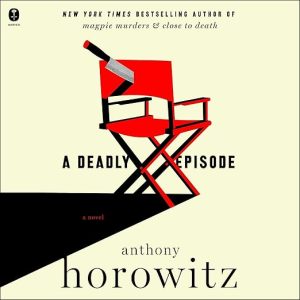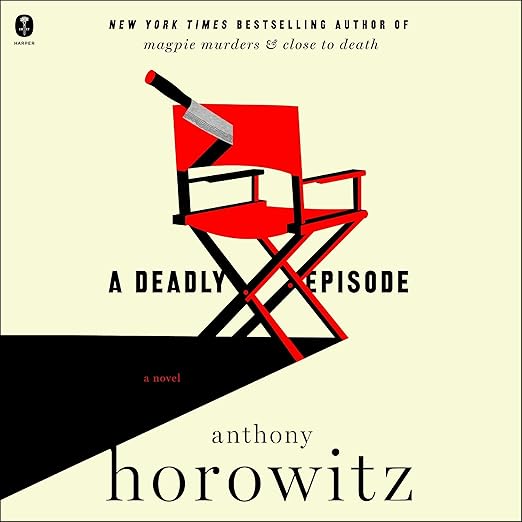
Can a detective become the intended victim of his own fictional adaptation? That is the kind of layered premise that Anthony Horowitz has been building toward across the Hawthorne and Horowitz series, and the sixth entry, A Deadly Episode, leans into the metafictional architecture more boldly than any previous installment. A film production of the first Hawthorne novel is underway on the south coast of England. The actor playing Hawthorne has been murdered. And the question hanging over everything is whether the killer wanted the actor, or whether he wanted the real detective whose methods he was performing. This audiobook version, narrated by Rory Kinnear, is a precisely constructed puzzle that also happens to be one of the most self-aware entries in modern British crime fiction.
Horowitz has spent this series playing a particular game: he appears in his own books as Hawthorne's bumbling sidekick, the writer who can't quite keep up with the detective's leaps. The self-deprecating humor in those passages is consistent and well-observed, but A Deadly Episode complicates it by creating a situation where Horowitz the character is genuinely operating without Hawthorne. The detective is pursuing the main line of inquiry through Yorkshire, to the village where he grew up, to a burned-down school and a car accident that isn't what it seems. Horowitz, meanwhile, is stumbling toward the same truth from a completely different angle. That split structure keeps the audiobook from settling into formula, which is a real achievement for book six of an ongoing series.
Kinnear Splits Horowitz and Hawthorne's Voices
Rory Kinnear is one of the strongest narrative voices working in British crime fiction audio, and his familiarity with the Hawthorne and Horowitz dynamic gives this production a textured quality that a new narrator would have difficulty replicating. He reads the 'Horowitz' sections with a self-mocking lilt that feels genuine rather than affected, and his Hawthorne is all clipped precision and barely concealed impatience. The contrast between the two modes of narration does more structural work here than in earlier volumes, partly because the two characters are literally separated for much of the audiobook.
The plot moves from a film set to a Yorkshire village and eventually to an Elizabethan country house, and Horowitz manages each location with a different register. The film set chapters have a comedy of manners quality: the fired PA, the estranged director, the screenwriter complications all provide a dense field of suspects with plausibly real motives. The Yorkshire chapters are darker and more personal. The burned-down school and the history of a local injustice ten years old give Hawthorne a dimensionality that the series has been accumulating slowly. What happened in that school is never entirely what it first appears, and the audiobook rewards close listening during those passages.
Restraint Keeps the Puzzle Genuinely Fair
The metafictional angle is handled with more restraint than the premise might suggest. Horowitz does not push the self-referential elements so far that they undermine the genuine mystery. The puzzle is fair and intricate, the red herrings are well-placed, and the solution, when it comes, connects the film set and the Yorkshire backstory in a way that feels earned rather than contrived. One of the pleasures of the Hawthorne series has always been that Horowitz constructs his plots with genuine rigor, and this entry maintains that standard despite having more narrative moving parts than most previous volumes.
Kinnear's narration handles the Yorkshire sections with particular skill. The village of Reeth and the surrounding landscape are evoked with restraint, but the social texture of the community, the long memories, the way old grievances shape present events, comes through clearly in his reading of the dialogue scenes. The character of DS Sarah Milnes, the helpful local detective with a possible romantic tension with Hawthorne, is a welcome addition to the supporting cast, and Kinnear gives her a distinctive voice that makes her memorable across what is a crowded ensemble.
Early Clues Pay Off in Hawthorne's Backstory
Pay close attention to the early chapters on the film set, specifically the details of David Caine's professional relationships. Horowitz plants his clues with the discipline of the classic British detective novel, which means the information that ultimately resolves the mystery is present from the beginning, embedded in the social dynamics of the cast and crew. Listeners who revisit the opening hours after finishing the audiobook will find that the evidence was available throughout. That structural tidiness is one of the series' signatures, and it is on full display here.
The blackmail strand and the Elizabethan country house sequence in the later portion of the audiobook bring together elements that initially seem disconnected. Those passages move quickly, and Kinnear's pacing accelerates to match the convergence. Listeners who have been following the series from the beginning will also notice that A Deadly Episode gives more backstory to Hawthorne than any previous installment, making it arguably the most important volume in the series for understanding the detective rather than just watching him work.
Prior Series Investment Pays Off Here
This audiobook is best suited for listeners who have worked through at least some of the earlier Hawthorne and Horowitz entries. The metafictional premise requires familiarity with the series' conceit, and the emotional payoff of the Hawthorne backstory revelations lands harder with prior investment. Listeners new to Horowitz's crime fiction would be better served starting with The Word is Murder. For existing fans, this is one of the more ambitious and satisfying entries in the series, with Kinnear's narration and a genuinely complex plot structure making it a strong candidate for the best audiobook in the run so far.
Questions Listeners Ask
Do I need to have listened to the earlier Hawthorne and Horowitz audiobooks first?
The series rewards reading in order, and the backstory revelations in this sixth entry will carry more weight if you know the characters. The mystery itself is self-contained enough to follow without prior knowledge, but the metafictional premise, where a film is being made of the first Hawthorne novel, makes much more sense with that context in place.
Does the audiobook work as a standalone listen for fans of classic British whodunits?
The puzzle construction and fair-play cluing make it work for classic detective fiction fans, and Horowitz's debt to Agatha Christie is visible in how carefully the evidence is distributed across the narrative. Without prior series knowledge the Horowitz sidekick self-deprecation loses some of its comic texture, but the mystery itself holds up independently.