Quick Take
- Narration: Emma Walton Hamilton captures the book’s arch, slightly gothic humor and handles four distinct child protagonists with real differentiation; her performance is one of the clearest arguments for listening over reading.
- Themes: Phobia and the logic of fear, unlikely community among outsiders, eccentric mentorship
- Mood: Delightfully absurd with a genuine emotional core underneath the comedy
- Verdict: A smart, funny middle-grade audiobook that delivers on its odd premise, Emma Walton Hamilton’s narration is a particular asset for families listening together.
I was about ten minutes into School of Fear before I started laughing. That is not always the case with children’s audiobooks, which can err on the side of relentless cheer or dramatic earnestness, but Gitty Daneshvari is doing something slightly different here. Her humor is dry, her descriptions are arch, and the world of Mrs. Wellington’s School of Fear is precisely as peculiar as it needs to be without tipping into chaos. I listened on a Saturday afternoon, and I found myself wishing I had a ten-year-old in the car to share it with.
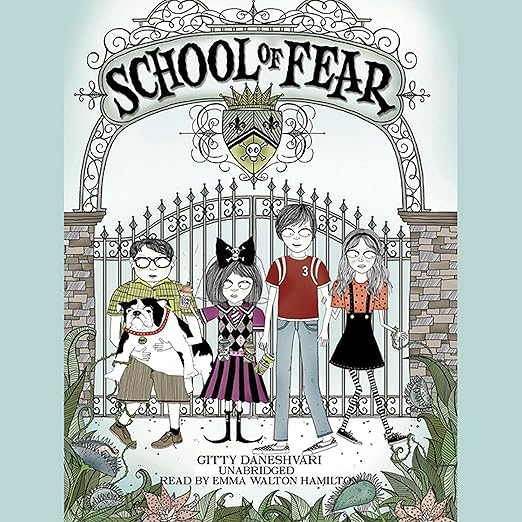
The setup is simple: four twelve-year-olds, each with a specific debilitating phobia, are sent to a school that promises to cure them. Madeleine is terrified of insects. Theodore is preoccupied with dying. Lulu cannot tolerate confined spaces. Garrison is afraid of deep water. The school itself, and its operator Mrs. Wellington, turn out to be more alarming than any of the phobias the students arrived with. This is, of course, the joke. But Daneshvari uses the joke to do something interesting with what fear actually is and what it feels like to be defined by something you cannot control.
Our Take on School of Fear
The four protagonists are well-differentiated in both personality and fear. Daneshvari does not treat the phobias as interchangeable quirks, each one has its own logic, its own social cost, and its own relationship to the character’s broader self-image. Theodore’s fear of death is played with a darkly comic specificity that is both funnier and more poignant than it sounds in synopsis. Madeleine’s spider phobia generates the book’s most visually inventive set pieces. The group dynamic that emerges from four kids who have nothing in common except being sent away by exhausted parents has a genuine warmth that grows more convincing as the story progresses.
Emma Walton Hamilton is exceptionally well-cast as narrator. She understands that the book’s humor is deadpan rather than broad, and she delivers Daneshvari’s driest lines with the timing they require. Her four distinct voices for the child characters are consistent enough that listeners rarely lose track of who is speaking in group scenes, which is a real technical achievement in a book with this much ensemble dialogue.
Why Listen to School of Fear
Middle-grade audiobooks benefit enormously from narrators who understand comedy, and School of Fear is a comedy before it is anything else. Hamilton’s background as a stage actress gives her the technical control to land jokes at the right moment, and she also handles the book’s occasional sentimental turns without sentimentalizing them. One reviewer called the book great for reluctant readers, children who find sitting with a printed page difficult but can stay engaged with a well-performed audio experience, and Hamilton’s performance is a significant part of why that recommendation holds.
The book is also a good family listen. Parents who listened alongside their children in reviews consistently reported enjoying it themselves, which is a meaningful test of whether a middle-grade title has genuine cross-age appeal. The humor operates on multiple registers simultaneously, which is the mark of a writer who knows how to write for children without condescending to them.
What to Watch For in School of Fear
One reviewer with professional literacy experience noted a potential gap between the book’s vocabulary complexity and its apparent target age. The prose is sophisticated, drawing on what she described as distinctly British grammatical structure and word choice, which could challenge readers younger than ten or eleven. As an audiobook this matters less than in print, Hamilton’s narration makes the vocabulary accessible through context and delivery, but parents of younger listeners should be aware that some of the more elaborate descriptive passages move faster than a seven-year-old can comfortably follow.
The book is also definitively book one of a series. It introduces Mrs. Wellington’s school and the four protagonists without entirely resolving the larger question of whether the school actually works. Listeners who need closure in a single sitting may find the ending functional but open-ended. Those happy to continue into a series will find the door left wide open in an inviting way.
Who Should Listen to School of Fear
Children between roughly nine and thirteen who enjoy humorous fiction with a slightly gothic edge, fans of Lemony Snicket’s A Series of Unfortunate Events will find the same DNA here, will likely want to finish the series in short order. Families doing shared listening during car trips will find the dry ensemble comedy rewarding for multiple age groups simultaneously.
Very young listeners who expect straightforward adventure plots without much irony may find the humor goes over their heads. This is also squarely a series opener, so listeners who prefer self-contained stories should know more adventures with the same cast are waiting in subsequent books.
Frequently Asked Questions
How does Emma Walton Hamilton handle the four main characters, does she differentiate them enough to follow in audio?
Yes. Hamilton gives each of the four child protagonists a distinct vocal quality, making group scenes followable without visual attribution cues. Reviewers who listened with children reported no confusion about who was speaking, which is a meaningful test for a book with four similarly-aged ensemble leads.
Is School of Fear appropriate for a child who is genuinely dealing with anxiety or a specific phobia?
The book handles phobias with humor rather than therapeutic framework, and Mrs. Wellington’s methods are played as absurdist comedy rather than actual treatment. Children who are sensitive about their own fears might find the comedic treatment validating, fear is shown as real and understandable, or they might find it uncomfortable depending on the specific phobia. Parents should preview the relevant sections for their child’s specific concerns.
Does this audiobook work as a standalone, or does it end on a cliffhanger that requires the next book?
The book resolves its main plot arc but leaves questions about Mrs. Wellington’s school and the characters’ futures deliberately open for continuation. It is not a cliffhanger in the dramatic sense, but listeners who want full closure will want to continue into the series. The ending is satisfying enough to stand alone if the series is not continued.
What is the recommended age range for School of Fear as an audiobook?
Reviewers suggest 9 to 12 as the primary audience, with some noting that the sophisticated vocabulary and humor work better from around 10 upward. One educator described it as suitable for ages 8 to 12 with adult read-aloud support on the lower end. Emma Walton Hamilton’s narration makes the complex vocabulary more accessible than reading in print would be for younger listeners.