Key Details
- Read by: A full cast production from Recorded Books brings the Redwall world to vivid life, with differentiated voices that make the ensemble cast of animals genuinely distinct.
- At its heart: The defense of home against overwhelming force, the discovery of a destined hero, loyalty and sacrifice across species lines
- Vibe: Rousing and mythic, with passages of genuine sadness
- Short version: The full cast format makes this the definitive way to experience Salamandastron, and the fifth Redwall book delivers the mountain's full history in a production that justifies every one of its nearly 12 hours.
I grew up with Brian Jacques. My school library had a battered copy of Redwall that had been read by enough children that the spine had given up entirely, and I remember the first time I encountered Cluny the Scourge with something close to the feeling you only get a few times in a reading life: the recognition that a book is going to be different from everything that came before it. I came back to Salamandastron, the fifth in the series, as an adult listener who knew the world well and was curious what a full cast audio production would do with it. The answer is considerable. There is a version of the Redwall series that exists in the imagination of everyone who has read it, and this production makes that imagined version audible rather than approximated.
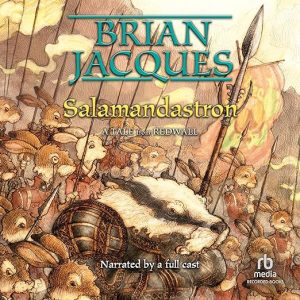
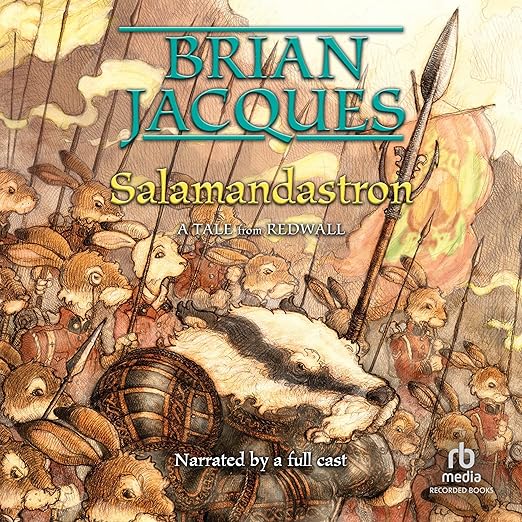
Salamandastron is not the most celebrated entry in the Redwall series, but it is the one where Jacques most fully realizes the mythology of the mountain itself. The fortress of Salamandastron, ruled by Badger Lords, defended by the Long Patrol of hares, is Redwall's war-making arm, and this book puts it under siege. Ferhago the Assassin and his band of vicious weasels are the antagonists, and Lord Urthstripe the Strong is the Badger Lord holding the mountain. The siege plot runs parallel to the story of young Samkin, who begins an adventure elsewhere in Mossflower that will eventually converge with the battle at Salamandastron. The structural parallel is quintessential Jacques: multiple storylines pursuing separate threads that will eventually braid together, each advancing its own momentum while the other develops in parallel.
First, the Big Picture
Jacques wrote dialogue that was designed to be heard. His villains drawl and bluster. His heroes are earnest and occasionally pompous in the particular way that hares in the Long Patrol are pompous, with a specific dialect involving military understatement and enthusiastic appetite. A single narrator reading all of this makes the world; a full cast inhabits it. The Recorded Books production differentiates the ensemble without caricature. The weasels and ferrets of Ferhago's Corpsemakers sound menacing rather than comic. The hares sound precisely like hares rather than generic soldiers. This is harder than it sounds. Jacques's animal characterization is very specific in register, and a production that played for generic animal voices would miss what the series actually is. The 4.8 rating across over 850 reviews reflects a fanbase that has been returning to this production for years and keeps finding it worth returning to.
The Best Parts of Salamandastron
When a lightning bolt uncovers the sword of Martin the Warrior midway through the novel, long-term Redwall readers feel the thrill of a recurring mythology being activated. Martin appears in the first book and becomes a recurring figure of inspiration across the series, appearing in visions and dreams to characters who need guidance. His sword functions as both a practical weapon and a mythological object, carrying the weight of the entire series' moral framework in a physical form. Newcomers to the series can follow what the sword's discovery means for Samkin's quest, but readers who have been with the series from the beginning will feel the weight of the symbol differently. This is one of the ways Jacques rewards loyalty without punishing new readers, and the full cast production handles the mythological register of these moments with appropriate gravity rather than treating them as plot mechanics.
A Few Reservations
Reviewer Amy Koliba, who has read this book five or more times and still cries, is describing something real about how Jacques writes. The emotional stakes in Salamandastron are not generic. Characters die. Friendships are maintained across long separations and reunited at cost. The battle at the mountain produces losses that are not reversed by plot convenience. Reviewer James Reynolds, who called this series the best read he had found in fifteen or twenty years and noted it is not only a children's book, was correct on both counts. Jacques wrote for children in the sense that he wrote about clear moral stakes and physical bravery. He wrote for everyone in the sense that he did not patronize his audience by protecting them from consequence. The full cast format makes those consequences audible in a way that a single narrator cannot quite achieve, because hearing a specific voice go silent carries weight that reading a death on the page does not always deliver.
Should You Listen to Salamandastron?
This is the right choice for Redwall series readers who have not yet heard a full cast production, for parents who want to share the series with children old enough to follow the siege narrative, and for adult fantasy readers who want something that delivers genuine emotion and adventure without the cynicism that contemporary adult fantasy often traffics in. Salamandastron is book five, and while it can be followed without the prior books, the mythology of Martin's sword and the relationship between Redwall Abbey and Salamandastron will mean more if you have the earlier context. This free audiobook is among the most accomplished productions in the Redwall catalog. Come to it if you want to hear what Brian Jacques actually sounded like in his imagination, brought to life by a cast that clearly understood what the books were asking for.
Questions Listeners Ask
Can Salamandastron be listened to without having read the earlier Redwall books?
Yes, with some caveats. The siege plot is self-contained and fully comprehensible without prior knowledge. However, the mythology around Martin the Warrior's sword and the relationship between Redwall Abbey and Salamandastron carry more weight if you have read at least the first book.
Is the full cast format significantly better for Salamandastron than a single-narrator version would be?
Based on the reviews and the nature of Jacques's dialogue, the full cast format suits this material particularly well. The differentiated voices make the ensemble of animal characters distinct in ways that single narrators have to work considerably harder to achieve.