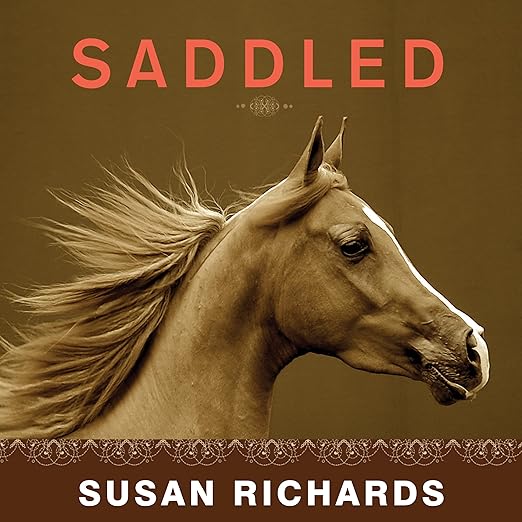
Quick Take
- Narration: Karen White brings a quiet steadiness to Susan Richards’ prose that suits the memoir’s rhythm perfectly. Her pacing mirrors the unhurried tempo of a morning ride, which is exactly the point.
- Themes: Alcoholism and recovery, the healing power of animals, children of alcoholics and inherited patterns
- Mood: Honest and quietly luminous, with moments of genuine darkness
- Verdict: A recovery memoir that earns its optimism through unflinching honesty rather than uplift-by-formula. Richards’ bond with Georgia the Morgan horse is both the vehicle and the destination.
I first came across Susan Richards’ name in a bookshop conversation about equine-assisted therapy, where someone mentioned Chosen by a Horse as a quiet masterpiece of the subgenre, and I tucked the name away. When I finally sat down with Saddled on a Saturday morning with a long walk ahead of me, I understood immediately what the fuss was about. Richards has a gift for the kind of honesty that does not perform itself, the confession that arrives without fanfare and lands all the harder for it.
This is the prequel memoir to Chosen by a Horse and Chosen Forever, though it stands on its own. The central revelation arrives with almost clinical plainness in the opening pages: at thirty-one, after nine years of waking up hungover, Richards writes in her journal that she is an alcoholic. What changed? A Morgan horse named Georgia.
What Georgia Demands That Kindness Cannot Provide
The equine-recovery memoir risks sentimentality at every turn, the idea that an animal’s love is sufficient to heal what human relationships could not. Richards avoids this. Georgia is not a metaphor, and Richards does not ask her to be. What Georgia provides is not unconditional love in the greeting-card sense but something more specific and more demanding: consistency, honesty, and a daily obligation that cannot be deferred. A horse requires feeding regardless of how badly your head hurts. A horse reads your body language with total accuracy. You cannot lie to a horse the way you can lie to a therapist.
Reviewer T. L. Needham captured the dynamic with precision, describing Richards’ language about Georgia as: she trusted me, and I had to be worthy of it. That sentence encapsulates the relationship Richards is exploring. The commitment of caring for an animal who might live as her companion for forty years becomes a mirror for the kind of commitment to self that recovery requires.
The Childhood That Made the Drinking Make Sense
What distinguishes Saddled from Richards’ other memoirs, according to readers who have followed her across all three books, is its reach back into childhood. She traces the origins of her alcoholism through a lonely early life marked by the legacy of a parent’s own drinking, and the writing in these sections is particularly precise. Richards does not position her childhood as an excuse. She positions it as context, which is harder and more honest.
One Kindle Customer reviewer noted that the author lets you into her struggles with remarkable candor without asking for sympathy, and that observation points to what makes Richards’ prose distinctive. She is not asking the reader to feel sorry for her. She is asking the reader to understand how someone gets from point A to point B, and the empathy she generates is earned rather than solicited. Karen White’s narration carries this quality into the audio experience. Her delivery is never heavy-handed, never telegraphing emotion in advance of where the text has earned it.
The Rhythm of Mornings and What They Accumulate Into
The structural spine of the memoir is the daily morning ride. Every day begins with Georgia. Every day Susan lives a little more and thinks about her mistakes a little less. Richards does not dramatize her recovery into a sudden transformation. The progress is incremental, measured in the accumulation of mornings, and that structural choice is both aesthetically elegant and emotionally accurate to what recovery actually looks like from the inside.
One reviewer noted this is their least favorite of Richards’ three books, which is worth acknowledging honestly. As a prequel, it works slightly differently than the others; it explains rather than reveals, and the emotional intensity of Chosen by a Horse is not matched here. But as a standalone portrait of how an animal can hold a person together long enough for them to hold themselves, it is persuasive and quietly remarkable. Seven hours and thirty-six minutes is exactly the right length for this material.
Who Should Listen and Who Should Skip
Listen if you are in recovery yourself and looking for a memoir that respects the complexity of the process, if you love animals and are drawn to the specific kind of attention that equestrians pay to their horses, or if you came from a household shaped by alcoholism and want writing that addresses that inheritance with clarity. Skip if you are looking for a dramatic recovery arc with a clear climactic turning point. Richards’ form is more spiral than linear, and some listeners find that unsatisfying. Also note that this is the prequel in a series; listening to Chosen by a Horse first and then coming back to Saddled as backstory is a valid alternative approach.
Frequently Asked Questions
Do I need to have read Chosen by a Horse before listening to Saddled?
No, Saddled stands alone. It functions as a prequel and covers Richards’ life before the events of Chosen by a Horse, so it can be your entry point to her work. Some readers find it more rewarding as a second book, but the narrative is self-contained.
How central is Georgia the horse to the recovery story, is this primarily about equine bonds or about alcoholism?
Both are genuinely central. The relationship with Georgia is the catalyst and the daily structure of recovery, but Richards gives equal weight to the alcoholism itself, including its childhood roots and the mechanics of early sobriety.
Is there any clinical recovery framework or program content, or is this a personal narrative only?
Saddled is a personal memoir with no twelve-step framework or clinical structure. It is experiential and literary rather than instructional.
Karen White is also a novelist, does her narration style suit nonfiction memoir, or does it feel novelistic?
White’s performance is restrained and well-suited to memoir. She does not impose a novelistic atmosphere on the prose; the delivery is understated and allows Richards’ writing to carry the emotional weight.