In Brief
- Narrator: Bill Gurley narrates his own material in what he calls his straight-talk voice, and that directness is central to why the advice lands as authentic.
- Subjects: Career regret and curiosity, venture capital success principles, mentorship and craft
- Tone: Direct, energetic, and grounded in real case studies
- Bottom line: A genuinely specific career framework backed by a James Clear blurb and real listener testimonials, best for professionals actively rethinking their path.
Bill Gurley landed a job at a famous tech company right out of college, the kind of position most young graduates would consider a finish line, and found himself bored almost immediately. That restlessness eventually pushed him into venture capital, where he built the career that makes Runnin' Down a Dream worth listening to in the first place. This audiobook grew out of a college talk Gurley gave that went viral, and it expands into six principles, chase your curiosity, hone your craft, develop mentors, embrace your peers, go where the action is, and always give back, illustrated through stories about people like restaurateur Danny Meyer and sports executive Sam Hinkie. At just under eight hours, Gurley narrates his own material in what he describes as his usual straight-talk voice.
Leaving a VP Role for the Danny Meyer Chapter
Gurley is addressing a real, well-documented problem here, the book cites research suggesting nearly six in ten people would choose differently if they could restart their careers, and rather than offering vague encouragement to follow your passion, he breaks the problem down into specific, repeatable behaviors. Reviewer barry peters called the book 'deeply insightful yet remarkably accessible,' adding that it manages to break down complex ideas into 'clear, engaging lessons,' which matches how the six-principle structure actually functions here, each idea gets its own space rather than blurring into generic career advice.
Reviewer charlotte a lewis offered the most concrete testimonial in the review set, describing leaving a VP role at a Fortune 500 tech company to build something from scratch and specifically connecting her own choices to 'the Danny Meyer chapter.' That's a meaningful endorsement, a listener who didn't just enjoy the book but actually mapped her own major life decision onto one of its case studies.
A Regret Statistic Treated as a Diagnostic
Talent agent Lorrie Bartlett gets folded into the case-study roster alongside Meyer and Hinkie, and the range is deliberate, restaurant hospitality, sports analytics, entertainment representation, three fields with little else in common. Gurley isn't arguing that one specific industry holds the secret to career satisfaction, he's arguing the same six principles show up across wildly different fields, which is a more convincing structure than a book that drew all its examples from a single industry.
Gurley treats that career-regret statistic less as a scare tactic and more as a diagnostic, evidence that the standard advice, follow the conveyor belt, take the safe path, isn't actually producing the satisfaction it promises for most people who follow it. Building the six principles around correcting that specific failure rate, rather than just generically encouraging ambition, gives the book a clearer, more actionable sense of the problem it's actually trying to solve, and a reason to keep listening past the opening pitch.
A Hired Narrator Would Lose the Directness
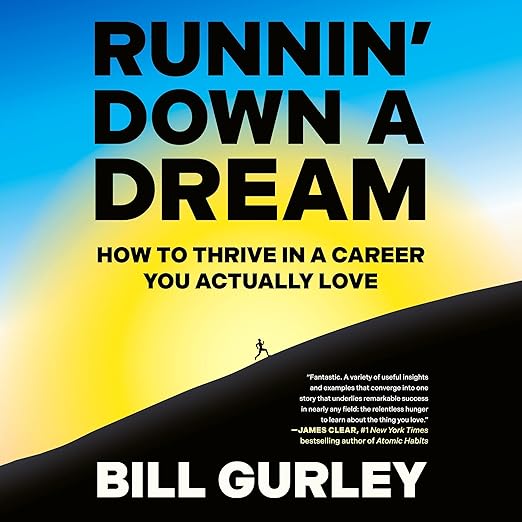
James Clear, author of Atomic Habits, blurbed this one directly, praising its 'variety of useful insights and examples that converge into one story' about what he calls 'the relentless hunger to learn about the thing you love.' That's a notable endorsement from someone whose own book lives in exactly this space, and it signals the kind of audience Gurley is writing for, people who've read the standard career and habit-formation books already and want something with more texture and specificity.
Gurley narrating his own material matters here in a straightforward way, this is explicitly framed as his straight-talk voice, and a hired narrator performing that voice secondhand would lose some of the directness that makes a venture capitalist's blunt career advice land as authentic rather than performed. Reviewer jf pushed back gently on reading the book as a pure success formula, calling it instead 'a tale of existence, commitment, and attitude,' which is a fair description of how personal and specific Gurley's stories get rather than staying abstract.
Part of what Gurley is explicitly pushing back against is the idea that hustle and happiness can't coexist, that genuine satisfaction in a career necessarily means either grinding yourself down or coasting without ambition. The six principles are pitched as a middle path, sustained curiosity and real craft development rather than either burnout or complacency, a more nuanced pitch than most career books manage.
This audiobook edition also includes a downloadable PDF with Gurley's own recommended reading list, a nice bonus for listeners who finish the six principles and want to keep going deeper into any one of them. It's a small production detail, but it signals the book is meant to function as a starting point for further reading rather than a closed, self-contained argument.
Gurley's Own Path Runs Through Elite Institutions
Gurley's own path runs through elite institutions and venture capital, a world with resources and access most listeners won't have, so some of the specific opportunities he describes seizing may not translate directly to every career or industry. The six principles themselves are broad enough to apply widely, but the illustrative stories (talent agents, restaurateurs, sports executives) skew toward high-achieving, well-connected professional worlds.
At just under eight hours, this also runs longer than the average business or career book, so go in expecting real depth on each of the six principles rather than a quick, skimmable overview. If you're looking for a fast read before a job interview, this is better suited to a longer-term project of rethinking how you approach your career generally.
Because the book is pitched most directly at people early enough in their careers to still meaningfully change course, the framing leans toward younger professionals, even though the underlying six principles arguably apply just as well to someone weighing a later-career pivot. Older listeners shouldn't assume the book has nothing for them, but the entry point is clearly aimed at people still actively forming their career identity.
Principles First, Autobiography Second
Young professionals feeling the conveyor-belt pressure Gurley describes, moving from test to application to job without ever stopping to ask what they actually want, are the clearest audience, especially anyone early enough in their career to still meaningfully change direction. Reviewer charlotte a lewis's experience suggests it also resonates strongly with people already mid-pivot, looking for validation and a framework for a leap they've already decided to make.
Mentors, career counselors, and parents of college-age kids navigating exactly the pressure Gurley describes will find this a useful resource to recommend or discuss together, since the six-principle structure gives a shared vocabulary for conversations that often stay frustratingly vague otherwise.
If what you want is a straightforward memoir of Gurley's own venture capital career rather than a structured framework illustrated by other people's stories, adjust expectations. The book spends as much time on figures like Danny Meyer and Sam Hinkie as it does on Gurley's own path, principles first, autobiography second.