Quick Take
- Narration: Adam Rubin reads his own picture book, and six minutes of enthusiastic author narration is exactly right for material this playful, the timing on the jokes lands, and his delivery of robot sound effects and the premise’s internal logic sounds genuinely delighted.
- Themes: imagination and transformation, the appeal of escaping ordinary human constraints, the surprise of a story that does what it says it will
- Mood: Gleefully silly with a genuinely surprising payoff
- Verdict: A six-minute audiobook that works because the comedic premise is tight, the narration is committed, and the surprise ending lands even in audio format, though listeners should know the physical book has a transformation gimmick that audio cannot replicate.
Six minutes. That is the runtime of Robo-Sauce in audio form, which makes this one of the shortest books I have ever deliberately sat down to review. But Adam Rubin and illustrator Daniel Salmieri built a children’s picture book with an actual structural surprise at its center, and the question of whether that surprise survives audio adaptation is a real and interesting one. My answer, after listening with a six-year-old who demanded we play it twice in immediate succession, is: mostly yes, with one significant caveat.
Rubin is the author of Dragons Love Tacos, which has the kind of cultural reach where you can reference it in mixed company and most parents will nod immediately. Robo-Sauce comes from the same creative register, irreverent, efficient, aware of exactly what jokes it is making and when to land them.
Our Take on Robo-Sauce
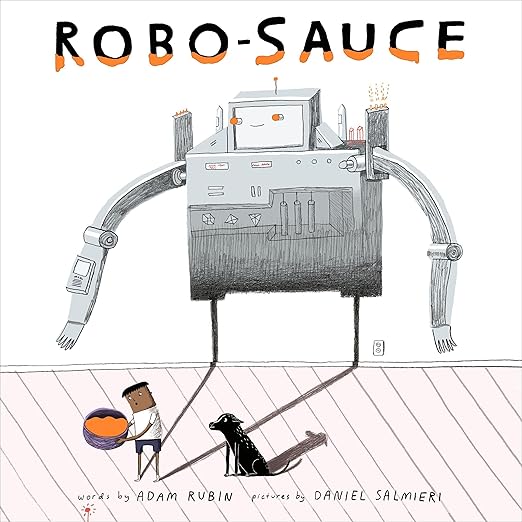
The premise is stated flatly and cheerfully: robots are objectively superior to humans. They have lasers for eyes, rockets for feet, and supercomputers for brains. They never have to eat steamed beans or take baths or go to bed. If only there were a magical substance that transformed squishy humans into robots, everything would be better. Well: now there is. The book then proceeds to demonstrate the existence of Robo-Sauce and its effects, culminating in a surprise ending that, in the physical book, involves an actual transformation of the book itself, the cover flips around to reveal a robot-themed cover, the whole object becomes a different object.
That physical gimmick is the one thing audio cannot replicate. Multiple reviewers specifically identified the book’s transformation as its defining feature, a child discovering that the book itself turns into a robot is an experience with no audio equivalent. The narration is still funny and the comedic logic holds up, but listeners who have not seen the physical book will be missing the actual payoff.
Why Listen to Robo-Sauce
Adam Rubin’s self-narration is committed and funny. He reads the premise with the flat declarative authority of someone presenting scientific facts, which is the exact right comic register for a book that lists the superiority of robots over humans as objective data. The transitions into the Robo-Sauce sequence are timed well, and his delivery of the ending has genuine energy. One reviewer noted a child walking around performing robot impressions for days after, which is the right measure of successful children’s content.
The audio format also makes this extremely useful for car trips and bedtime sequences, six minutes is a self-contained, complete listening experience that fits easily into any gap, and Rubin’s narration sustains the energy without requiring visual support for the primary jokes.
What to Watch For in Robo-Sauce
The central limitation has already been noted: the physical book’s transformation gimmick, where the book literally becomes a robot-themed book when you flip it, is the defining experience for most children who read it in print. Reviews of the physical book consistently identify this as a standout feature that Rubin and Salmieri built the entire narrative toward. In audio, that moment becomes a description of something happening rather than something actually happening.
This is not a failure of the audiobook so much as an honest assessment of format limitations. Listeners who come to the audio first will have a good six-minute experience. Listeners who know the physical book and come to audio expecting the same payoff will find it partial. For most families, the ideal is to own both, audio for car trips, physical for bedtime when the transformation moment can actually land.
Who Should Listen to Robo-Sauce
Ideal for: families already in the Dragons Love Tacos universe looking for more Rubin content, children between three and eight who respond to robot humor and absurdist comedy, and any adult who wants a six-minute audiobook that is unambiguously fun and requires no investment. The audio works on its own terms, but the physical book is the complete experience. If you only have access to one format, audio is still worth the six minutes, just know that a physical copy exists and does something the audio cannot.
Frequently Asked Questions
Does the audiobook version of Robo-Sauce include the physical book’s transformation gimmick?
No. The physical book transforms into a robot-themed object when you flip the cover, this is its most praised feature and what most children remember about the experience. The audio version narrates toward the same ending, but the physical surprise cannot be replicated in audio format.
What age range is Robo-Sauce best suited for in audio format?
Approximately three to eight years old, aligning with the picture book’s natural audience. Older siblings who liked Dragons Love Tacos may enjoy it at higher ages, but the primary audience is early childhood. The six-minute runtime makes it accessible even for very young listeners.
Is Adam Rubin’s self-narration notably better than a professional reader would be for this material?
The specific comic timing and the flat, declarative delivery of the robot-superiority premise are assets of an author who knows exactly what the jokes are. A professional narrator would likely perform it well, but Rubin’s narration has a particular quality of genuine amusement that reviewers responded to positively.
How does Robo-Sauce compare to Dragons Love Tacos for children who loved that book?
Multiple reviewers note that Dragons Love Tacos is the stronger book for most children, with Robo-Sauce as a very good companion rather than an equivalent. The transformation gimmick distinguishes Robo-Sauce as an object experience, but the laugh-per-minute count in Dragons Love Tacos is generally rated higher by repeat readers.