There is a specific afternoon I associate with the Ricky Ricotta books: my nephew Oliver, then seven, sitting in the back seat on a long drive to the coast, suddenly completely silent. Not asleep, listening. He had been resistant to audiobooks since we started the trip, cycling through suggestions with the world-weariness only a second-grader can project. Then this one came on, and he did not move for the rest of the drive. That is the Dav Pilkey effect, and it is real.
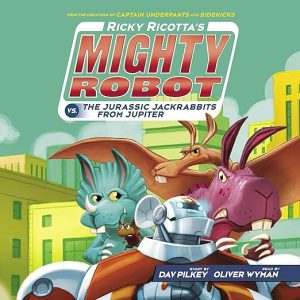
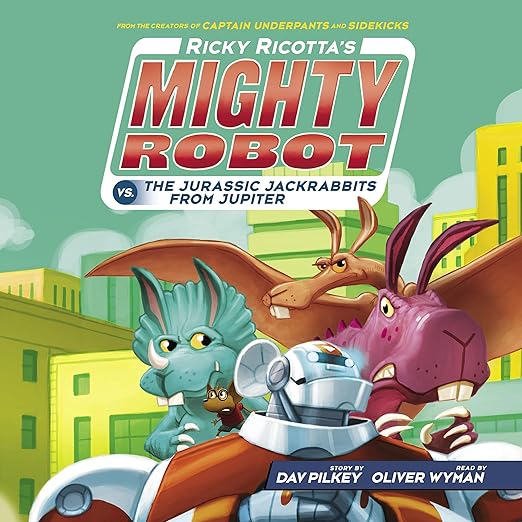
Ricky Ricotta's Mighty Robot vs. the Jurassic Jackrabbits from Jupiter is exactly what its title promises and exactly what its audience needs. Ricky, a small mouse with a giant robot best friend, is facing what appears to be a perfect birthday: peanut-butter pancakes, presents, a dinosaur museum trip. Then his cousin Lucy arrives, and things get complicated in the way that only cousins can complicate a day. Then General Jackrabbit, an evil genius from Jupiter, creates three Jurassic Jackrabbits to invade Earth, and the birthday situation escalates considerably.
Pilkey's genius in this series is structural as much as narrative. The stories are genuine chapter books with real plot logic, heroes, villains, stakes, and resolution, but they are engineered to feel accessible to children who might find longer books overwhelming. At twenty-seven minutes, this audiobook is short enough for a restless listener to finish in a single sitting, which is pedagogically important. A child who finishes a book, even a short one, has the experience of completing a story. That experience compounds.
Multiple reviewers make this point from lived experience. A parent of a child with dyslexia notes that the Ricky Ricotta books work because they do not rely on the repetitive, controlled-vocabulary structure of early readers, which her son found both frustrating and dull. Another parent describes a seven-year-old who had previously resisted books of all kinds tearing through the series in a week. A third reviewer mentions their child reading and re-reading these books compulsively. That pattern, reluctant reader becomes enthusiastic reader, appears with enough consistency across the reviews to be taken as a reliable outcome rather than an anomaly.
What Dav Pilkey Gets Right
Oliver Wyman is the right narrator for Pilkey's material. He commits fully to the villain sequences, General Jackrabbit gets appropriate menace, given the age-appropriate stakes, while keeping the family dynamics warm and the protagonist's uncertainty genuine. The humor lands in the way cartoon humor lands: broadly, without condescension, with the kind of timing that suggests the performer is actually enjoying himself. For a twenty-seven-minute audiobook, this kind of full commitment to the material matters more than it might seem.
The accompanying PDF provides the visual content, Pilkey's illustrations, the Flip-o-Rama sequences, that the print books are known for. Listeners who have the physical book alongside the audio get the full experience. The audio alone works as a story, but the visual element that reviewers consistently cite as a hook for reluctant readers is best accessed through the print companion.
Where Dav Pilkey Loses Some Ground
This is a book for approximately five to eight-year-olds and does not pretend otherwise. Adults listening alongside children will find it cheerful and brief. Adults listening alone for any other reason will find it efficiently wrong for them. The character development is brisk by necessity, at twenty-seven minutes, there is not space for interiority. Ricky learns something about cousins and something about kindness, the robot helps, the bad guys lose, and everyone goes home. That economy is a feature of the form.
The series does not require sequential listening, each book is self-contained, though the world and relationships established across multiple entries will be more resonant for children who have followed Ricky from the beginning.
Who Dav Pilkey Is Writing For
Perfect for children ages five to eight, particularly those who have shown resistance to books, long listening sessions, or both. Parents of children with dyslexia, attention difficulties, or simply a preference for visual media will find this a productive bridge. Teachers looking for audiobooks that work for early chapter book readers will find the series consistently effective. Adults will do better elsewhere, but as a shared listening experience with a child, twenty-seven minutes of benevolent robot heroics is a fine way to spend an afternoon.
- Read by: Oliver Wyman brings the right comic energy, playful, slightly over-the-top in the villain sequences, and warm during the family scenes. Exactly calibrated for the target age range.
- At its heart: Birthday expectations versus reality, family dynamics and reluctant cousins, unlikely heroics from small protagonists
- Vibe: Silly and celebratory, with enough peril to feel like a real story
- Short version: Dav Pilkey doing what he does best, making kids who don't like books become kids who love books.
Before You Listen
Is this a good audiobook for a child who struggles with reading or has dyslexia?
Several parents specifically mention it in this context. The book avoids the controlled-vocabulary repetition of early readers, which some children with reading difficulties find frustrating, while remaining accessible in content and length.
Does the audiobook work without the printed book, or is the visual element essential?
It works as a standalone audio experience. The story is complete and coherent on audio alone. The Flip-o-Rama sequences and illustrations that reviewers praise are available via the PDF download included with purchase, but children listening without the physical book will still follow the story.