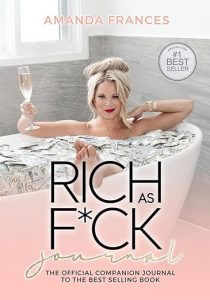
Amanda Frances's voice fills the room before the first sentence is finished, and for this audiobook, that quality is the entire point. Rich as F*ck is cataloged as a companion journal to Frances's bestselling main title, and listeners who purchase it expecting a full book on wealth mindset will be surprised by what they find: at one hour and eight minutes, this is a short-form audio companion built around the journal's reflection prompts rather than a standalone exploration of money philosophy. Frances self-narrates, which is essential to understanding how this product works in practice. The companion depends on her voice, her delivery, and the energetic conviction she brings to the material in ways that a professional narrator reading the same words could not replicate.
An Intentional and Sacred Space for the Prompts
Frances is known in the women's business and wealth mindset space for her particular blend of spiritual conviction and financial directness. The original Rich as F*ck book has been a consistent bestseller in the women's finance and self-help categories. This companion is designed to deepen engagement with those principles through reflective writing, and the audio version delivers Frances's journal prompts in her own voice, framed by the coaching presence she has built across her platform and live events.
The structure is built around what the synopsis describes as an "intentional and sacred space" for working through the book's principles. The prompts are designed to help listeners integrate the money psychology of the original book into their actual daily thinking and behavior. Frances is direct, warm, and unambiguous about her positions. She does not hedge. If you are already aligned with the foundational premise, that money is essentially a mindset problem before it is a strategy problem, the prompts will function as intended. If that premise is not one you share, the hour will feel thin on substance regardless of the delivery quality.
The honest caveat here is the duration. At just over an hour, this is a short-form audio product. Listeners who are purchasing it expecting something comparable in length and scope to the original book will be disappointed. Listeners who want the full Frances money philosophy argument rather than a companion reflection experience should start with the original Rich as F*ck title. The journal companion makes most sense for people who have already engaged with the main book and want structured exercises to deepen that engagement, delivered in Frances's own coaching voice rather than read silently from the page.
Exercises on the Page, Coaching in Her Voice
Self-narration by Frances is the reason to choose audio over the physical journal. The prompts on the page function as writing exercises. The same prompts delivered in Frances's voice function as coaching, with the tonal authority and energy she has developed through her platform. Reviewer Veronica described it as "wonderful insights and inspiration," and the experience is consistent with what Frances's existing audience has come to expect from her direct style. Reviewer Jennifer called the book one of the best and said it makes you want to succeed.
Frances's approach is rooted in the intersection of business coaching, spirituality, and positive psychology around financial abundance. She positions money as something the listener can fundamentally restructure their relationship to through belief and internal practice. This framing resonates strongly with listeners already engaged in personal development work from a spiritually adjacent angle. Listeners who prefer evidence-based behavioral finance or purely strategy-oriented money content will find the philosophical framework here very different from what they are looking for, and the companion format will not close that gap.
A Coaching Session Delivered in Audio Form
The journal prompts are designed to be written to, not simply listened through. This creates a specific challenge in audio format: the listener is receiving reflection invitations but has no built-in mechanism to respond unless they pause the audio to write. Listeners who use this audiobook as background sound while commuting or doing other tasks will absorb it as passive inspiration rather than active integration, which is a legitimate use but not what the companion is designed for. Getting the most from this audio requires treating it as a structured exercise session, pausing after each prompt to actually engage with the reflection it is asking for.
The format is best understood as a coaching session in audio form rather than a conventional audiobook in any traditional sense. At sixty-eight minutes, the commitment is low and the companion sits easily alongside other Frances content rather than demanding space as a standalone listening experience. Listeners who have been looking for a way to work through the original book's principles more deliberately will find the structure useful. Those who want the full content delivered across a standard audiobook runtime should look to the original title in the catalog, which covers the money philosophy itself rather than the companion exercises.
A Genuine Asset for Existing Frances Readers
This audiobook companion is best suited to existing Amanda Frances readers who have read or listened to the original Rich as F*ck book and want structured reflection prompts delivered as active coaching rather than text on a page. It is not a starting point for the uninitiated. New listeners curious about Frances's work should begin with the main book before approaching this companion. The self-narration is a genuine asset, and the coaching presence Frances brings to the prompts is the experience the format is selling. At just over an hour, the time investment is minimal, but the return depends almost entirely on whether the listener arrives already invested in the framework the original book established. As a companion to that work, it does what it promises.
Common Questions
Is the Rich as F*ck audiobook the full book on money mindset, or is it the journal companion?
This is the companion journal to the original Rich as F*ck book. At one hour and eight minutes, it consists of reflection prompts designed to help listeners integrate the original book's principles. Listeners who want the full money mindset argument should start with the main Rich as F*ck title rather than this companion.
Does Amanda Frances narrating her own audiobook make a meaningful difference?
Yes. The journal prompts are designed as coaching exercises, and Frances delivers them with the energetic conviction and tonal authority she has developed through her platform. The same prompts read by a professional narrator would lose the coaching-session quality that makes the audio version distinct from simply having the physical journal.
Can you use this audiobook without having read the original Rich as F*ck book?
Technically yes, but the companion is designed to deepen engagement with principles introduced in the original title. Listeners who arrive without that foundation will be missing context that the prompts assume. The audiobook works best as a supplement to the main book rather than as a standalone introduction to Frances's money philosophy.
Is this audiobook suitable for passive listening, or does it require active participation?
Active participation is what the companion is designed for. The journal prompts invite reflection and written responses, which means pausing the audio to engage with each exercise properly. Listeners who use it as background audio will receive passive inspiration rather than the structured integration experience the format intends.