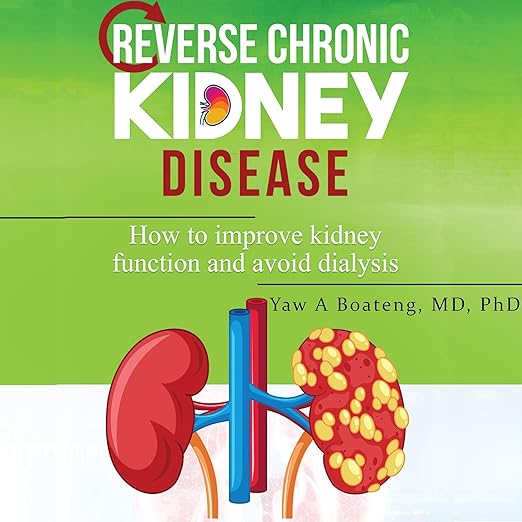
Quick Take
- Narration: Mark McDevitt delivers a measured, clinical-yet-accessible read that suits the book’s evidence-based tone without becoming dry; he handles medical terminology clearly and at a pace that lets the science land.
- Themes: Dietary intervention for kidney health, plant-based nutrition science, supplement and herbal guidance
- Mood: Hopeful and methodical, grounded in peer-reviewed research
- Verdict: A nephrologist-authored guide that translates real clinical research into practical steps for the 40 million Americans living with CKD, strongest for newly diagnosed patients and their caregivers.
I came to this one on a Tuesday evening after a conversation with a friend whose mother had just received a stage 3 CKD diagnosis. The family was overwhelmed, their questions unanswered at the clinic, and someone in the group chat had forwarded a link to this audiobook. I downloaded it that night partly to help them and partly because, as someone who spends a significant portion of her life evaluating health audio, I was curious whether Dr. Yaw Ababio Boateng could do what so few medical authors manage: make clinical evidence readable without watering it down into uselessness.
He largely does. Boateng is a practicing nephrologist, and that credential matters here in ways it often does not in wellness publishing. This is not a naturopath speculating about kidney health from the outside. The clinical context shapes every chapter, from the opening epidemiology (that 13.4% global prevalence figure, the 40 million Americans) through to the specific discussion of dietary protein and phosphorus. The argument that a low-protein, plant-based diet is beneficial for kidneys has been in the nephrology literature for decades but rarely surfaces in mainstream health conversations dominated by meat-heavy dietary advice. Boateng addresses this gap directly and, importantly, backs it with published studies rather than anecdote.
The Science Behind the Plant-Based Pivot
The strongest section of this audiobook is the dietary analysis. Boateng walks through how protein metabolism produces waste products that healthy kidneys filter but damaged ones struggle with, and why animal protein generates a higher acid load than plant protein. He is not anti-meat as a lifestyle stance but as a clinical reality for CKD patients, and that distinction matters. Reviewers note the book is trustworthy because he pairs every major claim with relevant published studies. Mark McDevitt’s narration helps here: he reads citations and study references clearly rather than rushing past them, so listeners who want to follow up can actually do so.
The hydration section is similarly well-reasoned. Boateng does not simply instruct listeners to drink more water. He explains the mechanism by which adequate hydration affects filtration rate and waste clearance, which transforms a platitude into something actionable. One reviewer, a medical professional herself, noted she learned things she had not known despite working in OB/GYN, which speaks to the clinical density Boateng achieves without losing general readers.
Vitamins, Teas, and the Evidence Question
The alternative medicine positioning of this title requires some nuance in the review. Boateng covers certain vitamins, herbal teas, and supplements with claims about improving kidney function. He consistently cites studies, which distinguishes this from speculative wellness content, but listeners should understand that the evidence base for some of these interventions is preliminary or drawn from small trials. Boateng is generally careful to signal uncertainty where it exists, but the book’s subtitle around reversing chronic kidney disease sets an expectation the content only partially meets. CKD stage matters enormously here: halting progression in stage 2 or 3 is a different proposition from genuinely reversing damage in later stages, and the nuances between those scenarios receive variable treatment across the chapters.
That said, the book earns its 4.6 rating with 604 reviews by delivering something most CKD patients do not get in a 15-minute appointment: a coherent, science-adjacent framework for dietary and lifestyle choices that can support, not replace, nephrology care. Reviewer Ivan calls it fundamental for patients and caregivers, and that framing feels accurate.
What the Audio Format Gains and Loses
At just under five hours, this is an efficient listen. McDevitt moves through the content at a brisk but comprehensible pace. The audio format serves the narrative sections and the explanatory science well. It serves the study citations less well: a print version with a bibliography you can browse is genuinely useful here, and the audiobook does not include a companion PDF. Listeners who want to act on specific supplement recommendations will need to take notes or return to the text version.
The chapter structure is logical and cumulative rather than modular, which means this is best consumed sequentially. It is not a reference you will dip back into by chapter; it is a one-pass foundation. For a newly diagnosed patient or a family member trying to understand what dietary changes might help, that linearity is actually an advantage. The information builds coherently toward a set of practical conclusions.
Who Should Listen and Who Should Proceed With Caution
This audiobook will be most valuable for CKD patients in stages 1-3 who want to understand the dietary science behind what their nephrologist may or may not have explained, for caregivers supporting someone through a new diagnosis, and for anyone curious about how plant-based nutrition intersects with kidney physiology. It is worth listening to alongside, not instead of, medical care. The book does not encourage patients to stop treatment or forgo dialysis assessment when clinically warranted, which is the responsible position.
Listeners expecting a strictly conventional medical text may find the supplement and herbal sections feel like a departure from the clinical rigor of the dietary chapters. They are not wrong about that tonal shift, though Boateng continues to cite studies throughout. The alternative medicine tag in this catalog reflects that hybrid approach honestly.
Frequently Asked Questions
Is this audiobook appropriate for someone in stage 4 or 5 CKD, or is it primarily aimed at earlier stages?
The book addresses CKD broadly and includes discussion of dialysis avoidance, which implies it covers a range of stages. However, the dietary and lifestyle interventions discussed are most impactful in stages 1-3 when function can still be preserved or slowed. Patients in stage 4 or 5 should treat the content as supplementary to specialist care rather than a primary guide, and consult their nephrologist before making significant dietary changes.
Does the book recommend stopping prescribed medications or dialysis?
No. Dr. Boateng is a practicing nephrologist and his framing consistently supports conventional medical care. The dietary and supplement guidance is positioned as complementary, intended to support kidney health alongside prescribed treatment, not replace it.
Does Mark McDevitt’s narration make the medical terminology accessible, or is this a dense listen?
McDevitt reads at a measured pace and handles terminology clearly, making the clinical content more approachable than a straight academic text. He reads study references legibly rather than rushing past them, which helps listeners who want to follow up on specific claims.
Is there a companion PDF or print supplement with the bibliography and study references?
Based on available information, there is no companion PDF included with the audiobook. Listeners who want to review the cited studies or reference specific supplement recommendations will benefit from also having access to the print edition.