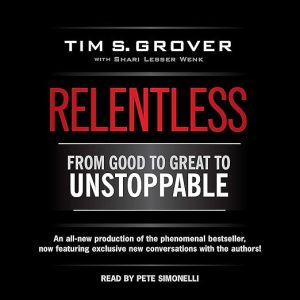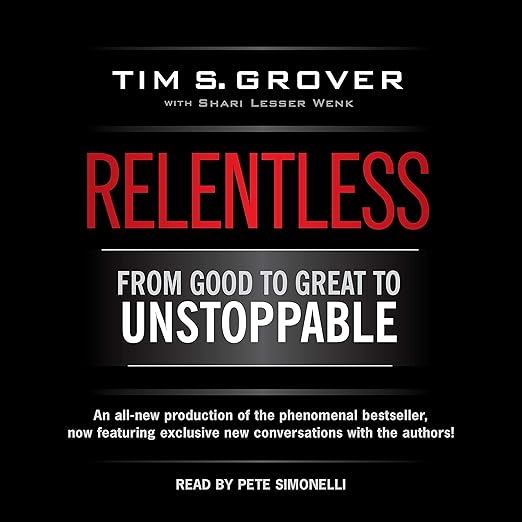
Tim Grover's Relentless has been in circulation since 2013, and the updated audiobook production - featuring exclusive new conversations with the author alongside the original text - signals something deliberate: Grover is not issuing a simple reprint but revisiting the material in dialogue with himself and with athletes who have lived its principles. At 6 hours and 38 minutes, this is the kind of audiobook that does not ease you in. Grover's voice, via Pete Simonelli's narration, establishes its register in the first few minutes and does not shift it: direct, blunt, and precisely calibrated to discomfort. If you came for encouragement and reassurance, this is the wrong book. Grover knows that, and he says so.
Simonelli is well cast for this material. The danger with books built on aggressive, imperative prose - do this, don't think, trust your instincts - is that narration can tip into either harangue or empty motivation-poster delivery. Simonelli finds the middle register: he delivers the intensity without shouting and keeps the pacing brisk enough that the book's argument feels like it is building toward something rather than circling in place. Reviewer Sam specifically noted the different level of intensity compared to most performance or mindset books, and that distinction is partly Grover's writing but also partly a function of how Simonelli delivers it - with the controlled aggression of a trainer who means every word.
Simonelli Delivers Intensity Without Shouting
Grover's framework, the Relentless 13, identifies thirteen traits shared by the most intense competitors in sports and business. He calls the highest tier Cleaners - a category exemplified by Michael Jordan and Kobe Bryant, two athletes Grover trained for decades - and distinguishes them from Coolers and Closers in ways that are more diagnostic than aspirational. This is not a book about becoming the best version of yourself in the self-help tradition. It is a book about recognizing what separates the truly relentless from everyone else, including the very good, and about whether you have the capacity to operate at that level or even want to. That question - and Grover's willingness to suggest that most people do not and maybe should not - gives the book an unusual directness within the performance genre.
The Jordan and Bryant stories are the obvious draw, and Grover delivers on them substantively. He has firsthand access to what those athletes were actually like in training, in pressure situations, and in the psychological patterns that sustained their performance across injuries, losses, and competitive threats from other elite performers. The previously untold stories the synopsis promises are real - not just anecdotes but observations about how elite performers actually process failure, boredom, and external pressure in ways that contradict both the public mythology and the conventional sports motivation genre. Grover was in the room for moments that shaped championship performances, and that proximity shows.
A Salesperson Calls It a Life Changer
Reviewer Spooky, a salesperson with 14 years of professional experience who tried expensive coaching and found something missing until encountering Relentless, describes the book as a life changer. That testimonial is worth taking seriously on its own terms. Grover is not writing for athletes specifically. The Relentless 13 traits apply wherever sustained performance under pressure is required, and the audiobook's crossover appeal into business and professional contexts is genuine rather than retrofit marketing. Grover explicitly addresses business and professional performance alongside sports throughout the book rather than translating between domains in a single chapter appended at the end.
The exclusive new conversations added to this production are the differentiation point for listeners who have previously encountered the original edition or the print version. These conversations allow Grover to address how the Relentless 13 material has aged, how the athletes he references have continued to demonstrate or diverge from those principles, and how the framework applies to the current landscape of elite performance across professional sports and business. For listeners who have already read Relentless in print, those conversations provide a substantive reason to return in audio specifically.
Asking the Question Proves You Are Not a Cleaner
Grover's philosophy is not for everyone, and the book is honest about this in ways that will feel either refreshing or alienating depending on your orientation. His argument - that the Cleaner mentality requires suppressing emotional processing, maintaining detachment from what others think, and operating on instinct rather than deliberation - runs directly against the grain of most contemporary performance psychology, which increasingly emphasizes psychological safety, emotional intelligence, and integration of self-awareness. Grover explicitly frames that kind of self-awareness as weakness in elite contexts, and he means it. Listeners who have found genuine value in more nuanced performance frameworks will find this approach uncomfortably reductive in places.
Reviewer Ashley Taylor called it essential to push yourself toward excellence in whatever you are focused on. That enthusiasm is genuine and earned from inside the book's worldview. From outside it, the question of whether the Cleaner mentality is replicable by ordinary dedicated people, or whether it describes a specific subset of elite performers who are constitutionally built for it rather than trained into it, is worth holding as a counterpoint. Grover would likely say that question itself proves you are not a Cleaner. That meta-level rhetorical move is either brilliant or circular depending on how much of the premise you accept going in.
An Unmediated Look at Elite Psychology
This audiobook belongs in the library of anyone in high-performance professional or athletic contexts who wants an unmediated look at the psychology behind elite achievement rather than a sanitized motivational version of it. Athletes, coaches, competitive business professionals, and anyone who has found conventional self-help frameworks unsatisfying will find Grover's bluntness genuinely different from the category norm. The book sits within the Tim Grover Winning series, and listeners who respond strongly to Relentless will find related material in his subsequent work. Those who prefer performance frameworks that integrate emotional intelligence, collaborative development, or psychological nuance alongside raw intensity should know upfront that Grover's approach is deliberately opposed to those frameworks and makes that opposition explicit throughout. The updated audio production with new conversations makes this the definitive version for newcomers and returning readers alike.
Frequently Asked Questions
What is new in this audiobook production of Relentless compared to the original book?
This version features exclusive new conversations with Tim Grover added to the original content. These conversations allow Grover to revisit and extend the Relentless 13 material in light of subsequent developments, making this production meaningfully different from the print edition or earlier audio versions. Listeners who have encountered the original should find those additions substantive rather than supplementary.
Is the Relentless audiobook appropriate for professional contexts outside sports, such as sales or business leadership?
Yes, and Grover makes this explicit throughout rather than confining the sports examples to a single application chapter. Reviewer Spooky, a 14-year sales professional, described it as filling a gap that formal coaching had not. The Relentless 13 framework is presented as applicable to any competitive, high-stakes performance context, not just athletic competition.
Does Pete Simonelli's narration capture the intensity of Tim Grover's original voice in this audiobook?
Simonelli handles the aggressive, imperative style of Grover's prose without tipping into harangue or monotony, which is the specific challenge this material poses for narrators. Reviewer Sam noted the distinct intensity of the book compared to other performance titles, and Simonelli's delivery is a meaningful contributor to that effect. The narration is direct and punchy throughout the 6.5-hour runtime.
How does Relentless differ from other elite performance audiobooks like Can't Hurt Me or The Mamba Mentality?
Grover's framework is practitioner-derived from training multiple elite athletes rather than first-person athlete memoir. Where Can't Hurt Me gives David Goggins' personal experience and The Mamba Mentality gives Kobe Bryant's own account, Relentless gives a trainer's diagnostic view of what distinguishes Cleaners from everyone else, including the stories Grover observed firsthand with Jordan and Bryant that those athletes did not necessarily tell themselves.