Quick Take
- Narration: Chopra narrates his own work with meditative cadence and unhurried conviction, which is either the perfect delivery for this material or an acquired taste depending on your relationship to his worldview.
- Themes: Body as dynamic energy field, soul-body integration, transformation beyond the material
- Mood: Contemplative and expansive, like a long meditation session that occasionally becomes a lecture
- Verdict: For listeners already oriented toward Chopra’s framework, this is a rich synthesis; newcomers should expect a steep conceptual on-ramp.
There are books you read once and books you return to, and the reviews for this one suggest it falls firmly into the second category. One listener, Denisse Villar, describes reading it three times and discovering something new in each pass. That kind of repeated encounter with a text is not accidental. It usually means the book is organized around depth rather than novelty, that it is asking you to change how you perceive rather than simply informing you of facts you did not previously have.
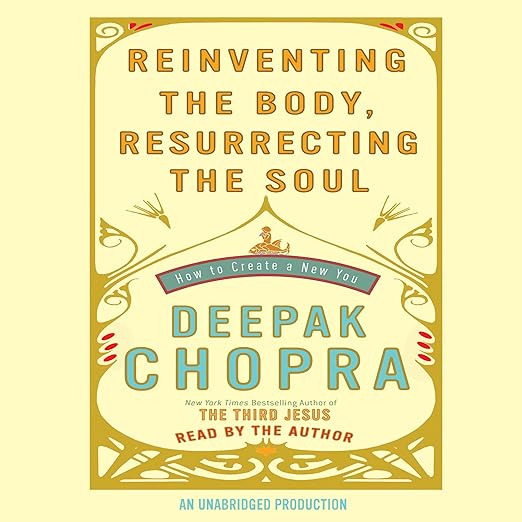
Reinventing the Body, Resurrecting the Soul arrived fifteen years after Chopra’s Ageless Body, Timeless Mind, and it functions partly as a reconsideration of that earlier work. Where the 1993 book operated primarily at the level of biology and quantum mechanics metaphor, this one pushes further into the territory where the body and the soul become inseparable. Chopra’s central provocation, that your physical body is a fiction, that every cell is composed of awareness and energy rather than purely material substance, is either the most important idea you have encountered or the most challenging, depending on your priors.
The Ten Breakthroughs and What They Actually Require
The book’s structure is explicit: five breakthroughs for the body, five for the soul. Chopra uses breakthrough in a specific sense, not as a dramatic discovery but as a shift in perception that allows something previously blocked to become possible. The body breakthroughs address cellular intelligence, the role of awareness in physical function, and the body’s capacity for renewal that conventional medicine systematically underestimates. The soul breakthroughs move into territory most medical writing refuses to enter: consciousness, the relationship between inner experience and outer expression, and what Chopra calls accessing full potential.
The practical commitments Chopra derives from these breakthroughs are grounded in orientation rather than protocol. He asks readers to commit to deeper awareness, to focus on relationships rather than consumption, to approach each day as genuinely new rather than as a continuation of yesterday’s story. These are not micro-habits. They are changes in how you inhabit your life, and Chopra is careful to show why they are not merely philosophical but physiologically consequential.
Self-Narration as the Only Right Call
Chopra narrates his own work here, and that choice shapes the entire listening experience. His voice carries the particular quality of someone who has been teaching these ideas for decades and still believes them with full conviction. The pace is slow by audiobook standards, deliberately so. He does not rush through the difficult conceptual passages, and the meditative quality of his delivery invites a listening posture that is more contemplative than task-oriented. A reviewer named Donna Miesbach describes the book as confirming what science is discovering and ancient wisdom has always known, and Chopra’s narration conveys exactly that dual authority.
This is worth knowing before you begin: if you tend to listen at 1.5x speed and take notes, this audiobook will resist that approach. The material works differently when encountered at pace. The ideas need time to settle.
The Evidence Question
Chopra draws on quantum physics in ways that have drawn both admiration and criticism from scientists over the years. The body-as-energy-field framing is not peer-reviewed in the conventional sense, and listeners who need empirical citation for every claim will find the book frustrating. What Chopra is doing is closer to what philosophers of medicine do: articulating a framework for understanding health that the available data cannot yet fully verify but that explains phenomena conventional frameworks leave unaddressed. The epidemic of noncommunicable diseases, the failure of purely genetic medicine to deliver its promised revolution, the documented reality of placebo effects that exceed mechanism, these are real puzzles that Chopra’s framework addresses seriously.
For Whom and Under What Circumstances
This is a book for listeners already oriented toward the body-mind-spirit synthesis, either through prior Chopra reading or through equivalent frameworks in integrative medicine, contemplative practice, or consciousness studies. Readers approaching from a purely materialist scientific worldview will need significant tolerance for claims that outpace the evidence. Listeners who have been with Chopra since Ageless Body, Timeless Mind will find this a deepening rather than a departure. At just over ten hours of self-narration, it asks for a sustained kind of attention that rewards the right listener generously.
Frequently Asked Questions
Do I need to have read Ageless Body, Timeless Mind before this one?
No, though Chopra references it explicitly as context for this book’s evolution. Reinventing the Body, Resurrecting the Soul stands independently, but knowing the earlier work helps you understand what he is revising and deepening.
Is this audiobook spiritually denominational, or does it work across belief systems?
Chopra draws on Vedantic philosophy but frames the soul in non-denominational terms rooted in consciousness and awareness rather than religion. The book is broadly compatible with contemplative traditions of multiple kinds.
How does Chopra’s narration pace compare to other health audiobooks?
Significantly slower and more meditative. He is not rushing toward the next concept. Listeners accustomed to brisk nonfiction narration should expect something closer to guided contemplation in pacing, which suits the material but takes adjustment.
Does the book offer practical tools or is it primarily conceptual?
Both, though the conceptual framework takes precedence. The ten breakthroughs each carry practical implications, but Chopra prioritizes shifting perception over providing protocols. The practical guidance flows from changed awareness rather than scheduled activities.