Quick Take
- Narration: Cindy Piller delivers the material plainly and steadily, her direct reading style matches a book that prioritizes honesty over polish.
- Themes: Developmental trauma, caregiver isolation, navigating mental health systems
- Mood: Unflinching and validating, like talking to someone who genuinely knows what you are living through
- Verdict: For adoptive and foster parents in the trenches of RAD, this book offers the peer validation and practical navigation that clinical resources typically fail to provide.
There is a particular kind of isolation that comes with parenting a child whose diagnosis most people have never heard of and fewer still understand. I have spoken with adoptive parents who describe going through entire school years without a single teacher, therapist, or family member truly grasping what they were managing at home. Keri Williams writes directly to those parents, and the reviews for this book read like dispatches from a support group: person after person saying that every story in this book is their story.
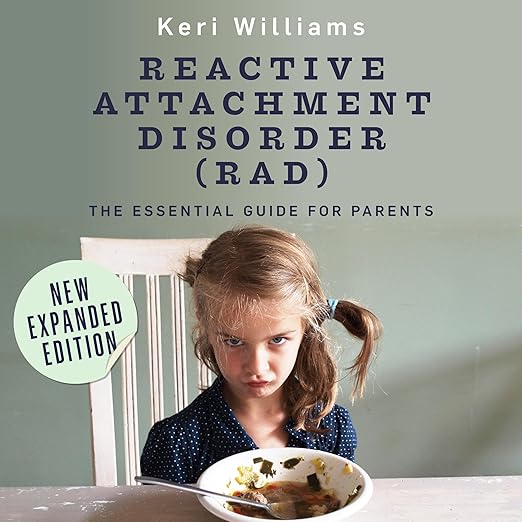
Reactive Attachment Disorder: The Essential Guide for Parents occupies a specific and underserved niche. It is not an academic text. It is not a clinical manual. It is a first-person account from a parent who has spent over a decade raising a son with RAD and navigating the systems around him, distilled into practical guidance for people who are at various stages of the same journey. That positioning matters enormously, because the dominant experience of RAD parents is that the specific, sometimes shocking behaviors RAD children exhibit are so consistent across families that only lived experience makes them credible.
What Clinical Resources Miss
Williams addresses something that clinical resources almost universally fail to do: she validates that the behaviors associated with RAD, the lying, the hoarding, the violent outbursts, the deliberate provocations, are not the result of bad parenting. They are the predictable responses of children who learned in their earliest years that caregivers are dangerous and that the only reliable survival strategy is to maintain control at all costs. Understanding that framing does not make the behaviors easier to manage, but it removes the shame that compounds the exhaustion.
Reviewer Figment of Imagination captures the book’s central value precisely: it validates what the primary caregiver experiences. They purchased multiple copies hoping to help therapists and teachers understand what they were living with. The frustration they report, that professionals read the book but still did not truly grasp it, underscores why peer-written resources exist in the first place. Some things only someone who has lived them can convey convincingly.
Navigating the System
One of the book’s more practically useful sections covers what Williams calls navigating the system: the labyrinthine process of finding therapists who specialize in attachment trauma rather than applying standard behavioral interventions that can actively backfire with RAD children, working with schools that do not recognize the disorder’s particular presentation, and accessing residential or intensive programs when home placement becomes untenable. This is territory most parenting books do not enter at all. Williams enters it with specificity that suggests genuine experience rather than research-based synthesis.
At just over three hours, the book is compact. Some readers may wish for more depth on any given topic. The treatment options section in particular could sustain a full volume on its own. But Williams is not writing a comprehensive clinical resource and does not pretend to be. She is writing the guide she wished she had at the beginning, and that scope is appropriate to what this book actually is.
Cindy Piller and the Demands of the Material
Cindy Piller reads the material in a way that feels consistent with the book’s register: direct, unadorned, without performative emotion. That is the right call for content this stark. Williams writes about some genuinely harrowing situations, behaviors that most listeners will not have encountered personally, and an overly emotive narration would either sensationalize or soften what needs to be stated plainly. Piller’s delivery keeps the focus on the information and the witness rather than on the narrator’s response to it.
Who Will Find This Essential
This book is written primarily for adoptive and foster parents of children with RAD diagnoses, and that is the audience it will serve best. Reviewer Dutchie identifies the core problem this book addresses: you cannot understand RAD unless you live it daily, and the professionals who are supposed to help often do not. This book exists to help caregivers explain the inexplicable, feel less alone, and make more informed decisions about treatment and support.
Mental health professionals interested in a parent’s perspective on the disorder will find it illuminating rather than comprehensive. Readers looking for peer-reviewed interventions or outcome data should look elsewhere. But for the parent who is sitting at the end of another impossible day wondering whether they are the only person on earth experiencing this, Williams offers something more immediate than data: proof that someone else has been there and survived it.
Frequently Asked Questions
Is this book primarily for adoptive parents, or does it also address biological parents whose children develop RAD?
Williams writes from the perspective of an adoptive and foster parent, and the majority of examples reflect that context. However, the behavioral and systemic guidance is relevant for any caregiver of a child with RAD regardless of how the attachment disruption occurred. Biological parents dealing with early trauma in their children’s histories will find it applicable.
Does the book recommend specific therapeutic approaches, and does it weigh in on the controversy around some RAD treatments?
Williams provides resource recommendations and discusses what has and has not worked in her experience, including why some mainstream behavioral approaches can backfire with RAD children. She does not provide an exhaustive treatment review, but she does flag the importance of finding specialists with genuine attachment trauma training rather than general child therapists.
At three hours, is this book thorough enough to be useful, or does the short runtime mean it is too surface-level?
The runtime reflects a deliberate scope: Williams is writing an accessible introduction and validation tool, not a clinical manual. Parents who are early in their journey will find the length appropriate and non-overwhelming. Those who are further along and want deeper treatment guidance will need to use it as a starting point and seek out more specialized resources.
How does Cindy Piller’s narration handle the more emotionally raw or disturbing content in the book?
Piller reads steadily and without dramatization, which is the right approach for material this serious. She does not add emphasis that the text does not call for. Listeners who want a more warm or personal narration style may notice the plainness, but for content dealing with trauma and behavioral crisis, the restraint serves the material well.