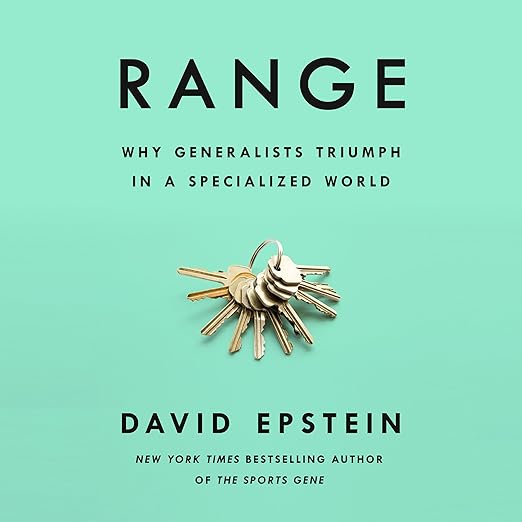
Range by David Epstein is one of those audiobooks that seemed to follow me around for a year before I finally sat down with it. The subtitle, Why Generalists Triumph in a Specialized World, positions it as counterintuitive self-help, but the book is considerably more rigorous than that framing suggests. Over nearly eleven hours, Epstein dismantles the cult of early specialization using research drawn from athletes, musicians, scientists, and political forecasters, building toward an argument that has direct consequences for how parents, coaches, employers, and anyone navigating a career thinks about skill development and commitment. Will Damron narrates, and his ability to keep the analytical passages moving without rushing the case studies makes the runtime feel well-used rather than padded.
The book opens with the Tiger Woods versus Roger Federer comparison that circulated widely before publication, and Epstein uses it not as a gimmick but as a genuine conceptual entry point. Both are among the greatest practitioners their sport has ever produced. One specialized at age three. The other played multiple sports into his mid-teens before committing to tennis. Epstein uses that contrast to ask a structural question: which development path is actually more generalizable, and in what kinds of domains?
Foxes Outperform Hedgehogs Yet Draw Less Attention
Epstein's core conceptual framework distinguishes between what he calls kind learning environments and wicked learning environments. Golf and chess are kind: rules are fixed, feedback is immediate and unambiguous, and deliberate practice produces reliable skill. That is why deliberate practice research, and the ten-thousand-hours doctrine Malcolm Gladwell popularized from it, holds in those domains. But most fields, medicine, scientific research, business strategy, forecasting, geopolitical prediction, are wicked environments where feedback is delayed or misleading, rules shift, and the pattern recognition that leads to expertise requires exposure to diverse prior situations. In wicked domains, the generalist with a jagged resume and broad reading habits consistently outperforms the specialist who has only ever done one thing deeply.
Reviewer Wally Bock identified something important about the book's actual scope: it is not simply a brief for generalism but "an investigation into how to capture and cultivate the power of breadth across different kinds of domains." The sections on forecasting draw on Philip Tetlock's decades of research into which kinds of thinkers make accurate predictions. The answer, foxes who draw on multiple disciplines and hold their views loosely, rather than hedgehogs who know one big thing and apply it everywhere, is consistent with Epstein's broader argument about the value of range. The foxes outperform the hedgehogs, and more interestingly, the hedgehogs get more media attention because confident specificity sounds better on television than acknowledged uncertainty.
The chapter on scientists who made major discoveries after switching fields mid-career is one of the book's most practically useful sections. Epstein documents patterns where the outsider perspective, bringing one domain's tools and concepts into another where they had not been applied, generated precisely the creative leap that insiders could not find. Nintendo built the Game Boy from electronics the industry had discarded as obsolete. The polymath inventor pattern appears repeatedly in the history of scientific progress, and Epstein argues it is systematically undervalued by institutions that reward early commitment and narrow specialization.
Damron's Flow Doesn't Dumb Down the Science
The audio version of this book rewards sustained attention in a way that dipping in and out of the print edition does not fully replicate. Epstein's chapters build on each other's logic, and the case studies in early chapters become callbacks for conclusions drawn in later ones. Damron's narration creates a flow that makes the hours pass productively, and his handling of the research-heavy passages, where Epstein summarizes experimental designs and their implications, keeps the book accessible without dumbing down the science.
Reviewer DrM noted that the stories can run longer than their key takeaways require, which is fair. Epstein likes context, and some of his case studies are elaborate before they deliver their point. But reviewer Haical Sajovic Haddad described being unable to put the book down once engaged, and that experience is common among listeners who give the accumulative argument time to build. The opening chapters, with the tennis and chess comparisons, are the densest entry point. The book opens up significantly once the conceptual framework is established.
Quitters Gather Information, They Don't Abandon Commitments
The chapter on what Epstein calls sampling periods, stretches of life devoted to trying different activities before committing to a direction, is the most practically actionable in the book. Epstein draws on developmental psychology and career research to argue that early commitment, particularly in wicked domains, often forecloses paths that a broader early experience would have revealed. The idea that frequent quitters end up with the most fulfilling careers, because they are gathering information rather than abandoning commitments, is presented with enough evidence to feel like genuine argument rather than consolation.
The artificial intelligence angle that closes the book has gained relevance since the original publication. Epstein argued that as AI increasingly handles the tasks that reward deep narrow expertise, humans who think broadly and can make cross-domain connections will be disproportionately valuable. That argument looks more prescient now than it did at publication.
A Direct Conversation With the Ten-Thousand-Hour Doctrine
Listeners who found Gladwell's Outliers persuasive will appreciate that Epstein is in direct conversation with the ten-thousand-hours doctrine, partly confirming it for kind learning environments and partly challenging the assumption that it generalizes. Anyone in education, coaching, parenting, or career transitions will find the book directly applicable. People who have followed a non-linear professional path and spent years feeling vaguely defensive about it will find the book unusually validating. Specialists who are deeply happy in kind domains may find the argument less personally urgent, but the intellectual case is worth hearing regardless of whether it describes your own experience.
- Performance: Will Damron delivers Epstein's case studies with clarity and enough pacing variation to keep ten-plus hours of argument-driven nonfiction from feeling like a lecture.
- What it covers: Generalism vs. specialization, late blooming, interdisciplinary thinking
- Feel: Intellectually charged, occasionally contrarian, ultimately encouraging
- Our call: Range makes a persuasive case for breadth over early focus, grounded in research from golf courses to Nobel prize labs, and it holds up exceptionally well in audio form.
Does the audiobook version of Range include all of Epstein's research citations, or are the notes omitted?
The audio follows the main text fully, but the footnotes and citations are not read aloud. This is standard for nonfiction audiobooks. Listeners who want the full citation apparatus should pair the audio with the print or ebook edition, which includes Epstein's extensive notes section documenting every study he draws on.
Is this audiobook better suited to sequential listening or can chapters be sampled individually?
Sequential listening is preferable. Epstein builds his argument across chapters, and the case studies in early chapters serve as reference points for conclusions drawn later. The conceptual framework introduced in the kind versus wicked learning environment discussion is essential for the rest of the book to make sense.
How long does the Range audiobook run, and does the pace stay comfortable throughout?
The audiobook runs ten hours and forty-six minutes. Will Damron maintains a consistent pace, though some chapters with extended case studies can feel slower before they pay off. The opening chapters are the densest entry point. The book opens up considerably after the initial conceptual framework is established in the first three chapters.