Quick Take
- Narration: Steve Wojtas delivers Dr. Korb’s developmental material with a clear, warm professionalism, the pacing suits both the step-by-step activity guidance and the explanatory developmental science.
- Themes: Executive function development from infancy through adolescence, organization as a learned skill, whole-family systems thinking
- Mood: Confident, optimistic, and grounded in developmental science, the tone of a specialist who actually enjoys working with children
- Verdict: A practical, developmentally anchored parenting guide whose core claim, that organized children are raised, not born, is supported by both the science and the age-specific strategies Dr. Korb offers.
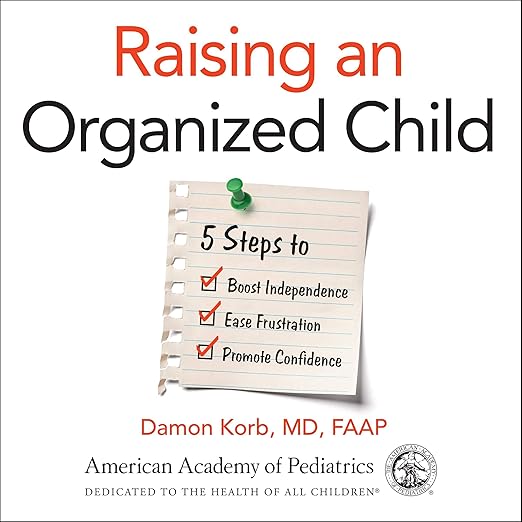
I was talking to a friend recently about why some parenting books feel genuinely useful and others feel like you already knew everything in them before you started. Her answer was that the useful ones tell you why something works, not just what to do. Raising an Organized Child fits that description. Dr. Damon Korb is a pediatric developmental specialist, and the book he’s written is not a list of organization hacks. It’s a developmental framework that explains why children of different ages are capable of different kinds of organization, and how adults can build toward it rather than demand it.
The central claim, organized children are raised, not born, is simple and carries real implications. If organization is a developmental skill, like reading or riding a bicycle, then it can be taught, scaffolded, and built over time. If it’s a fixed trait, then parents of disorganized children are stuck. Korb argues firmly for the former, and the five-step framework he builds around that argument applies from infancy through adolescence.
The Developmental Science Behind the Five Steps
What separates this book from comparable guides is its grounding in executive function research. Korb doesn’t just tell you to use visual schedules and checklists, he explains what executive function is, how it develops across childhood, what the neurological underpinnings look like, and why certain strategies work with certain children at certain ages. The reviewer who noted that the book makes child developmental stages easy to understand and just makes sense is describing the book’s genuine pedagogical achievement: complex developmental science delivered without condescension.
Steve Wojtas narrates with a clean, warm professionalism that serves explanatory science well. He doesn’t over-dramatize the anecdotes or rush through the step-by-step activities. The listening experience has the quality of a clear lecture from someone who understands the material, exactly right for a book that asks parents to genuinely understand the framework before applying it.
Scaling Across ADHD and Typical Development
This book is explicitly useful for children with ADHD, but it is not an ADHD parenting book. The distinction matters. By framing everything through executive function development, Korb makes the strategies applicable across the spectrum from typically developing children to those with significant executive function challenges. The reviewer who works as a therapist with ADHD children and their families and describes the book as something her families rave about captures this well, the framework scales, which is unusual.
The activities Korb provides are differentiated by age and developmental level, which is the design feature that makes the book genuinely reusable. A parent with a toddler, a middle-schooler, and a teenager could use the same book and find relevant guidance for each child at their current stage. At just under seven hours, the runtime reflects a book that earns its length through specificity rather than padding.
The Messy Bedroom as Diagnostic Lens
The reviewer who mentioned tidier bedrooms as a concrete concern is pointing at something real in the book’s framing. Korb uses the messy bedroom not as a problem to be solved through punishment or nagging but as a diagnostic signal: if a child can’t maintain an organized space, what does that tell you about where they are developmentally with planning, sequencing, and working memory? The bedroom is a lens, not the point.
This reframing from behavioral problem to developmental question is what gives the book its clinical usefulness. The parent who understands why their child can’t maintain a clean room, rather than simply assuming the child is being lazy or defiant, responds differently. And different responses produce different outcomes. The reviewer who called this their new child-rearing bible and compared it to Dr. Spock in scope is reaching for a cultural comparison, but the underlying point stands: this is a book parents return to across years, not one they read once and shelve.
Who Should Listen / Who Should Skip
Ideal for parents of children at any age from infancy through adolescence who want to understand executive function and organization as developmental skills they can actively cultivate. The book is equally valuable for parents of neurotypically developing children and for those with ADHD, learning disabilities, or other executive function challenges. Therapists and occupational therapists working with children will find the framework consistent with developmental practice. Parents looking for quick tricks rather than a developmental understanding will benefit from the content but may find the explanatory depth more than they were seeking.
Frequently Asked Questions
Does the book provide activities for specific ages, or is the guidance general across childhood?
Korb specifically differentiates activities by age and developmental level throughout the book. Whether you have an infant, a school-aged child, or a teenager, the book provides stage-appropriate guidance rather than one-size-fits-all advice.
Is this book primarily for children with ADHD, or is it relevant for typically developing kids too?
Both. Korb frames everything through executive function development, which means the strategies apply across the range from typically developing children who are simply disorganized to those with ADHD or other challenges. The book does not require a diagnosis to be useful.
Can this book be used starting with any age child, or is it better to start early?
The book covers the full arc from infancy through adolescence and is organized by developmental stage. Korb explicitly states it is never too late or too early to start, parents with teenagers will find relevant guidance, as will parents of toddlers. The entry point adapts to wherever your child currently is.
Does Dr. Korb address what to do when organization strategies consistently don’t work?
Yes, the book includes guidance on troubleshooting when the five-step framework isn’t producing results, including how to recognize when a child’s organizational challenges may reflect an underlying condition that warrants professional evaluation.