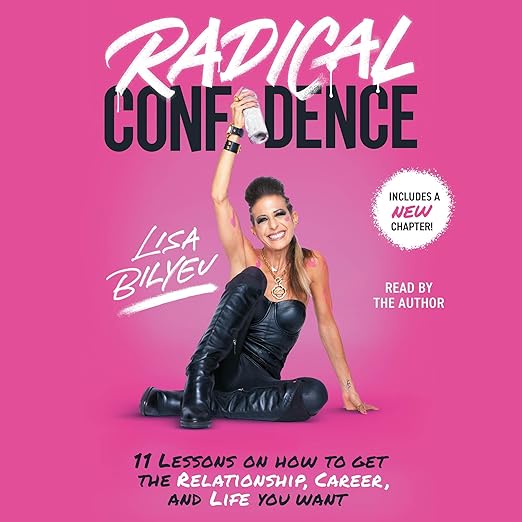
Lisa Bilyeu reads the opening chapter of Radical Confidence the way a person talks when they have finally stopped apologizing for themselves, and that quality never leaves the audiobook. The narration is Lisa in your ear the whole time, unfiltered, often profane, and completely convinced that the tools she is sharing can do what she claims they did for her. Bilyeu is the cofounder of Quest Nutrition and Impact Theory, and this audiobook recounts how she spent eight years as a housewife in Los Angeles before deciding, at considerable personal cost, to unpause her life. Running just under eight hours, it is one of those rare self-help listening experiences where the author's voice is so specific that a professional narrator would have been a downgrade.
What Lisa Bilyeu Delivers
The biographical spine of this book is what separates it from the crowded shelf of confidence literature. Bilyeu does not open with research citations or abstract frameworks. She opens with the embarrassing, uncomfortable story of being a London girl who dreamed of Hollywood, moved to Los Angeles to make films, and somehow ended up making elaborate dinners for a husband who was building a company she could not find a role in. The self-deprecation is pointed and funny, and it sets up everything that follows: the practical tools she developed not in a boardroom or a coaching program but in the process of figuring out her own specific failure of nerve. One reviewer called her a great communicator, and that is the right word. She writes and speaks the way someone talks when they have already told the story a hundred times and finally know which parts matter.
The book is organized around specific behaviors Bilyeu calls life hacks, but the word undersells them. Each chapter addresses a recognizable internal obstacle, whether it is the internal voice that insists you are an imposter, the tendency to wait for permission before starting, or the difficulty of staying motivated when progress is invisible. The practical framing is specific enough to be actionable without being prescriptive. Bilyeu is not asking readers to become her. She is asking them to identify their own version of the obstacle and work through it with the same rigor she applied to hers. A reviewer described the transformation from housewife to billion-dollar cofounder as the core of the book, and what makes that story work in audio is that Bilyeu sounds as surprised by it as anyone. There is no retrospective polish on the difficulty of the years she describes.
What Lisa Bilyeu Gets Right
Self-narrated books in this genre live or die by authenticity, and Bilyeu passes the test comfortably. There are moments where her timing as a speaker creates a beat that no script could have built in, a pause before a punchline, a slight change in register when she shifts from story to instruction. Her London accent surfaces occasionally and adds texture rather than creating any comprehension difficulty. One reader noted that she writes as though she is talking to you, and the audiobook makes that quality literal. The eight-hour runtime is well paced. Bilyeu does not linger in the memoir sections past their usefulness, and the instructional chapters are dense enough to reward note-taking but accessible enough to follow while walking or driving.
The production quality is clean and consistent, which matters in a self-narrated audiobook where recording conditions can vary. There are no distracting audio shifts between sessions. The bonus section at the end, a guide to the book's core tools, works well in audio format because Bilyeu delivers it conversationally rather than reading it like a checklist. The platform she built, Impact Theory and Women of Impact, gives her a substantial and engaged audience already, and their reviews reflect genuine investment in her message rather than promotional enthusiasm. The three reviewers cited here each identify something specific that landed for them, which is the reliable signal of a book doing substantive work rather than merely motivational noise.
Where Lisa Bilyeu Loses Some Ground
The book's title sets up a high promise, and Bilyeu delivers on most of it. The caveat worth noting is that the framework is most effective for listeners who are already reasonably self-aware and stuck on execution rather than on identifying what they want. If you are listening hoping the book will help you figure out what your ambitions actually are, the tools here assume you already know and need help acting on that knowledge. Bilyeu's specific context, a woman in the tech and entrepreneurship world navigating a marriage-career tension, will resonate deeply with some listeners and feel less directly applicable to others. The book does not universalize itself falsely, which is its strength, but it means some readers will need to do translation work to apply the frameworks to their own circumstances.
The chapters addressing negative self-talk are the strongest in the book. Bilyeu identifies the specific thought patterns that generate inertia and gives them names and addresses, which is more useful than the generic encouragement that fills lesser books in this genre. The chapter on learning to tolerate discomfort as a signal of growth rather than danger is particularly well argued and draws on her own physical fitness journey in ways that feel grounded rather than aspirational.
Who Should Pick Up Radical Confidence
This audiobook is built for listeners who feel the gap between where they are and where they want to be acutely but keep finding reasons to stay in place. It works especially well for women navigating professional transitions or recovering their ambitions after a period of deference to someone else's trajectory. Listeners who prefer evidence-based frameworks with cited research will find the approach too personal and anecdotal. Anyone who bounces off earnest, high-energy self-narration will struggle with the format regardless of the content's quality. But for the listener who needs someone to be direct with them about the internal mechanisms that generate self-limitation, Bilyeu's voice in this audiobook is exactly the right delivery method. The combination of personal memoir, practical instruction, and genuine self-deprecation is harder to achieve than it looks, and this book achieves it.