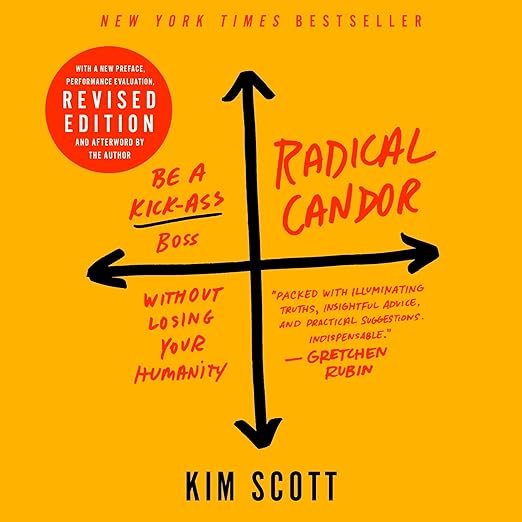
Kim Scott's Radical Candor has become one of those management frameworks that gets cited in organizations long after people have forgotten where it came from, which is the surest sign that an idea has genuinely taken hold. This fully revised and updated edition of the audiobook, narrated by Teri Schnaubelt, adds a new preface, afterword, and a bonus chapter on performance reviews that addresses the practical application of radical candor in formal evaluation contexts.
Naming Ruinous Empathy Gives You a Vocabulary
Scott's central argument is deceptively simple: you do not have to choose between being a pushover and being a jerk. The failure mode she is most concerned about is what she calls Ruinous Empathy, the tendency of managers to avoid difficult feedback in order to protect a team member's feelings, which ultimately fails both the person and the organization. Her framework places four quadrants along two axes: care personally and challenge directly. Radical Candor occupies the high-high quadrant. Obnoxious Aggression is high challenge without care. Manipulative Insincerity is low on both. Ruinous Empathy is high care with low challenge.
The value of naming these four failure modes is that it gives people a vocabulary for recognizing patterns they have always encountered but never been able to articulate. Most people, on first encountering the framework, can immediately identify supervisors who practiced Manipulative Insincerity, colleagues who suffered under Obnoxious Aggression, and moments when they themselves deployed Ruinous Empathy toward someone they were trying to help. That recognition is where the book's practical power begins.
One reviewer described the book as "a comprehensive playbook for the best management practices in Silicon Valley, taken directly from Kim Scott's incredible experience at Google and Apple." Another, who encountered the framework through a government agency training workshop, described falling "in love with the ideas behind it" and coming back to read the full book. That pattern of encountering the concept in an organizational context and then seeking out the source material is extremely common and says something about how well the framework holds up under scrutiny. It is not a simplification that collapses on examination; it is a genuine model that generates useful distinctions.
Schnaubelt Carries the Case for Care and Rigor
The updated edition is specifically worth the investment for listeners who have encountered the original. The bonus chapter on performance reviews is a concrete extension of the framework into the most high-stakes feedback context most managers face, and it addresses gaps that critics of the original edition identified. The new preface also reflects Scott's experience watching the concept get applied, and misapplied, in organizations around the world.
Teri Schnaubelt's narration is a good match for the material. Radical Candor is not a book that needs theatrical reading. It needs a narrator who can keep complex frameworks and their sub-components clear across nearly twelve hours of content. Schnaubelt does that consistently, maintaining a professional warmth that suits Scott's underlying argument that care and rigor are compatible.
Scott draws extensively on her own management experiences at Google and Apple, and those anecdotes do important work. Abstract frameworks are easy to dismiss; concrete stories about specific situations are harder to ignore. When Scott describes a moment when she failed to challenge directly, or a time when she overcorrected into Obnoxious Aggression, the specificity makes the failure modes feel recognizable rather than theoretical. The book's narrative portions land particularly well in audio, because Schnaubelt gives them the weight they deserve.
Directness as a Virtue Is Culturally Specific
The book's primary audience is managers and team leads, and the framework is presented with that context consistently in mind. Individual contributors who are not in management roles will find the content applicable but may need to do some translation work to apply the principles in peer relationships rather than supervisor-direct report dynamics. Scott has written about the broader applicability of radical candor in human relationships, but the book itself is oriented toward the managerial context.
At nearly twelve hours, the updated edition is substantially longer than many listeners expect for a business audiobook. The length reflects the depth of engagement Scott brings to the subject, including multiple frameworks, extensive anecdotes, and the new performance review chapter. Listeners who want a summary of the core concept can find it in shorter form elsewhere, but those who want to actually apply the framework will find the fuller treatment necessary.
Some reviewers have noted that the framework's Silicon Valley origins shape its assumptions about organizational culture. The emphasis on directness as a virtue is culturally specific, and organizations in different national or industry contexts may find some of Scott's prescriptions harder to implement than others. The revised edition addresses this more explicitly than the original did, but the California tech culture influence is still present in the examples and assumptions.
A Practitioner's Book, Derived From Real Experience
This audiobook is most valuable for new and mid-career managers who are navigating the challenge of giving meaningful feedback without either damaging relationships or allowing underperformance to continue. It is also worth listening to for senior leaders who want a common framework they can introduce to management teams, and for anyone who has been on the receiving end of feedback so vague it was useless.
Listeners who will get less from it include individual contributors who have no supervisory responsibilities, those who work in organizational cultures where direct feedback is structurally discouraged, and anyone who wants research-heavy academic treatment rather than practitioner experience. Radical Candor is fundamentally a practitioner's book, derived from specific organizational experience, and that is exactly what makes it useful and exactly what limits its scope.
Frequently Asked Questions
Does Teri Schnaubelt's narration serve the Radical Candor audiobook well, given its dense framework content?
Yes. Schnaubelt reads with the kind of professional clarity that keeps complex conceptual material trackable across a long runtime. She does not dramatize the content, which is the correct choice for a management framework book. The nearly 12-hour listen is sustained without the narration ever becoming an obstacle to following the argument.
Can someone apply the Radical Candor framework from the audiobook alone, or do you need a physical copy?
The audiobook is sufficient for understanding and beginning to apply the framework. The two-axis model and four quadrants are explained clearly enough that listeners can internalize the core distinctions without needing a diagram in front of them. Supplementary materials at the Radical Candor website extend the application for organizations wanting to implement the system formally.