Quick Take
- Narration: Luke Daniels brings the same accessible energy to Steve and his treasure-hunter companions that he’s applied to dozens of middle-grade audio titles, reliable pacing, clear character distinction, and a light touch with the humor.
- Themes: Single-player versus multiplayer as a philosophy of survival, trust earned through shared danger, the price of protecting others
- Mood: Bright and fast-moving, with the specific excitement of game logic translated into narrative stakes
- Verdict: Quest for the Diamond Sword does something harder than it looks, it makes a Minecraft story feel like an actual story, with real characters and a moral question at its center.
My cousin has a son who didn’t want to read. Not because he couldn’t, the school confirmed his reading level was fine, but because no book had ever presented itself to him as something more interesting than Minecraft. That standoff lasted from first grade through third grade. Then someone suggested he try the Unofficial Gamers Adventure series. He’s on book six now, and last month he started asking for books that aren’t about Minecraft. That pipeline, from game-adjacent fiction to actual reading, is the most important thing this series does, and it’s worth acknowledging upfront.
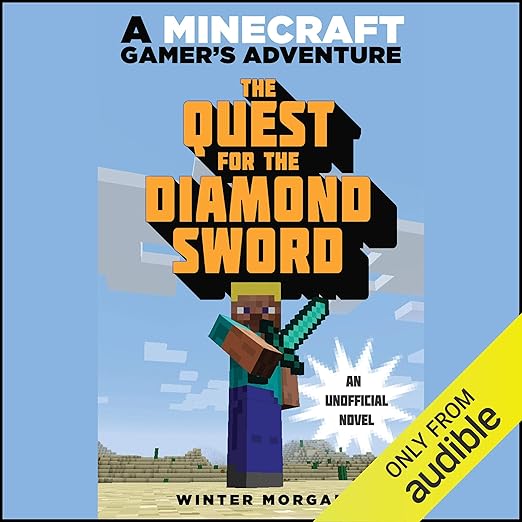
Quest for the Diamond Sword is the first book in Winter Morgan’s An Unofficial Gamers Adventure series. Steve lives on a wheat farm in the Minecraft world, trading with villagers, maintaining his supplies, living a careful single-player existence. When zombies attack and destroy the village’s access to swords, Steve sets out to mine 40 diamonds, the rarest material in the Overworld, to craft a weapon powerful enough to protect everyone. He finds the treasure hunters Max, Lucy, and Henry along the way, and the book becomes, underneath its action-adventure surface, a story about whether it’s better to do hard things alone.
The Game Logic as Story Logic
What Winter Morgan does well in this first volume is translate Minecraft’s actual mechanics into narrative stakes that make internal sense. Steve’s wheat farm, the trade economy with villagers, the fear of nightfall when hostile mobs spawn, the hierarchy of minerals, the crafting system, all of it functions as worldbuilding rather than tutorial. A child who has never played Minecraft can follow the plot without confusion. A child who has played it extensively gets the additional pleasure of seeing their game world rendered as fiction, with the unspoken rules suddenly articulated as story logic.
The reviewer whose six-year-old son had never wanted to read until this book captures something real: the vocabulary is appropriately varied, the sentences are structured for emerging readers, and the subject matter is immediately legible to any child who has spent time in Minecraft’s world. The reading level is calibrated for its stated audience without talking down to it.
Max, Lucy, Henry, and the Question of Multiplayer Trust
The decision to make Steve a committed single-player figure whose quest forces him into a group is the book’s smartest structural choice. The tension around whether Steve should trust his new treasure hunter friends is explicitly stated in the synopsis, and Morgan doesn’t resolve it cheaply. The three treasure hunters have their own agendas; their help with Steve’s quest is genuinely uncertain for most of the narrative. The book earns the resolution of that uncertainty because it doesn’t pretend the question is simple.
Steve’s goal, protect the remaining villagers by acquiring the most powerful weapon in the Overworld, is a classically simple heroic motivation. What gives it dimension is that the path requires cooperation with people he didn’t choose, which involves compromises and moments of doubt that the target audience of 6-10-year-olds will recognize from their own lives. The multiplayer-versus-single-player question operates simultaneously as game philosophy and social philosophy, which is genuinely clever writing for a children’s adventure novel.
Luke Daniels and the Requirements of Game-Adjacent Audio
Luke Daniels has narrated extensively in middle-grade audio, and his work here reflects a narration style calibrated for young listeners: clear articulation, reliable pacing, enough energy to maintain attention without overselling the material. The treasure hunters Max, Lucy, and Henry are voiced distinctly enough to track without becoming caricatures. Steve, as the central consciousness of the story, has the appropriate combination of determined earnestness and nervous survival calculation that the character requires.
The 2-hour-and-23-minute runtime makes this an ideal single-session listen for younger children, or a two-session listen for children who consume audiobooks before bed. The format question parents face, whether to buy the audio or the print version for a child who’s struggling to engage with reading, has an interesting answer here: the audio version removes the friction of decoding while still delivering the story, and several reviewers report using it as a stepping stone to print engagement.
Who Should Listen and What the Series Becomes
The Unofficial Gamers Adventure series is most effective as an entry point for children who are Minecraft players and reluctant readers. The first book is the natural place to start, it establishes the world and the central characters, and the trust question at its heart gives the series a thematic grounding that later volumes build on. Parents who’ve been told by teachers that their child needs more reading experience will find this series a reliable bridge between screen time and book time.
Frequently Asked Questions
Do you need to play Minecraft to understand Quest for the Diamond Sword?
No. Morgan explains the world’s mechanics naturally through the story, nightfall dangers, mob behavior, the mineral hierarchy, the trading economy, in ways accessible to children with no Minecraft experience. The game familiarity enriches the reading, but it’s not a prerequisite.
Is Quest for the Diamond Sword the first book in the An Unofficial Gamers Adventure series?
Yes, it is the first book and the best starting point. Steve’s character, his single-player philosophy, and his relationships with Max, Lucy, and Henry are all established here. Later books in the series build on this foundation.
The listing says ‘unofficial’, what’s the relationship between this series and actual Minecraft content?
This is fan fiction set in a Minecraft-inspired world. It is not published, endorsed, or affiliated with Mojang or Microsoft, who make the actual game. The ‘unofficial’ label is standard across this genre of fiction, which has a large and well-established market.
What age range is this audiobook specifically designed for?
The series targets readers ages 6-12, with the reading level calibrated for early independent readers. Reviewer accounts confirm the book works for children as young as five when listened to with a parent, and provides genuine independent engagement for children six and up. The moral complexity of the trust themes may resonate more with children in the 8-10 range.