Quick Take
- Narration: Hugh Kermode delivers a measured, intelligent read that suits Al-Khalili’s precise prose without oversimplifying for a general audience.
- Themes: Wave-particle duality, the history of quantum theory, the philosophical implications of uncertainty
- Mood: Thoughtful and unhurried, with flashes of genuine wonder
- Verdict: An honest, math-free introduction to quantum mechanics that rewards patient listeners willing to sit with ideas that refuse to be tidy.
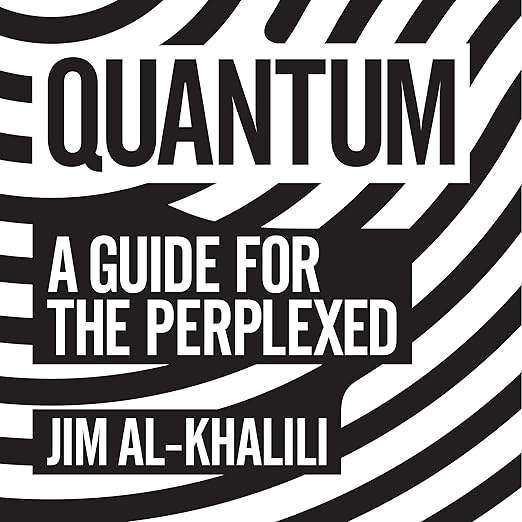
I was somewhere between Heisenberg and a headache when I first picked up Jim Al-Khalili’s Quantum: A Guide for the Perplexed. It was a Sunday afternoon, rain on the window, and I had just finished a thriller that left me wanting something that required a bit more from my brain. I wasn’t expecting to spend the next several hours genuinely unsettled by reality. But here we are.
Al-Khalili is a physicist and broadcaster with a rare gift for making the technically rigorous feel accessible without making it feel dumbed down. That balance is harder to achieve than it looks, and it’s the central reason this audiobook works as well as it does. Published in 2003 and read here by Hugh Kermode, it’s a title that has aged better than many of its contemporaries in the popular science genre because its subject is timeless in a way few topics are: the weirdness of quantum mechanics is not going away.
What Math-Free Actually Means Here
One of the first things listeners should understand is what this audiobook commits to and what it doesn’t. Al-Khalili explicitly sets out to guide the non-specialist through quantum mechanics without mathematical notation. Reviewer William Kehrer describes it accurately as a “math free survey” and flags the 2003 publication date as something to keep in mind. You won’t come away knowing how to calculate anything. What you will come away with is a genuine conceptual understanding of why Schrodinger’s cat became a cultural touchstone, why the Copenhagen interpretation remains contested, and why the double-slit experiment is one of the most astonishing results in the history of science.
The book moves chronologically through the birth of quantum theory, tracing the contributions of Planck, Einstein, Bohr, Heisenberg, Schrodinger, and Dirac with enough biographical texture to keep the human drama present. Al-Khalili is particularly good at conveying the sense that these scientists were not simply solving puzzles but actively arguing about the nature of reality itself, and losing sleep over it.
The Question of Who This Is Really For
The genre tag here says children’s audiobooks, but I want to be direct about that: this is an adult popular science title. Al-Khalili’s writing is sophisticated and assumes a baseline level of intellectual engagement. A motivated teenager with a serious interest in physics would get a great deal from it, but it is not designed for younger listeners, and its runtime of nearly eight hours reflects its depth. Reviewer K.A. Czepelka captures the audience well when writing that quantum mechanics is “not so much a difficult subject to understand (if explained well) as much as it is just plain weird,” suggesting the book is for those willing to sit with that weirdness rather than demand resolution.
If you’ve read Brian Greene’s The Elegant Universe or Richard Feynman’s QED, you’ll recognize the register. This sits comfortably in that tradition of serious popular physics writing that treats its readers as adults capable of tolerating conceptual discomfort.
Hugh Kermode’s Narration and the Pacing Question
Kermode’s narration is clean, precise, and unhurried. For a text this dense with ideas, a slower tempo is a genuine advantage. He doesn’t perform the material so much as present it, which is the right call for a book that asks the listener to pause and think. The downside is that listeners who prefer more warmth or personality in their narrators may find the delivery slightly austere. There’s no theatrical quality here, no attempt to animate the scientists as characters in the way a dramatized production might. It’s a considered reading of a considered book.
Where listeners may struggle is with concepts that genuinely require time to absorb. Some passages about wave function collapse or quantum entanglement may benefit from a second listen. Unlike a print book where you can flip back a page, the audio format demands either full attention or a willingness to rewind. That’s not a criticism of the production so much as a practical note about how to approach it.
What the 2003 Date Does and Doesn’t Change
Some reviewers flag the publication date. The foundations of quantum mechanics covered here, the Copenhagen interpretation, the EPR paradox, the measurement problem, are not developments that have been overturned since 2003. Al-Khalili’s account remains accurate to the history and the physics as it was understood then. What has advanced significantly since 2003 is quantum computing and quantum cryptography, areas the book doesn’t cover in the depth a current reader might want. For a conceptual grounding in the fundamentals, though, the age of the text is largely irrelevant.
There is something quietly admirable about a book that doesn’t try to wrap the quantum world in a neat bow. Al-Khalili ends on an appropriately open note, acknowledging that the philosophical questions raised by quantum mechanics remain unresolved after a century of argument. That intellectual honesty is part of what separates this from the more breathless entries in the popular science genre.
Who Should Listen / Who Should Skip
Listen if you want a careful, historically grounded introduction to quantum mechanics that doesn’t require a physics background but does require patience. This works well for adults returning to science after years away, or for anyone who has heard the terms but never had them properly explained.
Skip if you’re expecting to come away with practical knowledge of quantum applications, or if you need narration with warmth and personality to stay engaged. Also skip if you’re hoping for a children’s science title; this is an adult book shelved in the wrong category.
Frequently Asked Questions
Is this book actually suitable for children, given the genre tag?
No. Despite the children’s audiobooks category listing, Jim Al-Khalili’s Quantum is an adult popular science title. It requires patience and a willingness to sit with abstract ideas. A motivated and scientifically inclined teenager of 15 or 16 might manage it, but it’s not designed for younger audiences.
Does the 2003 publication date make the physics outdated?
For the foundational concepts covered, no. Quantum mechanics as Al-Khalili explains it, from wave-particle duality to the Copenhagen interpretation, hasn’t been overturned. What has advanced since 2003 is quantum computing and applied quantum technology, which the book touches on only briefly.
Is there any mathematics involved?
None. Al-Khalili explicitly designed this as a math-free guide. You won’t encounter equations. The trade-off is that some conceptual explanations require more effort to follow without the scaffolding of formulas, but reviewers consistently confirm that the writing makes the material accessible.
How does Hugh Kermode’s narration suit this kind of dense nonfiction?
Kermode reads with precision and an unhurried pace, which serves the material well. He doesn’t inject theatrical personality into the reading, which suits Al-Khalili’s measured prose. Listeners who prefer warmer or more animated narrators may find the delivery slightly dry, but for a conceptually demanding text, the clarity is an asset.