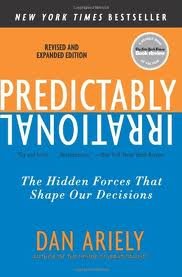
Before You Press Play
- Read by: Jason Reynolds reads Ariely's experiments with clear, measured delivery, accessible without dumbing down the behavioral economics.
- At its heart: Cognitive bias, irrational decision-making, hidden forces in consumer behavior
- Vibe: Intellectually engaging and gently provocative, you finish chapters questioning decisions you made that morning
- Short version: A foundational behavioral economics text that holds up better than most in the genre, though listeners who have read widely in this space will find familiar territory.
I first encountered Dan Ariely's work through a graduate seminar on editorial marketing strategies, specifically, how publishers price backlist titles and bundle digital editions. Someone assigned a chapter on the psychology of free offers and relativity in pricing, and I went home and read half the book that night. Coming back to it now as an audiobook, what strikes me is how well the core argument holds. Ariely is not making a trendy claim. He is making a structural one: that the irrationality in our decisions is not random but systematic, and therefore predictable.
The framework is familiar to anyone who has spent time in behavioral economics, Kahneman's work covers much of the same conceptual ground, and Thaler and Sunstein's Nudge territory overlaps here. But Ariely's particular gift is the experiment. Each chapter is built around a specific, often counterintuitive study that demonstrates one dimension of predictable irrationality: why a one-cent aspirin does less for a headache than a fifty-cent one, why recalling the Ten Commandments reduces dishonesty even in contexts where cheating would never be detected, why we pay four dollars for coffee we once paid less than a dollar for and feel entirely at peace with that decision.
Our Take on Predictably Irrational
What distinguishes Ariely from some of his behavioral economics peers is his refusal to moralize. He documents the irrationality without excessive hand-wringing about what it means for human nature or rational-choice economics. The tone is curious rather than prescriptive. He wants to understand the mechanisms, and the book rewards that curiosity rather than turning every chapter into a self-improvement intervention.
The material on expectations is particularly strong. The aspirin experiment, in which participants report more pain relief from a higher-priced placebo pill, is a clean illustration of how expectation shapes experience at a neurological level, not just a psychological one. Ariely builds from these individual findings toward a broader claim about how marketing, social norms, and emotional context reliably distort what we think of as rational preference. It is a convincing argument, assembled piece by piece.
Why Listen to Predictably Irrational
Jason Reynolds's narration serves the material well. He reads with the kind of measured clarity that academic nonfiction requires, neither artificially animated nor flat. The experiments translate to audio effectively because they are narrative in structure: setup, intervention, finding, implication. Reynolds does not rush through the implications sections, which is where the analysis earns its keep.
Reviewer HelloKitty99 described a reading experience I recognize: encountered it through a recommendation, went to the library, knew immediately it needed to be purchased, then made notes. That is the response to a book that keeps generating applications to your own life. The buffet behavior chapter alone is enough to make you reconsider the last time you ate past satisfaction because the meal was unlimited.
What to Watch For in Predictably Irrational
The honest criticism is that the genre has expanded significantly since this book's original publication. Listeners who have already read Thinking Fast and Slow, Nudge, Misbehaving, or The Psychology of Money will find the conceptual ground familiar and may wish for more methodological depth. The book was designed for a general audience, which is a strength for newcomers and occasionally a limitation for readers looking for the messier realities of behavioral research.
One reviewer gave it a single star for not finishing it, that review tells you more about mismatched expectations than about the book. This is a structured, academic-adjacent listen that requires attention and rewards reflection, not background listening.
Who Should Listen to Predictably Irrational
Ideal for listeners new to behavioral economics, marketing professionals wanting a principled foundation for understanding consumer behavior, and anyone who has ever made a financial decision they later couldn't rationally explain. Less essential for listeners already deep in the Kahneman-Thaler-Ariely canon who are looking for new material rather than a well-constructed primer. That said, even for experienced readers, Ariely's experimental storytelling is unusually engaging and worth a listen on its own terms.
Good to Know
Is Predictably Irrational still relevant given how much behavioral economics has developed since its publication?
The core experiments and arguments remain sound. The framework for understanding systematic irrationality is foundational rather than trendy, so it holds up. Listeners who have read widely in the field will find familiar territory rather than new discoveries.
How does Jason Reynolds's narration handle the academic material, is it accessible for non-specialist listeners?
Reynolds reads clearly and at an appropriate pace for the material. The experiments are narrated as stories, which makes them engaging, and he doesn't rush the analytical passages. Listeners without a social science background should follow without difficulty.