Quick Take
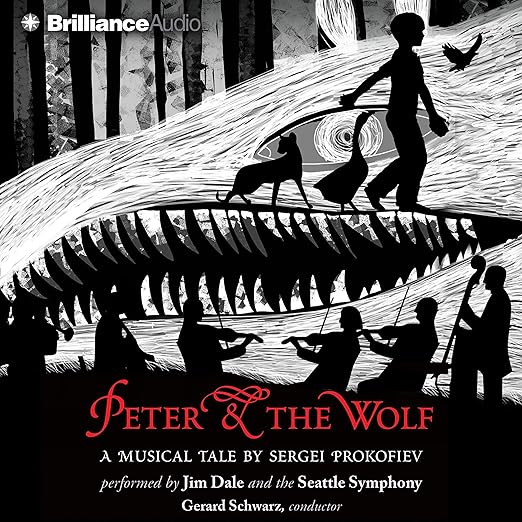
- Narration: Jim Dale brings his full range of vocal characterizations to Peter, the grandfather, the wolf, and every animal in between, paired with the Seattle Symphony’s live performance of the Prokofiev score.
- Themes: Courage and childhood independence, the gap between caution and action, triumph of cleverness over fear
- Mood: Adventurous and orchestral, with a theatrical grandeur that treats young listeners as a genuine audience
- Verdict: The combination of Dale’s multi-Grammy narration and a first-rate orchestra makes this the definitive audio version of Prokofiev’s classic for children.
There are certain pieces of music that embed themselves in memory so early and so deeply that encountering them again as an adult produces something almost like recognition of a lost self. Peter and the Wolf was one of those for me. I remember sitting on the floor of my childhood bedroom with headphones on, listening to a scratchy cassette recording, trying to figure out which instrument was playing which animal. Years later I put on this Jim Dale production during a quiet weekday morning, and within the first two minutes the duck’s oboe theme arrived and something in my chest did a thing I hadn’t expected.
Prokofiev composed Peter and the Wolf in 1936 as a symphonic fairy tale specifically designed to introduce children to the instruments of the orchestra. Each character is assigned a theme played by a distinct instrument: Peter by the string quartet, the bird by the flute, the duck by the oboe, the cat by the clarinet, the grandfather by the bassoon, and the wolf by the French horns. The concept is pedagogically brilliant and musically gorgeous, and it has been performed and recorded countless times. The question, then, is what Jim Dale and Brilliance Audio bring to a production that already has a long history of excellent recordings.
What Jim Dale Does That Other Narrators Don’t
Dale is a multi-Grammy Award winner whose recordings of the Harry Potter series are a benchmark for audiobook narration. What he does in this production is something subtler than those longer-form performances required: he creates vocal characterizations that complement rather than compete with Prokofiev’s instrumental portraits. When the oboe is playing the duck’s theme, Dale’s duck voice adds another layer of characterization without overwhelming what the orchestra is already communicating. When the grandfather grumbles, the bassoon underneath his words makes the grumpiness dimensional in a way that neither voice nor instrument could achieve alone.
The Seattle Symphony, led by music director Gerard Schwarz, brings genuine orchestral quality to the recording. This is not a reduction or a simplified version of the score. It’s a real symphonic performance, which means that listeners who grow up on this recording will encounter the same musical material when they hear the work performed live or on a concert recording later in life. That continuity matters: the best children’s music education is one that doesn’t patronize children by simplifying the source material.
Twenty-Five Minutes and the Art of the Right Length
The runtime deserves a moment of deliberate consideration. Twenty-five minutes is exactly long enough for the story to build, establish its characters, and resolve its conflict. It is short enough to hold the attention of children as young as three without restlessness. It is the perfect length for a bedtime listen, a car ride, or the kind of rainy afternoon that calls for something that feels like a special occasion rather than background noise. Productions that run this length succeed by being exactly what they need to be without padding, and this one doesn’t pad.
A reviewer mentions playing the soundtrack for a 53-year-old who still remembered what each animal represents, which captures something essential about the piece: the musical associations in Prokofiev’s score are genuinely memorable in a way that most pedagogical children’s music is not. They stay with you. A 25-minute investment that produces a lifelong connection to a piece of classical music repertoire is a remarkable return.
Who Should Listen and Who Should Skip
Families with children of virtually any age under 12 will find this a valuable listen, with the production particularly well-suited to the 3-8 range for initial discovery. Adults looking for a high-quality recording of the Prokofiev score alongside excellent narration will find Dale’s version among the best available in any format. Music educators or parents who want to introduce orchestral instruments to children have few better tools. Listeners who want only the orchestral music without narration should seek a purely instrumental recording instead, but for anyone who wants the full story-and-music experience, this is the one to choose.
Frequently Asked Questions
Does Jim Dale perform distinct voices for each animal character, or does he read the narration in a single voice?
Dale creates individual vocal characterizations for each character: Peter, the grandfather, the duck, the bird, the cat, and the wolf all have distinct voices that complement the instrumental themes Prokofiev assigned to each one. It’s a full performance rather than a straight read.
Is the Seattle Symphony recording used here a studio recording made specifically for this production?
The recording features the Seattle Symphony under music director Gerard Schwarz and was produced in coordination with the narration rather than licensed from an existing concert recording, allowing the musical timing to align with Dale’s pacing throughout.
How does this Peter and the Wolf compare to other audiobook versions for children?
The Dale and Seattle Symphony combination is among the strongest available. The voice casting is exceptional, the orchestral quality is professional-grade, and the integration of music with narration is tighter than in many competing versions. For a first-time listener, this is the version to choose.
My child is 3 years old. Is the wolf frightening in this production?
The wolf is played as dangerous and exciting rather than genuinely terrifying. Dale’s characterizations keep the tone adventurous rather than scary, and the story’s resolution is triumphant rather than tragic. Most 3-year-olds who enjoy animals and music will handle it without difficulty.