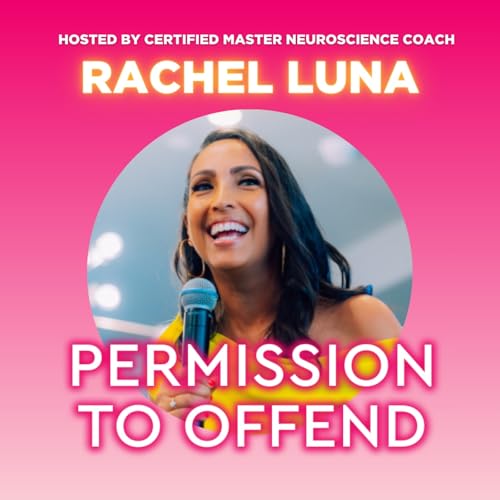
Rachel Luna's audiobook Permission to Offend arrives packaged like a business title but functions more like a coaching intervention at close range. Luna is a Certified Master Neuroscience Coach, and she leans into that credential not as an academic shield but as a framework for why so many people shrink themselves in professional and personal life. The central argument is as simple as it is uncomfortable: the versions of ourselves we perform for others' comfort are costing us something real, and the cure is learning to live with the discomfort of being fully seen. At eight hours and twenty-five minutes, this is a substantial commitment, and Luna earns every hour of it.
Luna self-narrates, which turns out to be exactly the right call. Her voice has the cadence of someone who has rehearsed these ideas in front of live audiences, not in a recording booth. She speaks with warmth and directness, and the occasional rawness in her delivery only reinforces the message. The audiobook has the pacing of her podcast work: conversations that move between personal disclosure, practical challenge, and the kind of honest reflection that catches you slightly off guard when you least expect to be caught.
Distinguishing Authentic Expression From Performative Provocation
What Luna is really teaching here is a form of self-editing awareness. She draws on neuroscience to explain why we instinctively soften our language, downplay our convictions, and seek approval even at significant personal cost. The title is deliberately provocative, but the book itself is not about cruelty or shock tactics. It is about recognizing where your editing habit is running your life and then, carefully and deliberately, choosing otherwise. The distinction between authentic expression and performative provocation is one Luna makes carefully and returns to throughout.
The structure loosely mirrors her podcast format: real conversations and real stories from people across different professional backgrounds who found that giving themselves permission to be unfiltered shifted something fundamental. These are not rags-to-riches success stories. They are stories about boundary-setting, creative courage, and what happens when you stop anticipating everyone else's reaction before you have even spoken. Luna ties each story back to specific brain mechanics, which keeps the material grounded rather than purely aspirational. She covers business, money, brain science, and faith as four interconnected domains where self-editing is most costly, and she is specific about what the costs actually look like in practice, not just in the abstract.
When She Drops Her Voice, the Texture Arrives
The audiobook format suits this material particularly well. Luna's narrative style is conversational, almost intimate, and the self-narration means you hear the exact inflections she intends. When she pauses for effect, when she drops her voice to say something she has wrestled with personally, that texture arrives intact. Reading the same passage on a page would flatten it considerably. This is one of those titles where the audio experience is the intended experience, not a secondary format for a primarily print-designed text.
Her focus on money, brain science, business, and faith is not accidental. These are the four areas where people most systematically hide from their own convictions. The business and money sections will resonate strongly with entrepreneurs and professionals who have found themselves softening their pricing, their vision, or their expertise out of fear of being judged. The faith dimension is present but not heavy-handed; Luna includes it as part of a complete picture of human motivation rather than as a doctrinal argument. For listeners who have felt suspended between what they believe and what they are willing to say in public, the convergence of all four areas in a single framework is likely to be clarifying in ways that individual conversations with coaches or mentors rarely manage.
A Smaller Sample That Still Feels Affecting
Listeners coming in expecting a structured, chapter-by-chapter framework with numbered steps may find the format less tidy than they expected. Luna is a coach and podcaster first, and the book reflects that. The ideas accumulate and reinforce each other rather than building toward a single climactic system. Some listeners will find this organic and refreshing; others who prefer dense, linear nonfiction may want to be prepared for a more associative structure that requires a different kind of attention.
The 4.9 rating, even across a smaller sample of seventeen listeners, signals that the people who find their way to this content tend to find it genuinely affecting. That tracks with what the book promises: it is not meant for everyone, and Luna says so directly. If you are comfortable with your current level of self-expression, this audiobook will not unsettle you. If you suspect you are holding something back and have been for a while, that is precisely the gap Luna is writing into, and eight hours of her voice addressing you directly is a meaningful way to begin addressing it.
Applying the Honesty to Yourself First
Luna's target listener is the professional who has been editing themselves into exhaustion: the entrepreneur who softens every pitch, the creative who waits for permission that never officially arrives, the person whose authentic voice has gotten quieter over years of seeking approval. The audiobook will also land well for anyone already working within coaching, therapy, or self-development contexts who wants to hear neuroscience framed accessibly rather than academically. Her emphasis on the nervous system and brain mechanics gives listeners a more granular account of the editing process than most motivation-focused books offer.
Listeners who prefer pure business strategy, data-driven frameworks, or content that keeps faith entirely separate from professional development may find this a less comfortable fit. Luna writes from an integrated life perspective, and that integration is central rather than incidental to the book's argument. Go in knowing that, and you will be in the right relationship with what she is offering. Luna's eight hours are dense with the kind of honesty that only works if you are willing to apply it back to yourself rather than using it to evaluate other people.
Does the audiobook version of Permission to Offend include the same content as the print edition?
Yes, Rachel Luna self-narrates the full content, and the audiobook runs eight hours and twenty-five minutes. The conversational delivery adds a dimension the print edition cannot replicate, since Luna's coaching voice and pauses are part of the experience.
Is Permission to Offend structured as a podcast or as a traditional audiobook?
It sits between the two. The content grew out of Luna's podcast work, so the tone and pacing reflect that background, with real stories and conversational momentum. It is produced as a standalone audiobook rather than a podcast episode collection, but listeners who enjoy the podcast format will feel immediately at home.