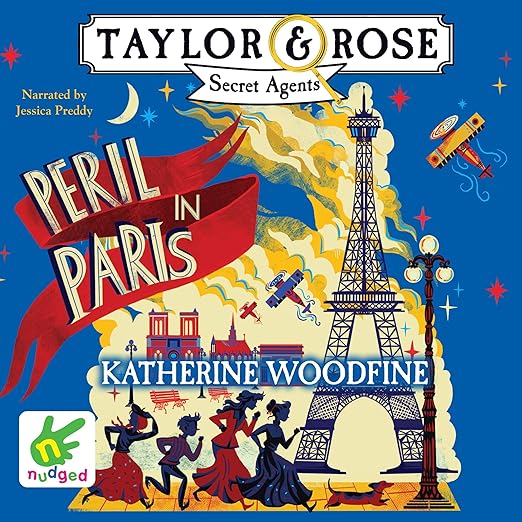
Quick Take
- Narration: Jessica Preddy’s performance is polished and carries genuine period warmth, she handles Sophie’s intelligence and Lil’s impulsiveness with clear vocal differentiation.
- Themes: Espionage and female friendship, Edwardian class and gender constraint, early aviation as a site of military anxiety
- Mood: Elegant and propulsive, with a European setting that feels genuinely researched rather than decoratively placed
- Verdict: A confident series opener that takes the Taylor and Rose partnership from mystery-solving into full espionage territory, the 1911 Paris setting earns its place, and Jessica Preddy’s narration handles the tonal shift from the Sinclair Mysteries gracefully.
I came to this series through its predecessor: Katherine Woodfine’s Sinclair Mysteries, which introduced Sophie Taylor and Lilian Rose as department store detectives in Edwardian London and built a loyal readership over four books. Peril in Paris is the opening of the Taylor and Rose Secret Agents series, which picks up the characters as adults and repositions them in the world of espionage. I listened to the first chapter during a Sunday morning run and ended up walking the final two miles because I did not want to interrupt the rhythm of what was happening.
It is 1911. Sophie and Lil are now working for the Secret Service Bureau, operating under enough cover to justify their presence in Paris without explaining too much. The city itself is deployed with care: the boulevards, the grand hotels, the aeroplanes overhead that would have been genuinely astonishing objects in 1911: and Woodfine uses the period detail not as atmosphere decoration but as plot material. The aviation context in particular matters to the mystery’s resolution in ways that reward attentive listeners.
From Department Store Sleuthing to Actual Espionage
Reviewer Mystery Fan, who had loved the Sinclair Mysteries for its ensemble team approach, expressed some ambivalence about the shift toward a two-character dynamic in Taylor and Rose. That is a legitimate observation about what changes in this series opener, and it is worth addressing directly. The Sinclair Mysteries’ pleasure came partly from the full cast of Baker Street Irregulars-style characters working together. Peril in Paris narrows the focus considerably, placing Sophie and Lil in a foreign country where their network is limited and their trust must be carefully calibrated. That constraint is a feature for the espionage genre even if it represents a loss from the mystery-ensemble format.
What the new format gains is intimacy. Sophie and Lil’s dynamic in their original series was charming; in Paris it becomes load-bearing in a different sense. The decisions they make under pressure, the way they cover for each other, the moments when their individual personalities create friction: these are rendered with enough specificity that the reader who loved the original series will recognize these characters while feeling their growth. Reviewer P. Babin, reading with her teen daughter, found the series just as entertaining and enchanting as the original books.
The 1911 Setting as Active Element
This is not 1920s Paris: not Hemingway’s expatriate mythology, not the art world of the interwar years. It is an earlier, more tightly ordered city with its own social anxieties and pleasures. The presence of aeroplanes as genuinely new technology, the class dynamics of grand hotel service, the way the British characters navigate French social territory: all of this is handled with the light touch of someone who has done genuine research and knows when to put the research away and let the story run.
Jessica Preddy’s narration is well-matched to this material. She has a crisp, clear delivery that carries period elegance without stiffness, and she makes the Paris sequences feel genuinely different from the London atmosphere of the Sinclair books. Her handling of French names and dialogue is natural rather than effortful, which removes a potential friction point for audiobook listeners unfamiliar with the period setting.
The Message Problem and Whether It Is One
Reviewer Mystery Fan noted the book felt heavy-handed in its messaging at moments, which is a fair critique of how Woodfine handles some of the feminist and class-related observations in this entry. The 1911 women-in-espionage premise is inherently political, and some dialogue that draws attention to Sophie and Lil’s exceptional position within their professional environment tips slightly toward the programmatic. This is not a frequent problem and does not override the narrative momentum, but listeners who prefer their historical fiction to let the period speak for itself rather than annotate it will notice it.
At nearly seven hours, Peril in Paris has enough space to develop the mystery through its proper stages without shortcuts. The murder that drives the plot lands with appropriate weight at roughly the midpoint, and the spy-network mechanics that complicate the investigation are set up cleanly enough that the resolution feels earned.
Who Should Listen and Who Should Skip
Fans of the Sinclair Mysteries are the natural first audience, but Peril in Paris works as a standalone entry for new listeners comfortable with Edwardian period detail and espionage plots. Reading parent-child pairs will find it an excellent shared listen: the themes of female friendship, professional competence, and period social constraint generate real conversation. The spy-thriller elements skew this slightly older than the Sinclair Mysteries: readers 10 and up rather than 8 and up. Adult listeners who enjoy Jacqueline Winspear or Laurie R. King’s Mary Russell novels will recognize the template and find it well-executed.
Frequently Asked Questions
Do I need to have read the Sinclair Mysteries before starting Peril in Paris?
No, but it helps significantly. Woodfine provides enough context that new readers can follow the story, but Sophie and Lil’s dynamic carries weight from four previous books that new listeners will not have access to. If you plan to read both series, start with the Sinclair Mysteries. If you only want the spy-adventure series, Peril in Paris works as an entry point.
How does Peril in Paris differ in tone from the Sinclair Mysteries?
The core tonal shift is from ensemble mystery to two-character espionage thriller. The Baker Street Irregulars-style group narrows here to Sophie and Lil working as a pair in foreign territory with limited support. The atmosphere is more pressure-dense, the stakes more explicitly life-and-death, and the historical texture more foregrounded.
Is the series appropriate for the 10-12 age range, or does the espionage content skew older?
The 10 to 14 range is the target, and that guidance is accurate. The spy elements: double agents, political intrigue, murder: are handled without graphic content, but they require slightly more narrative sophistication than typical middle-grade mysteries. The reading parent-child dynamic many reviewers describe works particularly well at this age.
Does the aviation backdrop actually matter to the plot, or is it just period decoration?
It genuinely matters. Woodfine uses the early aviation age as active plot material: aeroplanes in 1911 would have been extraordinary objects of both wonder and military interest, and the connection between aviation technology and the espionage stakes is part of the mystery’s resolution rather than purely atmospheric.