Quick Take
- Narration: David de Vries brings an unhurried elegance to Jean-Claude Ellena’s text, his measured delivery suits both the reflective passages and the industry insider sections without flattening the distinction between them.
- Themes: The craft of perfumery, olfactory memory, the business of luxury fragrance
- Mood: Intimate and meditative, with occasional glimpses into a world of serious commercial stakes
- Verdict: A rare piece of writing about scent that manages to be both practically illuminating and genuinely poetic, three hours well spent with a master of his craft.
I was halfway through a Saturday afternoon when I put on this audiobook, more out of curiosity than any systematic interest in perfumery. Jean-Claude Ellena has worked for Hermès, Cartier, Van Cleef and Arpels, and Bulgari. He is not an observer of the fragrance industry; he is one of its central figures. Three hours later I understood why perfumery is a stranger and more interesting discipline than I had appreciated, and I found myself standing in a pharmacy looking at fragrance bottles differently than I had that morning.
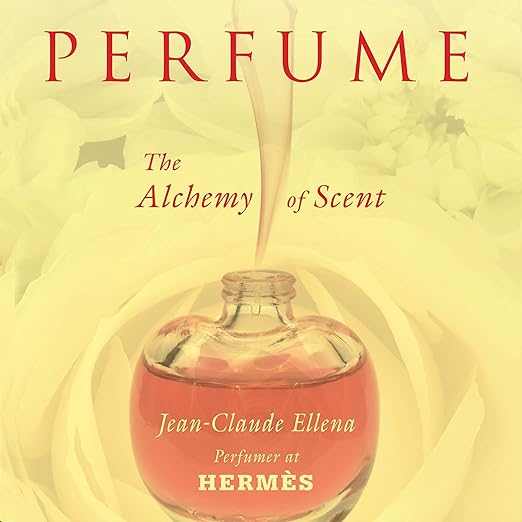
Perfume: The Alchemy of Scent is a short book, and in audio it lands somewhere between essay collection and extended meditation. It is not a history of perfumery in the conventional sense, though it contains history. It is not a technical manual for creating fragrances, though it contains technical detail. What it most closely resembles is an inside account of how a particular and highly specialized mind encounters and organizes sensory experience, and why that organizational process produces the objects we call perfumes.
How a Perfumer Thinks
The most absorbing sections of this audiobook are the ones where Ellena describes his compositional process, how he begins with a concept or an emotion rather than with a catalog of ingredients, how he uses what he calls a palette of fragrant materials to sketch an olfactory idea in the same way that a painter sketches in charcoal before committing to color. He is particularly interesting on the role of memory: his argument that a perfume works by activating personal olfactory memories in the wearer, rather than by simply smelling pleasant in the abstract, reframes what fragrance is doing in a way that is both technically accurate and emotionally resonant.
David de Vries handles this material with patience. He does not rush through the poetic passages to reach the practical ones, and he does not perform the more technical sections as though they are a digression from the real subject. The result is an audiobook that breathes rather than one that marches through its material. One reviewer described the book as pure elegance, and de Vries’s narration supports that quality rather than undermining it.
The Industry Behind the Art
Ellena is also candid about the commercial realities of high-end perfumery, and these sections give the book a useful tension. The fragrance industry is, as he notes, a cutthroat and secretive multibillion-dollar business, and the process of creating a perfume involves navigating safety regulations, intellectual property concerns, marketing expectations, and the particular pressures of working for fashion houses with very specific brand identities. Ellena is too tactful to expose specific commercial disputes, but he is clear-eyed about the constraints his art operates within. This is not a romance of pure creative freedom; it is an account of creativity that functions within a real economic structure.
The chapters on synthetic ingredients are particularly interesting from this perspective. Ellena defends the use of synthetic materials, not as a compromise of craft but as an expansion of the perfumer’s vocabulary, and his argument against a purist naturalism in fragrance is thoughtful and technically grounded. It is also implicitly a defense of his own approach.
Writing About the Sense That Cannot Be Described Directly
The book’s central challenge, which Ellena acknowledges, is that it is writing about smell, a sense for which our descriptive vocabulary is notoriously inadequate. He handles this by writing around smell rather than at it, building understanding through context, history, memory, and comparison rather than through direct description. A reviewer noted a surprising amount of back story, and that is accurate: Ellena contextualizes fragrance through commercial history, through the evolution of synthetic chemistry, through the geography of raw material sourcing, in ways that give the reader handles for a sense they cannot hear.
Audio is in some ways the perfect format for this kind of writing, you are already engaging with a non-visual sense, and the spoken word has its own rhythm and texture that reinforces Ellena’s argument about sensory memory.
Who Should Listen, Who Should Skip
This is the right listen for anyone fascinated by luxury crafts and the minds behind them, for fragrance enthusiasts who want to understand the industry from the inside, and for listeners who enjoy books that sit at the intersection of art and commerce. It is also a thoughtful three hours for anyone interested in the phenomenology of sensory experience.
Skip it if you want a practical fragrance buying guide or a comprehensive history of perfumery. Ellena is selective and personal rather than comprehensive. The book is organized around his perspective, not around the subject in full.
Frequently Asked Questions
Do you need prior knowledge of perfumery to follow this audiobook?
No. Ellena is a generous writer who builds his concepts from the ground up. Some technical vocabulary appears, aromatic families, synthetic versus natural materials, olfactory pyramids, but he explains these terms in context rather than assuming prior knowledge. The book works as an introduction and as something more advanced simultaneously.
How does David de Vries handle the more poetic and meditative passages?
With a patience that suits the material. He does not rush the reflective sections or change register dramatically between Ellena’s more lyrical writing and the industry-focused chapters. The narration maintains a consistent tone of engaged attention throughout, which reflects the book’s own blend of the artistic and the commercial.
Is this the same book as Patrick Süskind’s novel Perfume?
No. Jean-Claude Ellena’s Perfume: The Alchemy of Scent is a nonfiction account by a working master perfumer. Patrick Süskind’s Perfume: The Story of a Murderer is a completely separate novel. The two share only a title word; the content and tone are entirely different.
At three hours, does the audiobook feel complete or does it feel truncated?
Complete. Ellena writes with compression, he does not pad his arguments or repeat himself for effect. Three hours is enough for the material he is covering, and the book ends having fully explored its central questions. The length is a function of precision, not brevity.