- Performance: Don Moore reads his own research like a seminar leader, unhurried and precise, though not a trained voice performer.
- What it covers: Overconfidence versus underconfidence, calibration, decision-making under uncertainty
- Feel: Analytical and mildly humbling
- Our call: A tightly argued case for confidence as an accuracy problem, best suited to listeners who want research over reassurance.
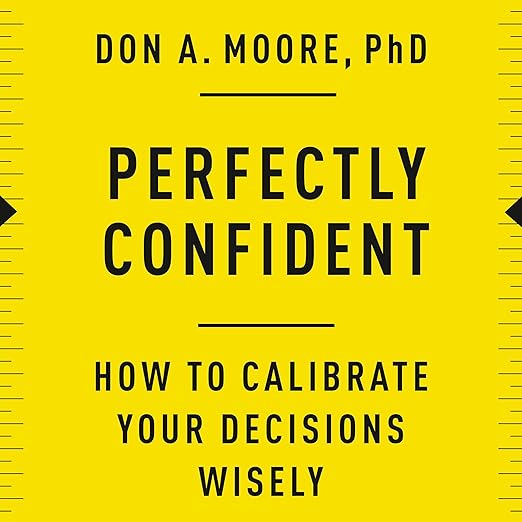
Don Moore wants you second-guessing your own certainty within the first chapter of this audiobook, and he has decades of research to back up the discomfort. Perfectly Confident sets out to dismantle a piece of conventional self-help wisdom, that more confidence is always better. Moore, who studies decision-making at Berkeley's Haas School of Business, argues instead for calibration, matching how sure you feel to how sure you actually have reason to be. The premise sounds academic, but the questions he poses land close to home: how optimistic should you be about a career bet, a relationship, or your own sense of humor? Listeners expecting simple affirmations should recalibrate their own expectations first.
Moore's central distinction, between confidence as a feeling and confidence as an accurate estimate, gives the book its spine. He walks through the two failure modes with equal seriousness: overconfidence that convinces someone to launch a doomed business or skip preparation for a difficult conversation, and underconfidence that keeps someone from applying for a job or speaking up in a meeting they actually understand well. What keeps Perfectly Confident from reading as a dry literature review is Moore's insistence on application. Nearly every chapter closes by asking what a listener should actually do differently, not just what the research found. One reviewer, a self-described outsider to business psychology working in medicine, compared Moore favorably to Malcolm Gladwell for exactly this reason, the ability to explain research findings without losing the audience in method sections.
The audiobook covers a lot of adjacent psychological terrain along the way: the planning fallacy, the base-rate neglect that makes rare events feel likelier than they are, and the specific ways professional overconfidence shows up in finance and medicine. Moore resists the temptation to turn any single idea into a full chapter's worth of anecdote, which keeps the pacing brisk for a book built on academic literature. The tradeoff is that some sections move fast enough that a distracted commute listen risks losing a thread, particularly when Moore strings together several related studies in quick succession to make one point.
Moore's argument runs counter to a common misreading of the Dunning-Kruger effect, the pop-psychology shorthand that incompetent people are always the most overconfident ones. He's careful to complicate that story: skilled people misjudge their odds too, just in different directions and different contexts, and expertise in one domain doesn't transfer the calibration skill to another. A surgeon confident in the operating room can be wildly overconfident about a stock pick, and a chronically anxious novice negotiator might actually be underrating skills they've already built. That nuance separates Perfectly Confident from the flatter, meme-ified version of overconfidence research that circulates online, and it's one of the more genuinely surprising threads running through the middle chapters.
The title itself plays a small trick worth noting: 'Perfectly Confident' sounds like it's promising maximum self-assurance, the kind of phrase a motivational poster might use, when the actual argument spends most of its energy warning against exactly that kind of unchecked certainty. The irony seems intentional; Moore redefines 'perfect' confidence as accurate confidence, not abundant confidence, and that quiet redefinition of a familiar phrase is itself a small preview of the book's whole method, taking a comfortable assumption and complicating it.
Lecturing a Room of Skeptical MBA Students
Moore narrates his own book, and that choice pays off in a specific way: he sounds like someone lecturing a room of skeptical MBA students, not someone performing enthusiasm for a microphone. His pacing through statistical explanations is unhurried without dragging, and he clearly knows which sentences need to slow down for the idea to land. That authority matters more here than in a typical business book, since Moore is essentially asking listeners to trust his interpretation of psychological research they can't independently check mid-commute.
The book earns comparisons to behavioral economics writing that reaches well beyond the genre's usual audience, the kind of territory Daniel Kahneman and Philip Tetlock have covered from different angles. Moore's specific contribution is narrowing the lens to confidence itself rather than judgment and decision-making broadly, which gives Perfectly Confident a tighter argument than most books in the category attempt. Listeners who've read Thinking, Fast and Slow will recognize some of the underlying research, but Moore applies it more directly to the everyday question of how sure to sound in a meeting or how hard to negotiate.
Citations Rarely Surface in the Audiobook Itself
Peer-reviewed citations rarely surface in the audiobook itself, a gap one reviewer, a senior military officer, flagged directly: he liked the book's grasp of the concept but wanted more of the science, data, and rationale behind Moore's specific claims. That's a fair description of the tradeoff Moore makes throughout. He's writing for a general audience, so the studies get summarized rather than dissected, and listeners who want methodology alongside conclusions will need to chase down his academic papers separately.
The accompanying enhancement PDF mentioned in the audiobook's packaging suggests Moore or his publisher anticipated this exact limitation, offering supplemental material for listeners who want to see the frameworks laid out visually rather than just described aloud. Business-book veterans should also know this isn't a step-by-step productivity system; no workbook structure, 30-day challenge, or fill-in-the-blank exercises accompany the material. It's closer to a research-backed argument than a program, which changes what kind of listening session it rewards. A single uninterrupted sitting works better than fragments grabbed between other tasks.
The book sits in an odd spot between two shelves, too research-driven for casual self-help browsers, too application-focused for readers who want a pure academic treatment, and that positioning is worth naming directly. Listeners who bounce off popular business books for being all anecdote and no substance will likely appreciate Moore's discipline; listeners who bounce off academic writing for being all citation and no takeaway will likely appreciate his insistence on real-world application. Anyone expecting a single, comfortable genre lane should know this one straddles two shelves rather than settling into either.
Closer to a Seminar Than a Fireside Chat
Professionals who make repeated high-stakes judgment calls, hiring managers, investors, doctors, anyone whose job depends on estimating odds under uncertainty, will find the most direct application here. So will chronic self-doubters who've been told for years to just believe in themselves more, since Moore's framework gives that advice actual boundaries. The book rewards listeners willing to sit with an uncomfortable idea, that their gut sense of how good they are at something is probably a little inflated, and that's fixable with better feedback loops rather than more self-esteem.
A memoir-style emotional register never really surfaces across these six hours, and listeners drawn to confidence books for warmth or personal storytelling, the Brene Brown end of the shelf, will find Moore's tone closer to a research seminar than a fireside chat. The reward is rigor instead of comfort; the tradeoff is a certain clinical distance that some listeners may not expect from a book about something as personal as self-belief.
Frequently Asked Questions
Does Don Moore narrate his own audiobook, and does that work for dense psychological research?
Yes, and it mostly works. Moore's delivery is measured and clear, closer to a professor pacing through a lecture than a performer, which suits the material even if it lacks the polish of a professional voice actor.
Does the audiobook include the supplemental PDF mentioned in the listing?
The listing notes a companion enhancement PDF is included with purchase, useful for anyone who wants to see Moore's frameworks laid out visually rather than only described in audio.
Who gets the most out of this book, overconfident people or chronically self-doubting ones?
Both, by design. Moore treats overconfidence and underconfidence as twin failure modes of the same miscalibration, so the book spends real time addressing listeners who chronically underestimate themselves, not just the more commonly criticized overconfident type.