Quick Take
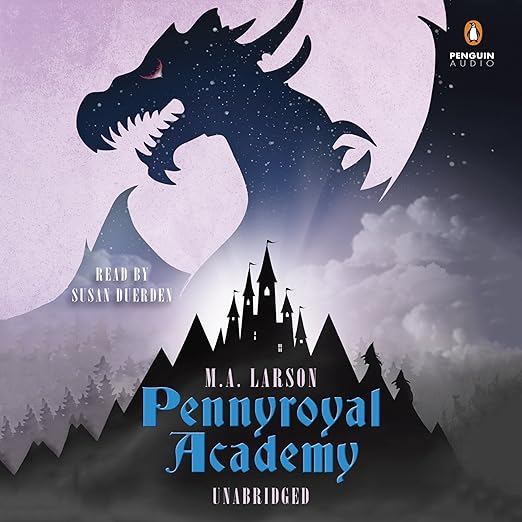
- Narration: Susan Duerden gives Evie a voice that’s uncertain but never passive, finding the right register between fairy-tale formality and contemporary emotional honesty.
- Themes: Courage as an internal quality, identity without history, the danger of fear as a weapon
- Mood: Adventurous and emotionally resonant with genuine darkness beneath the fairy-tale surface
- Verdict: A Grimm’s fairy-tale world reimagined as a training academy story that rises well above its premise through careful character work and unusual thematic intelligence.
I went into Pennyroyal Academy expecting a straightforward princess-school riff, the kind of middle-grade fantasy that dresses familiar boarding school tropes in crowns and training sequences. M.A. Larson, who many will know from his writing work on My Little Pony: Friendship Is Magic, does something considerably more interesting than that. He builds a world in which the internal qualities of a hero, specifically courage and compassion rather than beauty or rank, are treated as the actual currency of power, and then he puts a protagonist with no name, no history, and no understanding of that world at the center of the story and asks her to figure it out in real time.
Evie arrives from the forest. She doesn’t know her name. She doesn’t know why she ended up at Pennyroyal Academy or what she has to offer its rigorous curriculum. She is given the name Evie and assigned to a training company alongside other aspiring princesses, and the book earns its academy premise by making the training genuinely difficult and by making failure carry real consequences for the broader war the academy exists to support. This is not a story where the school is merely backdrop for friendship drama.
The War That Actually Matters
The world of Pennyroyal Academy is at war with witches, and that war is not metaphorical or distant. Witches here are not misunderstood outsiders awaiting redemption. They are genuinely threatening forces, and their primary weapon is fear. This is the book’s central and most interesting idea: that courage is not the absence of fear but a specific kind of internal discipline that witches cannot access and cannot replicate. Princesses and knights are trained to cultivate this quality because it is their actual defense mechanism, more durable than swords or magic.
This framing gives the training sequences at Pennyroyal Academy a logic that many school-in-a-fantasy-world stories lack. Every exercise is pointed toward the development of this internal quality. The Fairy Drillsergeant’s harshness is not arbitrary cruelty but calibrated pressure designed to reveal where a trainee’s fear lives. Susan Duerden reads these training sections with the right edge: Evie’s confusion and fear are audible, as are the moments when something genuinely shifts in her.
What the Opening Sets Up and the Middle Delivers
One reviewer described this book as a standout that rises above the wave of Harry Potter boarding school knock-offs, and the comparison is useful primarily as a contrast. Pennyroyal Academy is not interested in chosen-one mythology or prophesied destiny. Evie’s mysterious background has narrative weight, but the book’s argument is that her choices matter independent of whatever her origin turns out to be. The friends she makes, particularly Maggie whose pragmatic loyalty is one of the book’s real pleasures, and even the relationship with Basil, which another reviewer noted with genuine affection, develop through specific incidents rather than through proximity and shared peril alone.
At eight hours and forty-seven minutes, the pacing is well-managed. Larson doesn’t rush toward the witch confrontation, which means when external threat arrives, the emotional stakes are fully established. The risk with academy stories is that the school section outstays its welcome before the actual conflict begins, but Larson avoids this by making each training challenge carry narrative information rather than just filling time.
Darkness and How It’s Used
The Grimm’s fairy tale atmosphere is not decorative. There are genuine losses in this book, moments where characters face consequences the narrative doesn’t immediately soften. Larson trusts his young audience to handle uncertainty without the reassurance of a tidy resolution in every chapter. This is what one reviewer meant by describing the good and bad as recognizable but not always crystal clear in the moment, and it’s one of the qualities that gives Pennyroyal Academy more durability than its premise suggests. Children who have been managing the anxiety of the real world will find something in Evie’s education that speaks to them directly even if they can’t articulate why.
Who Should Listen and Who Should Skip
Listen if: your listener is between eight and thirteen and responds to fantasy worlds with genuine internal logic; you’re looking for a series opener that rewards investment without requiring prior knowledge of a long continuity; or you’ve been burned by fairy-tale retellings that prioritize aesthetics over story and want something with more substance. Skip if: your listener needs action from the first chapter and won’t invest in the academy setup phase, or if Grimm-adjacent darkness, even at middle-grade intensity, needs to be avoided.
Frequently Asked Questions
Is Pennyroyal Academy the first book in a series, and do the subsequent books maintain the quality?
Yes, it’s the first in the Pennyroyal Academy series. Reviews of this opening installment are strongly positive. The series continues Evie’s story and expands the war-with-witches mythology, though as with any series, quality assessments vary by reader.
How dark is the content for middle-grade listeners?
It has genuine Grimm’s fairy-tale darkness, meaning consequences are real and not always immediately softened. There are no graphic scenes, but the war against witches involves genuine threat and loss. Parents of sensitive readers in the eight-to-ten range may want to preview, while the ten-and-up crowd should handle it without difficulty.
Does Susan Duerden’s narration make the training sequences engaging or repetitive?
Engaging. Duerden finds variation in each exercise by grounding the scenes in Evie’s shifting emotional state rather than treating them as interchangeable. The Fairy Drillsergeant has a distinctive voice that makes her scenes immediately recognizable, and the progression from Evie’s confusion to developing competence is audibly tracked.
The synopsis mentions the story is set in Grimm’s fairy-tale world. Does this mean it connects to specific Grimm stories?
It uses the aesthetic and moral framework of Grimm fairy tales rather than adapting specific stories. Characters and elements feel drawn from that tradition, but this is an original world rather than a retelling of existing tales. Fans of the Grimm Brothers’ atmosphere without wanting familiar plots will find this satisfying.