Quick Take
- Narration: Aysha Kala navigates both Tilly’s grounded emotional register and Milo’s more guarded, prickly one with clear differentiation; her voice suits the British setting and carries the whimsy without letting it become sugary.
- Themes: The power of stories to harm as well as heal, found family on the road, loyalty across the divide between real and fictional worlds
- Mood: Warm and adventurous with an undercurrent of genuine urgency
- Verdict: A confident fourth entry in a series that keeps finding new angles on its central premise, and Kala’s narration makes the Wizard of Oz sequences feel genuinely transporting.
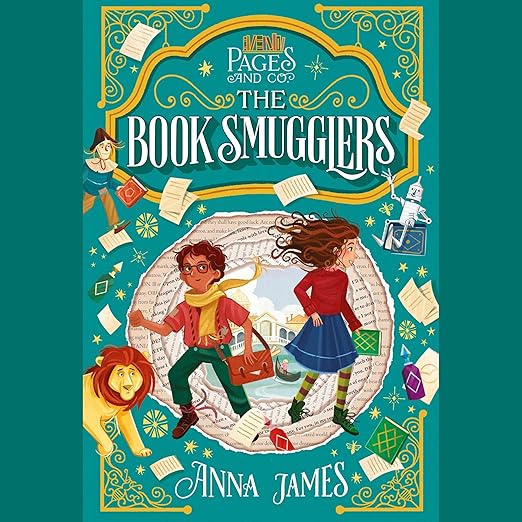
I started this one on a Saturday morning when I had about seven hours to fill with a long train journey, which in retrospect was nearly perfect pacing. The Book Smugglers is the fourth book in Anna James’s Pages and Co. series, and one of the things it does unusually well for a series this deep is give new characters real weight without shortchanging the established ones. Milo, the train-dwelling book smuggler introduced in the previous volume, takes a larger share of the story here, and his different emotional baseline, more guarded, more accustomed to impermanence, gives the adventure a different texture than the earlier Tilly-centered books.
The series premise, children who can walk inside the pages of books, is a rich one that James has been using in increasingly inventive ways. The Book Smugglers takes the concept somewhere more dangerous: a poisoned copy of The Wizard of Oz puts Tilly’s grandfather Archie and Milo’s uncle Horatio into a deep sleep, creating a ticking clock that forces both children into the story to find the cure. The Wizard of Oz setting is well-chosen, familiar enough that the story does not need extensive worldbuilding within the book-world, but strange enough in James’s rendering that it retains real tension.
Milo’s World and the Train That Runs on Imagination
The Sesquipedalian, the magical train Milo and Horatio use to travel through stories, is one of the best new elements James has introduced across the series. It functions as a home with wheels, literally and emotionally, and the fact that it runs on imagination rather than fuel is one of those details that feels exactly right for a story about how reading sustains people. Milo’s attachment to the Quip and to his uncle gives the series its emotional stakes for this volume: when Horatio falls into the enchanted sleep, Milo’s distress is not just about solving a mystery but about potentially losing the only real family he has. Aysha Kala pitches his voice slightly lower and more controlled than Tilly’s, and that restraint makes his moments of genuine fear land harder.
The Wizard of Oz Sequence and What James Does With It
One of the riskiest structural choices in the book is putting the characters into a story that almost every listener will know. James handles this by treating the Oz that exists inside the poisoned book as subtly wrong, the kind of wrong that signals something has been tampered with. Dorothy is present but slightly off. The familiar landmarks appear but feel like echoes of themselves. Kala captures this uncanny quality without overdoing it; her Dorothy reads as warm but hollowed out in small ways, which is exactly the register James needs. Several reviewers praised the series for its twists and turns, and this volume’s central mystery builds on that Oz strangeness in a satisfying way.
Series Entry Points and Whether This Works as a Starting Place
The Book Smugglers is the fourth book in a series with clear accumulated lore. New listeners can follow the plot of this volume, James provides enough context, but relationships between characters and the weight of previous events will carry more meaning for listeners who have read the earlier books. The series is best started at book one, The Bookwanderers, and worked forward. If you are arriving here because Milo sounds interesting, he is, but the payoff on his relationship with Tilly is richer with the full context of how bookwandering has shaped both of their lives.
Who Should Listen and Who Should Skip
This is well-suited to listeners between eight and twelve who love reading as a subject and enjoy adventures where books are not just objects but portals. The series has a clear reverence for literature that makes it an excellent companion for young readers who are already avid. Adults who read it alongside children will find it genuinely engaging rather than merely tolerable. Listeners seeking high-stakes action-first fantasy may find the pacing contemplative in places; the emotional and relational textures take precedence over pure adrenaline.
Frequently Asked Questions
Can The Book Smugglers be read as a standalone, or do I need to start from book one?
James provides enough context for new listeners to follow the plot of this volume, but the emotional weight of the characters’ relationships and the accumulated history of the Pages and Co. world are significantly richer if you have read the earlier books. Book one, The Bookwanderers, is the proper starting point, and the series builds linearly. Milo was introduced in book three, so his dynamic with Tilly is also easier to appreciate with that prior context.
How does Aysha Kala differentiate between Tilly and Milo as the story alternates perspective?
Kala uses a slightly warmer, more open register for Tilly’s perspective and a more controlled, guardedly self-contained voice for Milo’s. The distinction is consistent enough that listeners quickly learn to orient themselves at the start of each section. Given that the two characters have quite different emotional baselines, the differentiation serves the story well rather than feeling like a performance showcase.
The Wizard of Oz features prominently. Do I need familiarity with the original to enjoy this book?
Familiarity with Oz helps but is not required. James uses the setting primarily as an adventure space with a specific atmosphere rather than as a test of Oz knowledge. That said, the moments where Oz feels subtly wrong, which are central to the mystery, land harder if you have a strong sense of what Oz is supposed to feel like. Most readers will have enough cultural familiarity through the film version alone.
Is the Pages and Co. series suitable for adult listeners, or is it strictly a children’s series?
It reads comfortably for adults, particularly those with strong affection for books and reading culture. The series is frequently praised by adult reviewers who came to it independently rather than with a child. The emotional intelligence in James’s writing and the layered concept of how stories sustain people resonates with adult readers in ways that go beyond nostalgia. It is clearly aimed at middle-grade readers but does not condescend to older audiences.