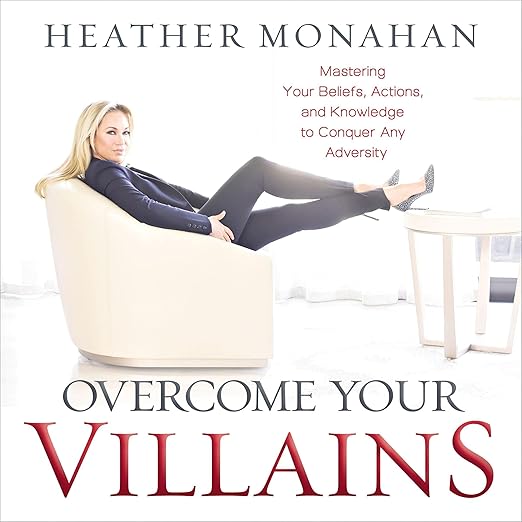
Heather Monahan tacks a genuinely new layer onto this audiobook that print readers never get: closing commentary at the end of nearly every chapter, recorded specifically for the audio edition, where she circles back with updated thoughts on material she originally wrote months or years earlier. It's a small production choice with an outsized effect, and it's the first thing worth knowing about Overcome Your Villains, entrepreneur and speaker Heather Monahan's second book. She narrates herself, which matters more than usual here, since the entire premise rests on trusting that she actually lived the collapse-and-rebuild story she's describing.
The Third Villain Running Commentary in Your Head
The book's spine is what Monahan calls the BAK process, a three-step framework for evaluating a toxic situation, at work, at home, or entirely inside your own head, and deciding what to do about it. She builds the case for the framework on her own story: a childhood in poverty, a hard-won rise to the top of a media sales organization, and then a firing by a boss she describes without much diplomacy as a villain. That specificity keeps the book from reading like a generic confidence-coaching product, since Monahan names her own low points precisely enough that the framework feels earned rather than assembled from borrowed slogans.
Her delivery carries the keynote-speaker energy you would expect from someone who built a second career on stages after leaving corporate media: direct, fast paced, comfortable holding a room even when the room is just one listener with earbuds in. One reviewer, Bob Burg, calls her 'a well-known and highly-regarded speaker, author, and coach' in the self-confidence space, and that assessment lines up with how she actually sounds across six and a half hours of narration.
The BAK framework gets applied across three arenas in sequence: workplace toxicity, domestic and family dynamics, and the self-defeating inner voice Monahan argues does the most damage of the three. That third arena is where the book earns its title most directly, since for Monahan the biggest villain is frequently the one running commentary inside your own head, and the framework spends real time on catching and interrupting that voice rather than only the external ones.
The 'villain' framing itself is a deliberate rhetorical choice worth noticing rather than dismissing as a marketing hook. Naming a boss, a colleague, or an inner voice as a villain gives listeners a concrete story shape to work with, a protagonist and an antagonist, at a moment when workplace conflict often feels formless and difficult to even describe out loud. That reframing does real psychological work before any of the specific BAK steps even come into play.
Danielle's Fifteen Years Offer a Second Entry Point
The audio-exclusive commentary is the single best argument for choosing this format over the print edition. Reviewer Cristina Leira, Ph.D. singles it out specifically, writing that she 'LOVED the audio version of the book because of the side comments at the end of each chapter, with updated remarks that made it even more relatable.' That is a genuinely unusual production choice: most business audiobooks are a straight reading of the finished manuscript, while this one lets Monahan revisit her own advice with the benefit of hindsight, sometimes just months after the print edition shipped.
Self-narration matters more here than in most business audiobooks, because Monahan is not explaining a framework she studied from a distance, she is narrating her own firing, her own poverty, and her own decision to rebuild in public. A hired narrator, however skilled, would flatten that first-person stake into a secondhand retelling. Listening to Monahan describe getting fired by the person she now calls a villain carries a different weight when it is her own voice doing the describing.
Leira Loved the Side Comments Most of All
Reviewer Danielle's account offers a useful second data point on who this book actually reaches: a fifteen-year run in corporate America, sales awards along the way, and underneath all of it, insecurities she says she didn't fully recognize until after she had already left. That is a specific, relatable entry point distinct from Monahan's own more dramatic villain-boss story, and it suggests the book's audience is broader than just listeners who have survived one obvious workplace villain.
The book also speaks to two different moments in a listener's crisis simultaneously: someone in the middle of an active blowup with a toxic boss gets practical, in-the-moment triage, while someone further out, already processing a firing or a departure, gets a framework for making sense of it after the fact. Monahan's own story spans both moments, which lets the narration shift naturally between urgency and reflection depending on which chapter a listener needs most.
The Companion PDF Is Half the Program
The audiobook companion PDF, which includes exercises and links referenced throughout, is not optional homework so much as half the actual program. Listeners who want the full BAK process, not just Monahan's account of it, will need to pull up that PDF at some point rather than relying on narration alone to deliver the complete framework. That is a real structural tension in any workbook-adjacent business title released in audio, and this one does not escape it.
At six hours and thirty-one minutes, the book moves briskly for a self-help title built around a personal collapse-and-rebuild narrative. Real economy shows in how quickly Monahan moves from her own backstory into actionable framework, and listeners expecting a slower, more reflective memoir pace should recalibrate toward something closer to an extended keynote than a traditional audio memoir.
The toxic-workplace and women's-confidence category has gotten crowded enough in recent years that a new entry needs a genuine differentiator, and Monahan's is specificity: a named three-step process, a documented firing, a companion PDF with concrete exercises rather than only affirmations. Listeners who have already worked through several similar titles should weigh whether a familiar structure justifies another six-plus hours, though the audio-exclusive commentary is a real point in its favor even for readers returning to the genre.
Keynote-Style Delivery Rewards Monahan's Returning Fans
This audiobook works best for listeners currently navigating, or recently out of, a genuinely toxic work situation: a bad boss, a hostile team, a role that has quietly eroded their confidence over months or years. It also speaks directly to Monahan's existing readers, since the second-book framing and the callback commentary reward familiarity with her earlier work without requiring it.
Fans of keynote-style business audio, direct, energetic, unapologetically confident, will find Monahan's delivery an asset rather than an obstacle, and the audio-exclusive end-of-chapter remarks give returning readers a real reason to choose this format specifically over a straight re-read of the print edition.
Skip this one if you're looking for an academically rigorous or research-driven treatment of workplace toxicity, or if you specifically want the full exercise-based BAK program without ever touching the companion PDF. The audio experience alone delivers the philosophy and the story, but not the complete written framework.
At a Glance
- Narration: Heather Monahan self-narrates with keynote-speaker energy, plus audio-exclusive end-of-chapter commentary that print readers never get.
- Themes: workplace toxicity, self-confidence rebuilding, poverty-to-boardroom resilience
- Mood: Direct and motivational
- Verdict: A strong pick for anyone dealing with a toxic boss right now, especially if you already know and trust Monahan's voice.
A Few Questions About Overcome Your Villains
Does this audiobook include the same end-of-chapter commentary that print readers get, or is that content exclusive to the audio edition?
The chapter-ending commentary is exclusive to the audiobook. Monahan recorded new remarks reflecting on her own material after the print edition had already shipped, so listeners get an updated layer the printed book does not include.
Do I need to read Heather Monahan's first book before starting Overcome Your Villains?
No. This second book stands on its own, though listeners already familiar with her debut will notice the audio commentary rewards that familiarity with more specific callbacks.
Can I complete the BAK process just by listening to the audiobook, or do I need the companion PDF?
You can follow the philosophy and Monahan's own story through narration alone, but the companion PDF contains the exercises and links needed to actually work the full three-step process, so treat it as a required companion rather than an optional extra.