Quick Take
- Narration: Laura Hicks handles the alternating structure of historical overview and individual testimony with clean differentiation, her reading of Lee Nailling’s 1926 story has genuine warmth without sentimentalizing the hardship, which is the correct register for this material.
- Themes: Displacement and belonging, the randomness of mercy, American institutional history
- Mood: Quietly affecting and informational, a history that earns its emotion rather than performing it
- Verdict: An essential piece of American social history delivered in a form accessible to middle-grade listeners, one of the stronger nonfiction audiobooks in the 9-to-12 age category.
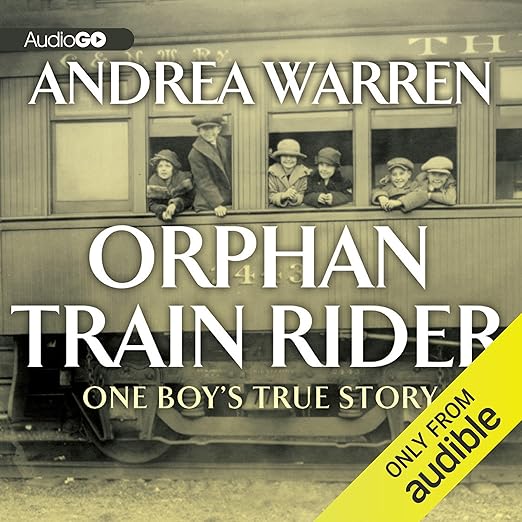
I came to Orphan Train Rider relatively late, recommended by a teacher who used it in a fifth-grade unit on American social history. What struck me first in the audio, narrated by Laura Hicks, was the structural choice Andrea Warren makes in alternating between broad history and one boy’s story. The technique is familiar from documentary film, but it is less commonly done well in children’s nonfiction, where the pull toward either pure information or pure narrative is usually too strong to resist. Warren resists it, and Hicks’s narration honors the dual register: the factual and the personal sit side by side without flattening into each other.
Between 1854 and 1930, more than 200,000 orphaned or abandoned children were sent west on what became known as orphan trains, an organized system of child relocation that operated on the assumption that rural and midwestern families needed labor and that urban orphans needed homes. The match between those two needs was imperfect at best and exploitative at worst, and Warren does not look away from the range of outcomes. Some children found loving families. Others found themselves in conditions that were functionally indentured servitude. The system was not a charity operation that simply needed better oversight; it was a product of social assumptions about children, poverty, and the deserving versus the undeserving poor that are worth examining directly.
Lee Nailling’s Story and What It Holds
Lee Nailling rode an orphan train to Texas in 1926, near the end of the system’s operational life. Warren centers his story not because it is representative, his adoptive parents were, by the accounts available, genuinely good people, which was not every rider’s experience, but because his willingness to share his memories allowed Warren to reconstruct an individual life with enough specificity to make the broader historical patterns feel human rather than statistical. Hicks reads Lee’s sections with a warmth that avoids nostalgia; the emotional weight is in the material, not in her delivery, which is the correct choice.
One reviewer described learning things they had not previously known about the Placing Out Program, which is the most useful indicator of whether nonfiction for children is actually conveying information. Warren’s research is genuine and her framing is honest about the program’s failures as well as its occasional successes. For children aged 9 to 13, the book provides a piece of American social history that is rarely taught in school and that connects directly to contemporary questions about child welfare, foster care, and institutional responsibility.
The Audio Format’s Specific Strengths Here
The 1-hour, 26-minute runtime is substantial for a nonfiction audiobook targeting this age group, but not excessive. Warren’s structure maintains forward momentum across the historical and narrative alternations, and Hicks’s narration is consistent enough in quality that neither section feels like an interruption of the other. The oral history quality of Lee Nailling’s story: his memories reconstructed by Warren from interviews, benefits from audio presentation in a way that silent reading does not quite replicate. Hearing testimony, even mediated testimony, has an immediacy that the written page sometimes loses.
The 4.5 rating across 471 reviews is one of the more reliable data points in this batch, suggesting genuine reader satisfaction across a meaningful sample. The reviews note emotional response alongside appreciation for the historical information, which reflects exactly what Warren’s dual structure is designed to produce.
Who Should Listen
This audiobook works for children aged 9 to 14 with an interest in American social history, family history, or the history of childhood. It is particularly valuable for children with connections to foster care or adoption, though it should be approached thoughtfully in those contexts: the range of experiences among orphan train riders includes both deep happiness and significant trauma, and families may want to listen together and discuss. Adults curious about this period of American history will find the audiobook genuinely informative. This is not a book that simplifies its subject for its young audience.
Frequently Asked Questions
Is Orphan Train Rider appropriate for children who are in foster care or who were adopted?
It can be, and many families in those circumstances have found it meaningful, but it warrants thoughtful handling. The book honestly depicts a range of outcomes for orphan train riders, including difficult placements and exploitation. For children with personal connections to foster care or adoption, co-listening and discussion would be valuable rather than independent listening.
How does Andrea Warren structure the alternation between historical overview and Lee Nailling’s individual story?
Warren alternates chapters: one chapter provides the broader historical context of the orphan trains, the next follows Lee Nailling’s specific experience from 1926. The two threads inform each other, and Laura Hicks maintains distinct but not dramatically different registers for the two types of content.
Is this connected to the adult novel Orphan Train by Christina Baker Kline?
No, these are completely separate works. Warren’s Orphan Train Rider is children’s nonfiction published in 1996, focused on the historical Placing Out Program and Lee Nailling’s real experience. Kline’s adult novel Orphan Train, published in 2013, is fiction inspired by the same historical period. They share a subject but are otherwise independent.
Does the audiobook include the photographs that appear in the print edition?
The photographs from the print edition do not carry over to the audio format. Laura Hicks’s narration describes some historical images and their contexts, but listeners who want the visual primary source material will need to access the print book. The audio stands on its own for the narrative and informational content.