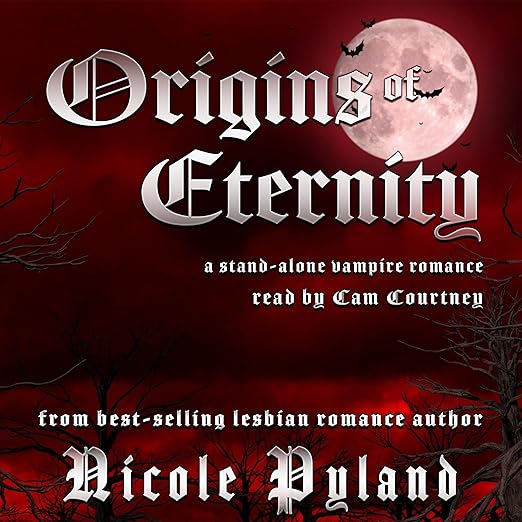
Three centuries into a relationship, Iro Black decides she is finished. That is where this audiobook opens, and it is a better setup than most paranormal romance manages: not a meeting, not a curse, but the slow administrative end of something that lasted three hundred years. Iro gave up killing and feeding on humans a long time ago. Cassia, the vampire who made her, still revels in every part of it. Ten and a half hours later, only one of the two has genuinely moved on.
Ethics of Quitting Replace Vampire Mythology Here
Relocating from Paris to Washington, DC does real structural work. It hands Iro a business reason to leave that is not a fight, which keeps the separation ambiguous enough for Cassia to treat as temporary. Then comes a bar, a drink offered to a stranger, and Arwen Lam, who only went out because her best friend Zara had something important to raise and never got the chance to raise it. Bailz, the single visible response filed after the recording appeared, calls the resulting tangle between the four of them messy in exactly the way that makes drama work.
Pyland's angle is restraint rather than mythology. The rules governing what a vampire is get very little airtime; what gets the airtime is the ethics of having been one for three hundred years and deciding, at some point along the way, to stop. Iro's abstinence reads as ongoing discipline rather than a backstory beat, and Cassia's refusal to join her in it is the genuine conflict. The threat to Arwen follows from a difference in values, not from a prophecy.
Described as Reading, Never Tested as Listening
Which brings up the thing this listing declines to tell you, and it matters more in audio than on paper. The book runs on four points of view. Cam Courtney carries all of them alone on this credit, and nothing in the visible responses addresses how those four separate by ear, since every one of them is describing a reading experience rather than a listening one. Sample it first if voice distinction is something you tend to notice.
Loving the Woman Who Made and Failed You
Erin F, at four stars, makes the strongest case for the structure everybody else questions. Losing the extra viewpoints would have cost elements needed to understand why each character acts as they do, and that judgment holds up: Cassia only frightens once you have been inside her reasoning, and Zara's thwarted news needs its own vantage point to land at all. The same response supplies the best line anyone has written about the lead, that after three hundred years Iro is a gentlewoman who has worked hard to be better than her creator.
That formulation is the book's actual subject. Iro is not tormented by what she is; she is tormented by who made her, and by having loved that person for three centuries while gradually ceasing to approve of her. Romance rarely grants the ex a claim this legitimate. Cassia is not a villain who turns up in the third act, she is the person who granted the protagonist her existence, and the story never once lets you forget the size of that debt.
Queer romance sits at the center rather than at the margins, which the shelving reflects, and the pairing works because the two women want incompatible things from the outset. Arwen has a life, a best friend and no idea what she has walked into. Iro has three hundred years of accumulated caution. The distance between those positions gives the courtship somewhere to travel beyond attraction, and ten and a half hours exists partly because the book refuses to rush the journey.
CJ Flags a Blurb That Hides Four Viewpoints
CJ, also at four stars, states the complaint most plainly: the book is told from four people's points of view and the blurb does not warn you. That is verifiable. The page's own description mentions Iro, Arwen, Zara and Cassia without ever indicating that the viewpoint rotates between them, and anyone who bought this expecting a two-hander has fair grounds to feel misdirected. It is the single most useful thing said about the book anywhere on the page.
Dates tell their own story here. Four of the five write-ups are stamped earlier than the March 2026 release, the oldest by close to seven weeks. Whatever those buyers went through, they went through it in another format. Their grades still feed the 4.4 average displayed across a hundred and thirty-two votes, which means that aggregate is measuring the text rather than this particular edition of it.
Zara arrives carrying something important to tell Arwen, and the description pointedly withholds what it is, which is effective marketing and slightly awkward structure, since the eventual reveal has to carry weight it was never set up for. Both series lines on this listing sit empty too, despite a story that plainly opens a world rather than closing one. If a continuation exists or is planned, nothing here will tell you so.
Domestic Vampires Skip the World-Ending Stakes
Paranormal romance regulars are the core audience and should settle in immediately. A January response at the top of the scale sets expectations usefully: a great deal going on, four viewpoints you need to actively want, twists as the thing unfolds, and a guaranteed happy ending waiting at the end of them. That same write-up flags the heat level in its headline without hedging, so nobody should arrive expecting fade to black.
It should also suit readers who like their vampires domestic. The stakes here are romantic and ethical rather than apocalyptic, and nobody is saving a city. If your favorite part of the genre is watching immortals negotiate ordinary business, a relocation, a bar, a best friend with news, this is built precisely for you. Listeners who already know Pyland's contemporary work will recognize the character-first approach carried intact into a paranormal setting.
Give this a miss if rotating viewpoints frustrate you, because four of them landing on a single reader is the format's hardest ask and the description offers no warning at all. Vampire lore, hierarchies, factions and rules are not on offer either, so leave it alone if that was the draw. Come for the three-hundred-year breakup and the woman refusing to accept it, and that thinness stops registering about an hour in.
Before You Press Play
- Narrator: One credited reader, Cam Courtney, carries a book that rotates through four viewpoints, a casting arrangement the description never mentions.
- Subjects: A three-hundred-year breakup, restraint against appetite, queer romance under a jealous maker's eye.
- Tone: Simmering and character-led, with real heat and a slow-building threat.
- Bottom line: Strong on the ethics of immortality and thin on lore, so come for Iro and Cassia rather than for worldbuilding.
Frequently Asked Questions
Is the Origins of Eternity audiobook a standalone or part of a series?
Nothing on this page commits either way. Both series lines sit empty, yet the story closes its central arc while leaving the wider world wide open, and Debtwice, awarding five stars in February, signs off hoping more like it are coming. Treat it as complete in itself and treat any continuation as unconfirmed.
Do you need to have read Nicole Pyland's other books first?
No. Nothing in the description ties this to an earlier title, and Iro, Arwen, Zara and Cassia are all introduced from scratch. Returning readers get one extra pleasure, watching a character-first contemporary approach transplanted into a paranormal setting, but the story assumes no prior acquaintance with the catalog whatsoever.
Is Cassia a villain or an ex-partner?
Both, and the book refuses to simplify the question. She is the vampire who made Iro, the partner of three hundred years, and the figure now watching the new romance with revenge in mind. Because the story spends time inside her viewpoint, the possessiveness arrives with reasoning attached rather than as motiveless menace.
Where does the audiobook take place?
It opens on a move from Paris to Washington, DC, made for business reasons rather than as an escape, and the American capital carries the bulk of the action from the bar scene onward. That relocation does quiet structural work: it gives Iro a reason to leave that Cassia can read as temporary rather than final.